Showing posts with label content farms. Show all posts

Monday, April 9, 2012

[Moon-dæg] Finishing Off on Freelance Writing

Introduction
Musings
On Organization
The Teaching Alternative
Closing
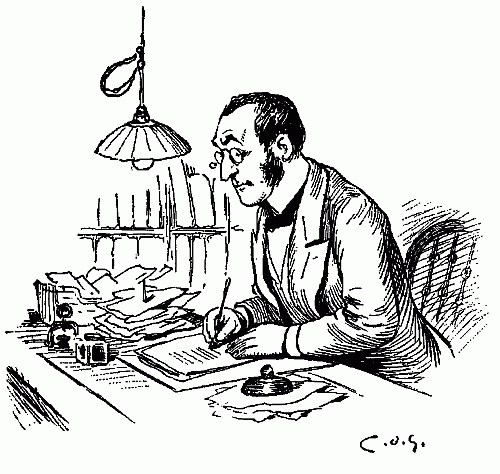
{If only he could speak from 1893. Image from public-domain.zorger.com}


Back To Top
Introduction

This is the final piece in my four part series on freelance writing. It's also written in a more freewheeling style, though a logical order is still loosely imposed. You've been warned.

Back To Top
Musings

Freelance Writing is it? The sort of thing that requires a quick mind on the page, and in the checkbook. It'll keep you sharp, but it can tear you apart, too. Academics have GoogleScholar to figure out how many people reference their research, but to think of how many people could see your writing if you had hundreds of articles, stories, and clips circulating about. That just adds to the rush.

Teaching can impact a room, but the written word can impact an audience severed by space, and even by time.

Writing in general seems to have more of an impact than teaching - though teaching might have the potential for a deeper impact.

Freelance writing doesn't need to be something you go broke for, either. It's just about keeping up on the jobs. And with stuff like content farms out there now - forget about it. If you can take the pittance they pay when times are tight, then those times will be loosened just enough. Of course, that's if you've got the time - or will.

Back To Top
On Organization

Signing up for all of those sites takes a lot of organization, too. You need to keep all of that account information straight, and then you need to figure out how best to keep them all checked and responded to.

Yeah, being a freelance writer is maybe more possible now than ever, but it also seems to require more organization, too. Makes you much more of an entrepreneur when the whole damn internet could use your article. Not to mention the few offline publications still afloat and hungry for words.

The offline ones (and those "e-zines") pay better, too. Then again, with the old procedure of query, draft, submit, you deserve extra. Not like write, submit, pass, get paid. Gee-zus.

Anyway, all that organization's needed up front. Being a freelance writer isn't like becoming a cop or a getting into med school program. You need to plan your specific moves much more carefully if you want to be successful right out of the cage.

You need to know how much you'll charge, how much you can do in an hour, what sort of work you want to concentrate on, how many hours you can work a week, what sorts of outlets you'll use to look for work in the first place. So much more organization, and all up front. None of this dicking around with training and learning in a place separate from the real thing, only to be faced with something almost entirely alien when you finally get to the job itself.

No, as a freelance writer you know up front what you're getting into or you just don't make it. Some might muddle their way in, but they're the ones who learn quick. Real quick.

Quick learners get ahead as freelance writers, too. They know just what it is they need to do for a client, they can see it in their job offer, smell it in the proposal or description. Then it's no problem to just go with it, and run along with all that cash flow pushing you on.

Yeah.

Back To Top
The Teaching Alternative

Back to that teaching alternative - if you know enough to write things, you know enough to teach things, right? - it's not entirely a sure thing anymore. Anywhere local, anyway. Even according to the recent Transition to Teaching Report, only 21% of graduates say they've got full-on teaching work within their first year after graduating (in Ontario). Shit. That doesn't look good. But writing, that's always gonna be around. As long as you get a good start, find your stride, it'll just keep going.

Y'know, more than anything, writing's more liberating, too. Teacher's can keep their summers off, freelance writers are doing what they love and what they love's not work to them at all. But teachers college is like a band-aid being used in the place of gauze and surgical tape, a temporary solution that might help in the long run, but that just doesn't stand up to the potential in writing.

Still, I plan to accept one of the offers I've gotten for teachers college and to see where writing takes me in the interim. Writing and teaching might be like feuding brothers in my mind, but they're still kin.

Back To Top
Closing

Watch this space for Wednesday's piece on the newest news, and check back Friday for a review of 2011's I Am Number Four.

Back To Top

Monday, April 2, 2012

[Moon-dæg] Writing Towards A Golden Age

Introduction
Three Helps
Writing and Regular Work
Closing

{Image from PRLOG.org}


Introduction

To live off of your words would be like living off of the bounty of the land. At its best it could be like life in the mythical Golden Age, where the earth's abundance came naturally and humanity had no need for toil.

In this metaphor though, things work backwards. Instead of staring in a Golden Age, any writer starts in the Iron Age - maybe even the "Clay Age" considering how low the pay is at many content mills and freelancing sites.


But through your writing, you, like Merlin, could travel backwards in time to a Golden Age. One where your words are being licensed for translations and adaptations, where they're earning royalties, where they're earning you a tidy portion of shared profits, or where the work just flows and your rates are fair and enviable.

Of course, all of that comes after the iron's been turned into gold. If alchemists still haven't figured it out, then it's certainly no easy feat.

Yet, like the alchemists and their mad quest for that mystic formula, the potential to live sheerly from words is what fills the pursuit with promise.

As bipolar as it can be trying to do something so artistic (or even just psychological) in a town of engineers, labourers, restaurateurs, clerks, servers, and such, it is a rewarding thing to do.

On the one hand it's possible to show all of these concrete-thinking, left-brained people that you can live from something as airy as words and ideas, and on the other, well, you can show yourself that you can live on such airy things as words and ideas. Because that's the biggest hurdle starting out. Really, truly, and seriously believing that you can make it as a writer. It's not always a pretty process, but there are certain things that can help you along.

Back To Top
Three Helps

Being part of a writing group is the best way to start. Regular feedback and the ability to talk to other people about writing can jazz you up and make you feel ready to tackle any project, to mould words into any form.

Getting paid to write, definitely helps. Even if it's not a rate that's going to allow you to work only hours a week, getting something for your writing beyond praise, accolades, or even just serious acknowledgement is great.

Having people ask you to write for them is also a great boost, especially if this contact is made online. For such a person practically could've worked with anyone in the whole wide web, but by coincidence they found your stuff, and your stuff was just what they were looking for. Such an event is great. It's grand. It's a big help when the people around you go silent upon your announcement that you're a writer, or regularly bring up that such and such store has a help wanted sign in the window.

But that's not to say that being a writer means you're a one-job person.

Back To Top
Writing and Regular Work

People write and hold down "regular" jobs, too. But that's not what every writer does. After all, there's that freedom that comes with writing, that ability to work as hard as you like at it. you can throw all of your weight into it because of one thing or another, or you can just do it, but do it seriously, in whatever spare time you can muster.

Again, here comes a generalization, but if you'd just ended a stint in graduate school and originally been looking to become a professor to "feed your writing habit," then you're probably not going to want to sling fries or assemble boxes while writing on the side.

Turning away from the rush, though, there's the uncertainty. It might mean putting on a happy facade or joining the break room mumblers, but slinging fries and box assembly are at least steady jobs.

People will always love fries, and frozen fries come in boxes. You might not necessarily become CEO of either company, but working at that sort of thing is certain, and probably includes some benefit package or other.

These perks mean there's no need to worry about making it on your own, since you know that at the least you'll be getting your livable wage paycheck at the end of every two week period. And if the work is psychologically draining, well, isn't that what the time that you're not working is for?

Writing isn't necessarily different, though. It can be just as stressful, just as draining at times. But if you're not already plan-savvy, trying to be a writer from a room in your parents' house in a small town definitely gets you planning seriously, planning hard.

Plus, planning ahead doesn't have to be all that intimidating. It could just be a matter of setting goals of having so many articles finished in a given time, or so much money made in a month. Like almost every other aspect of being a freelance writer, it just comes down to will power. Saying you'll do something (even if you're just talking to yourself) and then doing it.

Back To Top
Closing

So, freelance writing, maybe it's a long climb up to that lofty Golden Age, but you'll definitely have plenty to write about when you get there. I know I will.

Stay tuned throughout the week for an opinion about some recent news on Wednesday, and a review of Hideaway on Friday.

Back To Top

Wednesday, December 21, 2011

[Wōdnes-dæg] A Lesson from Freelancing

This entry was written up for a Wednesday and so it is an exploratory essay, in the spirit of Odin (Wednesday's namesake) and his own search for knowledge.

For the past few months I've been working as a freelance writer. The income is humble so far, I (thankfully) haven't really needed to make anything comparable to a full time job because I've moved back in with my parents, but I'll be launching much more in the new year. And as my output increases, income is sure to - a truth that seems to be the result of the internet and the constant demand for content rather than an increase in magazines or anthologies hungry for technical articles or reviews.

Of course, as any one who has written internet content for pay before is likely to tell you, most positions pay peanuts. They'll usually pay a small fee per piece that works out to cents on the word, or, in a few cases, they'll pay you based on how many visits your articles get and how long those visits last. So in further explanation of my note above about increasing my output, doing so is a definite way increase my income as a content writer.

In spite of the low pay, content writing is work that I find to be quite fulfilling. Even if I'm writing about something that I haven't studied for months or years on end (building your own tap dance floor, for example). And, although having multiple outlets for my writing can be overwhelming, it is also encouraging - people still read! Writing and writers are still needed! It's not just a handful of people who can appreciate the written word! - but then, it is just internet content. In a way I feel like I am more of a pen for hire in this wired environment than I think I would were I freelancing fifteen or more years ago, when writers were still (almost) entirely print-based.

In spite of the somewhat transient nature of this work (the accounts don't go away but the assignments or titles sometimes do), I also learned that it can be as disheartening to lose a regular source of writing (and of income) as it can be to be called out by a boss or fired completely.

You see, I wrote for Demand Studios for a time. Yes, the pay per piece was not stellar, but the feeling of getting paid to do something that you genuinely enjoy is more exhilarating than hitting a runner's high or enjoying an excellent party. Of course, it is even more exhilarating when that pay is in a tighter proportion to the effort and the time spent creating a piece. I technically still write for DMS, but since they have essentially closed off new titles from all but the top percentile of their writers I've been unable to get any work with them.

This discovery struck a hard blow. I had been relying on DMS for months as a major source of income, and suddenly that source was gone. Of course, in any line of freelance work this is a major mistake. The very nature of freelance work is that there is generally no long-lasting bond between freelancer and employer/client. After the article or profile or essay is written, submitted, and approved, you no longer work for the person or company who requested/accepted it.

So why bother writing about this experience? Well, in the short term, it's a matter of putting to screen what doesn't work so that I can avoid doing it in the future. Of course, I want to be successful in earning a steady income from my writing and to do that I need to maximize my output. When one door closes I need to open another, or at least crack a window. Money can't squeeze through walls, after all.

But, for the long term, I write about this experience because I think that it is something that is now a much more frequent occurrence. In some of the forums that I have visited there are threads that ask just what a "writer" is. And on these threads is the opinion that people who write for sites like DMS are not really writers at all. They are given article titles that they just need to fulfill, they only care about the byline, and they are more than pleased to get peanuts for what they put their mind and their fingers to work on.

And really, what rookie writer wouldn't fall into such a trap? Getting paid to write? Sure! But the thing is there doesn't seem to be an informal screening process for writing anymore - with content farms and article boards anyone can make some money by stringing words together whereas in the past freelance writers needed to come up with ideas, query editors, and hope for the best.

Just as it is with teachers now in Ontario - by most first- and second-hand accounts, you need to substitute teach for five years before a school board will hire you full time - that process of thinking, querying, and hoping would discourage those who weren't really writers to their core. So am I being elitist? Is opening up the possibility of writing for a living to more people a bad thing?

No and no.

First, I fell into that trap - so there's no room for me to be elitist. Second, like any mass movement or shift I don't think that the proliferation of writers online is entirely bad or entirely good.

More writers means that more voices are heard and shared. But having more writers online does also devalue the written word to some extent. If someone who just finished high school but has always had a knack for words can write as well as someone with a BA in English does that BA really mean anything?

If everyone could generate their own gold it would lose its infallible value. But for all of the social and cultural and linguistic trading that goes on because almost anyone can write on the internet, it seems to me that this plethora of styles and views only enriches the English language.