Showing posts with label writing. Show all posts

Monday, November 5, 2012

[Moon-dæg] Looking East while Writing in the West

Context
Gazing Across Prairies
Closing

{The prairie's amber wave. Image found on Bridal Buds.}


Back To Top
Context

Inspired by a lovely face, this is another poem I composed out West. It's been modified from its original to bring some more unity to the over all metaphor of face as prairie field ready for harvest, but still needs some work.

If you've got some suggestions, leave them in the comments!

Back To Top
Gazing Across Prairies

Her face is like a field of wheat stalks
Each topped by grains massaged by wind
Bringing out the gold of harvest

Each grain heavy with meaning
Each gust a desirous finger
Joy itself is in the meadow beyond that field,
As each finger yearns to run
From field to hair through to air.

So that the deepest wells awake and open,
Awake to gaze, blink, and water

Always moistening in laughter's course,
Ridiculous echoes fill the field
As winter clouds call each grass leaf
Each stalk home.

Back To Top
Closing

That's it for a Glass Darkly this week. My commitment to getting through NaNoWriMo, and this week's work hours have conspired to force my blogging into a minimum. But don't miss my translations and commentaries over at Tongues in Jars: tomorrow, I look at stanza seven of "Dum Diane vitrea," and on Thursday, my delve into the Old English epic Beowulf continues!

Back To Top

Saturday, October 27, 2012

[Sæternes-dæg] Annotated Links #23: Chameleon Communications

1. Anders, Charlie Jane. "What would a Random House/Penguin merger mean for science fiction and fantasy?" io9 25 October 2012. Web. 27 October 2012.

Anders offers a handful of insights into what a merger of Penguin and Random House might mean for publishers, imprints, writers, readers and those aspiring to be writers. She also includes a link to an in-depth article about what mergers in general mean for science fiction and fantasy, and another link to a 2007 interview with Ace/Roc editor Anne Sowards. This article is written in a easy-going, conversational style.

This one is included, and set into the first place, because the possibility of a Penguin/Random House merger is huge news for anyone keeping an eye on the publishing industry.

2. Sullivan, Tim. "'Gone With The Wind' In North Korea An Unlikely Cultural Phenomenon." HuffPost World: Canada 24 October 2012. Web. 27 October 2012.

Sullivan writes on an array of reasons why Gone With the Wind is so popular among North Koreans. Among these reasons, he gives in depth treatment to the book's Civil War setting and its tough, hardship-enduring characters. He writes in a smooth style and uses a handful of quotations to underline his article's narrative quality.

This one's included because it's a great example of how cultural products can cross cultures and end up thriving in places that you would simply not expect.

3. Peng, Kan. "How to hard sell China's soft power." China Daily 26 October 2012. Web. 27 October 2012.

Peng begins by summarizing the Psy/Gangnam Style phenomenon, how social media has played an integral part in the phenomenon's popularity, and how the phenomenon has helped to promote South Korean culture and products across the world. He then moves into how China has tried and failed to do promote their soft power via cultural exports in the same way, but have failed because they've kept their attempts too official. Peng writes in a punchy, to-the-point style.

This article is included because of the contrast that it sets up between two nation's strategies for increasing their soft power. This contrast underlines the usefulness of pop-culture.

4. Rector, Gene. "'Science fiction' becomes 'science fact' following Utah test." WRWR The Patriot 23 October 2012. Web. 27 October 2012.

This is a brief article about a new microwave emitter-equipped missile (called CHAMP, or the Counter-electronics High powered Advanced Missile Project) that is designed to disable electronics. According to the article, the titular test in Utah saw this technology not only shut down all of the computers in a target building but also the camera recording the experiment.

As a technology article amongst articles about books and publishing, this one might seem out of place. However, at its heart it's about a missile that has the potential to take out communications systems - and what are publishing and books if not just friendly means of communication?

5. Perlow, Jason. "Computing's low-cost, Cloud-centric future is not Science Fiction." ZDNet 21 October 2012. Web. 27 October 2012.

This article looks at Stanley Kubrick's 2001: A Space Odyssey and Ridley Scott's Blade Runner as examples of futurism. Specifically, Perlow goes over the aspects of each movie that, some 50 and 30 years before the present, accurately depict technological aspects of our daily life and those elements of the movies that aren't here just yet. Perlow writes in an expositional style, using a generous number of links to his own and others' writing.

This one is included because it shows the importance of fiction as a way to explore ideas that seem far removed from reality, just one of fiction's enduring uses.

Back To Top
Closing

That's it for this week in the blog, but check back here next week for another short story draft, a review of the recent cult classic The Room (Monday and Friday), and, over at Tongues in Jars, more of "Dum Diane vitrea" and Beowulf (Tuesday and Thursday).

Back To Top

Monday, October 15, 2012

[Moon-dæg] From A Ship's Crow's Nest

Context
Blue Bricks
Closing

{A replica of a medieval ship. Image found on the Seasalt Cornwall blog.}


Back To Top
Context

Today's story is one of the many shorts that offers some insight into the backstory of the fantasy series that I'm currently working on. In fact, it's a kind of world building story, in the sense that it (once it's as finished as it can be) will offer a glimpse into a major aspect or two of my created world.

To date the process of writing this series has been drafting it book by book (as a "discovery" writer) to figure out how the world works. However, after taking a fair bit of time off from writing this series during my MA, I've gotten to the point where the discoveries made by writing the larger books need to be refined through shorter stories. These shorter stories will also, ideally help me to see how these aspects of the world I'm creating can feed back into the five books of the series.

This story was written based on a prompt at the local writing group, and just evolved from it. The prompt was to write a story in which each paragraph starts with a colour. It's still a draft of sorts, but much of what the story is is already here.

Back To Top
Blue Bricks

Blue bricks are a rare sight but still seen. The walls around the island city of Shev have them near their bottom, though other sailors said they were just turned that colour by the sea.

Ermina believed instead what some of the Shevites themselves told her. That the blue bricks around the bottom of their city's wall were made of the purest stone found in all the caves that wended through the cliffs over which the city sat. Caves where the more superstitious among them said they would never dare to tread. But even from her place at the top of every ship she ever sailed in, Ermina had never seen anything beneath the city's walls but breaking waves. Part of her wondered about the stories she had heard in the city's inns where the crews she had been with stayed. She believed what she would about the bricks, despite the evidence of her eyes, but the stories were always such a deep red.

She knew that red stories were not necessarily better than any other, but she loved them the most. They almost never moved at a slug's pace. Since she was a child the red stories always moved faster than gulls diving for fish, and their heroes and villains always came up from the plunge with their prey.

Ermina watched such gulls now. They looped and glided, all immaculate white tipped with grey, yellow and orange. Not the kind found around lakes but the sort that would give dull old hawks fair competition - the sort found by the sea, flying between white sails, white masts. She wondered why the place where she stood, her arms on its railing, was even called a "crow's nest." She'd never seen any crows flying out at sea, or even heard stories of such things.

The gulls's cries drowned the waves' crashing against the ship's side. The ship's sides that were still the colour of the meadow honey they made on the Kael Isles, despite recent layers of pitch. While the familiar sound of someone climbing rung over rung snuck in beneath that of the gulls she imagined herself back on those Isles.

“We’ve only just reached the green water and already this one is off beyond the Crumbs.”

Ermina stirred. “Oh, Cyril. There’s not as much to see out there as you and yours’d like to." She didn't bother to turn or straighten from her place at the nest's edge. "What’s got you up here?”

Cyril looked back down the way he had come. Beneath him the ship’s sides rose and fell. “Just to remind myself that even green has its limits.”

“Your maps'd tell you that just as easy.” She turned back to the water. “What’s the real reason?”

"We are bound for Shev. I thought you should know."

Ermina hunched her shoulders. "I already know. I'll get another look at those blue bricks, and hear some more stories about the creatures or gods or demons that gave them."

"And?" Cyril fingered a loose thread in his sleeve.

Ermina said nothing. Why does he press me on this? "And I'll be sure to shout down real loud when I see it all."

Ermina heard Cyril's leather jerkin creak before she heard any of his footsteps back to the ladder. She refused to look back, though she knew that he would linger before heading down. When she finally straightened and turned, she could hear him back down on the deck, giving commands and sending orders. She tried to think of the best red story from past voyages to Shev, but could only fear that with Cyril along the only one to be told would include them both.

Back To Top
Closing

Check back here on Friday for Part Three of Shocktober, a peek into the perils of Silent House. For mid-week stuff, check out Tongues in Jars on Tuesday (Latin) and Thursday (Old English).

Back To Top

Monday, September 24, 2012

[Moon-dæg] Poem #997b

Context
Sun and Moon
Closing

{A rare sighting, but a jackpot for the celestial paparazzi. Image found on the blog Wish You all the Best.}


Back To Top
Context

Tonight's piece is a sample of my poetry from 2010. This was when I wrote poetry that stuck to a fairly regular form. This specific poem is also an example of my stuff on love that's written in an Elizabethan style; in fact, it's similar to Christopher Marlowe's "The Passionate Shepherd to His Love" (a.k.a. "Poem #997").

Check it out, and let me know what you think in the comments!

Back To Top
Sun and Moon

A kiss and a peck and a see you tonight
Said the sun to the moon
at the coming of first light
Go my love and hide away
Scarce your face - scarce!

I’ll hide it behind window-blurred bars
And raise around you robes of cloud
As I shed light, generation, elation to those below.

Then, when those look up nightly
through eyes and disembodied words
To the glow of light from my cumulus chase,
We can join behind a dark-wooled herd
To stoke our lights before parting.

Before returning to our days.

Back To Top
Closing

Check back at this blog on Friday for a look for the likeable in The Samaritan (a.k.a. Fury). Then on Saturday, you'll be able to find the newest Annotated Links here, and a look back/look ahead on Sunday.

Back To Top

Sunday, September 23, 2012

[Sunnan-dæg] After a Partial Peter Gabriel Eclipse

Over the past week, here's what I've done for the sake of my fiction and poetry writing:

  • Outlined four of the five acts of the audio drama that I'm currently working on;
  • Worked out all of the climactic events for my perspective characters in Dekar 4 - except for the main female character;
  • Begun to research some of the magazines I'm thinking of sending my short story to;
  • Noted more story ideas.

By this week's end I'll have:

  • Completed my research into magazines and made a short list of five to send my stories to;
  • Sent my stories to the first magazine from this list;
  • Written up and organized a chapter-by-chapter outline of Dekar 4;
  • Written out the next act (4 scenes) of the audio drama I'm working on.

If you're wondering why this second list is fairly similar to the to-do list from last week's entry, my only excuse is that going to see Peter Gabriel in Toronto was a major distraction. In fact, here are the two highlights of the show (thanks to babyVantage and apc611 respectively):


This week's distraction will be a jaunt out to see "Whose Live Is It Anyway" at the Center in The Square. All the same, I'll have ample time for writing and planning, so I think that I'll be able to make short work of this week's to-do list.

Along with that, I'll be posting some creative writing tomorrow, seeking the salient in Samuel L. Jackson's The Samaritan on Friday, and posting "Annotated Links" on Saturday.

Over at Tongues in Jars watch for the first verse (for real this week) of "Dum Diane vitrea" on Tuesday and Beowulf's final words on Thursday.

And, watch for regular updates over at my examiner.com page.

Back to Top

Monday, September 17, 2012

[Moon-dæg] Writing of Pale Horses

Context
Horse Play
Closing

{Smoke rose from his silhouette like steam from a sewer grate. Image found on the blog Mystery Fanfare.}


Back To Top
Context

One of the early stories from my time with the writing group here in town, tonight's bit is a little noir. The exercise that lead to its being committed to paper simply asked for a first person piece.

It might be partially inspired by Sarah Palmer's vision of a white horse in the middle of the second season of Twin Peaks. In fact, in keeping with that show, the bizarre-ness might or might not be real.

Back To Top
Horse Play

Suddenly I saw a white horse pacing behind the curtains. They were drawn but the iridescent fur drew on the sun's fading strength (and the moon's gaining power) just as the snow did, and shone through the window's thin veil. Its silhouette gave me pause and I stood in the middle of the side walk, gawking over side walk snow banks and into the house.

If anyone else had been out walking that night they might have stopped as well. Or slowed down to gather details before calling the police to report a suspicious character staring into windows.

The animal faded from my sight and I took a step closer to the house. Blinked. It was gone. The window was empty.

In my delirium of curiousity I walked over the snow covered yard to close the distance between myself and the pane. Foot prints didn't matter. There was a horse in there. At least there might have been. I had to find out.

With my feet firmly rooted in the snow in front of the covered flower bed beneath the window sill I leaned forward and set my hands onto the rough stone sill. I could feel my gloves stick to the cold of it. My face nearly grazed the glass. My eyes were filled with the curtains' dull floral pattern and the shapes and shadows of things beyond. On my left I also saw the sun, reflected. Tucked behind houses as it was I knew that I needed to act quickly. Where was that horse?

A snort and a stamp caused me to whirl around so quickly that I nearly fell head first into the sill. Thinking of that possibility and trying to grasp what I saw before me set my heart pounding.

The man sitting astride the horse addressed me in an accent that would have wooed queens.

"Terribly sorry sir - but I do fear that my polo ball has fallen into those bushes."

I tried to keep my eyes off the mallet he held in one of his hands. The horse stamped. I felt my palms dampen.

"Oh. In the bushes. What's it look like?" I knelt and pretended to look.

"Small. Red. Ball-like."

I didn't need to turn around to see the look of growing suspicion that I knew was on his face. That would have been a rookie mistake. And I knew I was no rookie. Horse or no he sure was lucky that these were my old jeans. The trip to Missoula hadn't just been about business.

He said something in that accent of his and I could hear him getting closer. I noticed the horseman's shadow riding up and over my own. As much as I tried to convince myself that this was all just about a red ball I knew the truth. I knew I was trapped.

"Oh, do hurry on there." His horse whinnied to show its support for its rider.

I brushed against the side of the house now. Crawling among the shadows that hid the ball - I was delusional, ball, what ball? - as well as any first rate hacker could hide a data file.

Before the man and his horse could close off my escape entirely I closed both fists around the snow and slush. This would take speed, precision. Quick thinking after it was done. I hoped my week away hadn't dulled my senses too much. I rose, whirled, and threw.

Both fistfuls hit with a piff more satisfying tha any deli pastrami on rye and I dashed past - though that bastard horse almost pulled me down with its tail. I knew that I was scot-free when the man's curses were gentler than the breeze and just as incoherent.

At the next block I slowed and patted my pockets, unsure that nothing was lost. I reached into the one on the inside of my coat and pulled out the book concealed within. The image on its cover of a man in a round brim hat and full-on suit sitting behind a cluttered desk while a woman with bare shoulders wearing beads and short hair spoke to him reassured me that all was still there. That all was still all right. That my time off hadn't dulled any senses. There had to be a horse.

Back To Top
Closing

On Friday, definitely be sure to check in for my looking for the likeable (aside from Samuel L. Jackson and Luke Wilson) in Meeting Evil. Then on Saturday, watch for an Annotated Links, followed by the week-in-review/week-ahead entry on Sunday.

Back To Top

Sunday, September 16, 2012

[Sunnan-dæg] The First of many Lights

Welcome to the first Sunday Edition of A Glass Darkly.

In keeping with the themes of my other entries in this blog, since Sunday is named for the Sun, these entries will shine a light on what I did related to my writing over the previous week, while also using that light to peer ahead into the next. Yes, there will be lists, but there'll also be a little bit of description. Let's get to it.

As you might remember from the last "Update Entry" I made, I wrote that I was going to provide an update every three days rather than every two. That was back on Monday, and so things have sort of slackened on that end of things.

However, I'm now yanking that slack and drawing in the last parts of that blog update for this Sunday entry. So, in the future, those sorts of blog updates will come out every Sunday. In the meantime, these entries will be all about my writing efforts.

Over the past week, here's what I've done for the sake of my fiction and poetry writing:

  • Re-organized the schedule of A Glass Darkly to better accomodate my fiction and poetry writing;
  • Come up with the climactic moment for my current fantasy novel (Working title: Dekar 4);
  • Made notes for a number of short stories;
  • Done some world building for that fantasy series I'm working on (the world's cosmology, history, and magic system, specifically);
  • Compiled a list of Canadian science fiction magazines.

As a refresher, here are the things still outstanding from the blog update of August '12:

  • Send out two short stories to magazines
  • Outline entirety of the fantasy novel I'm writing
  • Completed 10 of those chapters
  • Completed the next act (4 scenes) of an audio drama I'm working on

It's my hope that I'll have all of these wrapped up come next Sunday.

Until then, don't miss tomorrow's creative writing entry and Friday's look at Luke Wilson and Samuel L. Jackson's Meeting Evil here at A Glass Darkly. Plus, on Saturday, you'll be able to find the newest "Annotated Links" here as well.

And keep an eye out for Tuesday's translation of a poem possibly written by Peter Abelard (of the famed pair of star-crossed medieval lovers Héloïse and Abelard), "Dum Diane vitrea," followed by Thursday's look at Beowulf's burial instructions at Tongues in Jars.

Oh, you might also have remembered that I mentioned a video game blog that I'd be starting up soon. I still intend to start it sooner rather than later, so watch for a link in future entries.

Back to Top

Saturday, August 18, 2012

Why the Blog Break? (Update Entry #0)

My taking a break from these blogs is nothing new. I've done it before a few times but, since each of those breaks has been motivated by an unfulfilled desire to tidy things up and to post new pages, I've decided to stop regular updates to both this blog and Tongues in Jars until I've:

  • Recorded, edited, and uploaded all of the missing translation recordings (over at Tongues in Jars);
  • Created and posted a hyperlinked portfolio page on these blogs;
  • Made all of the titles of entries uniform across both blogs;
  • Sent out two short stories to magazines;
  • Created a central, personal blog on tumblr;
  • Created a Facebook Writer/Author page;
  • Outlined the next 10 chapters for the fantasy novel I'm writing;
  • Completed five of those chapters;
  • Completed the next act (four scenes) of an audio drama I'm working on;
  • Completed my two outstanding commissions;
  • Created a Commissions page (accessible through every blog) to accept new commissions.

I might not be regularly updating these blogs for the next week or two, but I want it to be clear that, despite more than half of the list being indirectly related to my blogs, these blogs (and those reading them) haven't been forgotten. So, as I complete each of these tasks, I'll post an update explaining how the process as a whole is coming along.

Plus, because they're often the most anticipated and the most fun to put together, I'll continue to post my weekly movie redemptions/condemnations while I work on these various tasks.

That said, watch this space for updates on my progress, and for this Friday's attempt to redeem the TV mini-series Earthsea.

Thursday, August 16, 2012

Annotated Links #17: Writing of Rarities and Hard Finds

1. Doctorow, Cory. "Great writing advice from this year's Clarion Science Fiction and Fantasy writing workshop." Boing Boing 14 August 2012. Web. 16 August 2012.

The title really says it all for this one: it's a short collection of some great advice from this year's Clarion workshop. It's written in a straightforward style and includes a link to the blog of Sam J. Miller, one of this year's participants and a stalwart notetaker who's been benevolent enough to post most of his notes online.

Because this one showcases some great writing advice that will probably still be new to you if you've only read how-to guides and gone to a few general writing workshops it's leading off today's Annotated Links.

2. "South Korean writer to take 'Persian Myths Tour.'" Tehran Times 7 August 2012. Web. 16 August 2012.

Briefly relates the plans of Gong Wonkuk, the South Korean "walking mythologist," to visit historical sites in Iran as part of his Persian Myths Tour. It also explains that Gong will give lectures and interviews during his travels, and will ultimately write a book in 10 volumes that summarizes his tour called "Eurasian Myths." The article is written in a bare-bones style with a handful of grammatical and stylistic errors - but nothing that gets in the way of coherency.

This made it into today's Annotated Links because it offers a look into the literary culture of South Korea, and into what one of the country's literati is up to at the moment.

3. Kennedy, Maev. "Soldiers injured in Afghanistan make surprise find on UK archaeology dig." The Guardian 7 August 2012. Web. 16 August 2012.

Soldiers who had returned to the UK after serving in Afghanistan found the remains of an Anglo-Saxon warrior on a dig as part of their rehabilitation to civilian life. Their find is in the area of an ancient burial monument dating from 2000 BC. Because of the thrill of a successful dig, eight of these soldiers are now going on to study archaeology at Leicester University. This article is written in a straightforward, journalistic style.

It's rounding off today's set of links because it shows how transformative discovering something can be. In this case the discovery is archaeological, but I think the same thing can happen if you discover something amazing to write about (as Gong Wonkuk might) or how to write more effectively (following that advice from the Clarion workshop).

Back To Top
Closing

Have your galoshes ready for tomorrow - Part Three of All-Request August will be posted then. This week's movie is the Deep-South horror venture Squirm!

Back To Top

Wednesday, August 15, 2012

[Wōdnes-dæg] Plagiarism

Introduction
The Article Summed Up
Plagiarism: A Personal History
Root Causes
Plagiarism: A Crime Against Language
Closing

{An image that's direct and to the point. Image found on the blog Mono-live.}


Back To Top
Introduction

Perusing the day's Globe and Mail, I came across two stories that would work rather well as editorial fodder.

The first was an interview with Robin Pollock, A Torontonian currently at the Scrabble Championships in Florida. This one gave a good sense of what it took to be a champion (or just serious) Scrabble player, and would have been praised as a sign of the status of the wordsmiths among us: Not a story grand enough for the front page, but at least news-section worthy.

Delving deeper into the paper, however, I found an article that struck much deeper than anything about a board game could. I found an article in the Arts section about Fareed Zakaria and the controversy swirling around him because of the discovery of his plagiarism.

Back To Top
The Article Summed Up

The article begins by relating how a blogger discovered that a large part of his recent article on gun control for Time magazine was poached from an earlier piece written by Jill Lepore and published in The New Yorker. It then goes on to show how Zakaria apologized to some of those he wronged, has been put on suspension for a month by CNN and The Washington Post, and how, despite everything swirling around him, he seems to be feeling less guilty than expected.

After relating this instance of a professional plagiarising another's work, Houpt moves onto other cases of professionals plagiarizing before finishing with the hypothesis that journalists (and writers) are spreading themselves so thin that plagiarism is to be expected. Houpt cites Zakaria's own hectic schedule over the past few months in his defense and also notes how many major journalists don't always write everything that's attributed to them.

Back To Top
Plagiarism: A Personal History

All of this gives me, a young up-and-coming writer, pause - especially because of my academic background. Through all six years of my university studies plagiarism was constantly watched for, checked for, double-checked for, and avoided. All necessary citations were made as accurately as possible, and all sources that were used were included in bibliographies at the ends of papers.

Perhaps this extreme prudence came from being constantly warned about plagiarism in opening classes, in course outlines, and through email notifications. Or perhaps it came from being accused twice before.

Once it happened in elementary school where, being a little lazy and full of A's, a large section of a resource was poached to speed a project up. Then, once more I was accused in high school where the advanced argument and style of an essay made a teacher wary, though all evidence - and most importantly, the truth - were on my side.

Of course, in the former case, being guilty, I lost marks, but in the latter case I received an ever-after unthinkable 100% (on an English paper, no less).

Whatever the case in my own history, if journalists are spreading themselves thin and basically backing themselves into corners where they have no choice but to plagiarize to keep things running smoothly, then a few things might be to blame. There are the personal things - greed, audience pressure, the feeling/desire to just do more - and the matter of writers' pay.

Back To Top
Root Causes

The first of these issues can be dealt with easily enough on paper. Though restraint is much more difficult to put into true practice. Simply put, though, if you're a writer and seem to be trapped in a position where you have no choice but to plagiarize to meet deadlines or to keep a blog afloat, then just ask if anything can be ended. After Zakaria's month-long suspension is over his plagiarism will probably be largely forgotten by most of the public, but this isn't something that every writer will be able to weather.

The other issue is more systemic, and less personal, but still a major concern. Anyone can write, but to write things that show up in newspapers, that show up on reputable websites, or in magazines or books, writers need training.

To become a journalist you need to know how to write, but you also need to know about things like the impact that story can have on those involved or readers in general; you need to know about how best to approach topics and subjects; and you need to know about the ethics related to the profession. It's no different with fiction, or with poetry. And those with all this training (or awareness/skill) should be properly paid.

To write for yourself is one thing, but to write for other people - in most cases, people you don't even know, and may never know - is completely different. You need to know how to write so that you can interest people, you need to know how to convey emotion by showing it to a reader rather than telling him/her about it. And you need to be able to put words together in such a way that people can enjoy reading what you write for potentially long stretches.

Back To Top
Plagiarism: A Crime Against Language

Setting aside all personal and industry issues, the fact that plagiarism exists makes little sense.

English is a puny language in comparison to many others (Greek and Latin come to mind - after all, on the dance floor an Ancient Roman could just say crisa rather than "shake it!").

Yet, it's the magic of language to take a finite set of things and put them into a near infinite set of connections and orders, even to get across the same meaning. Some people call a writer's own way of putting words together to get across a meaning that another writer has already conveyed "style." Maybe that's part of the problem.

Outside of fiction and poetry, writing can sometimes drone. There are some journalists with unique voices, but more often than not the sort of thing that you'll read in a major magazine is hardly distinguishable from anything else in the same publication. By and large non-fiction writers, fiction writers, and poets have more unique voices than your standard reporter or news writer.

In part, this monotony in journalism comes from newspapers and news shows and magazines requiring a standardized tone - often authoritative - and it can be hard to maintain that tone if everyone is writing in their own unique style. The internet has helped to give people a platform to show off their own voices in their writing, but one of the trade-offs so far is the loss of that authoritative tone in a lot of what's posted online.

Back To Top
Closing

Check back here tomorrow for another Annotated Links, and don't miss Friday's delve for the deserving in Squirm.

Back To Top

Monday, August 13, 2012

[Moon-dæg] Digging Deep for Poetry?

Context
"Anyway"
Closing

{You may only know these words if you've read books as big as this one. The Image is "Manet's The Reader," and was found on the Eagle-Eyed Editor (ultimately from the Wikimedia Commons).}


Back To Top
Context

Today's piece is a poem written based on an earlier iteration of the 'obscure words' exercise mentioned in an earlier entry. It was originally written in January of 2008, when I was President of the University of Guelph's Creative Writing Society.

Now, the words themselves weren't recorded along with the poem (since I found this transcribed into a newer notebook), but here there are as close as I can figure (definitions from the Oxford English Dictionary Online):

  • Nasonite: (n.) "A trigonal silicate and chloride of calcium and lead, Ca4Pb6(Si2O7)3Cl2, which forms prismatic crystals and occurs as white or grey granular masses."
  • Hoodwink: (n.) A game of blind man's bluff; a blind; a person who deceives; (adj.) blindfold; (v.) to cover from sight; to blindfold mentally; to wink."
  • Draggling: (v.) "To wet or befoul (a garment, etc.) by allowing it to drag through mire or wet grass, or to hang untidily in the rain; to make wet, limp, and dirty."
  • Purloined: (adj.) "Pilfered, stolen"
  • Newspaperish: (adj) "Somewhat characteristic of or like a newspaper; having a style associated with newspapers; journalistic."

Unfortunately, I'm not sure if those last two words were in the original list, but those are the ones that look the most obscure compared to the rest of the words in this poem.

Back To Top
"Anyway"

Each and every purloined belch
Is a squeamish expulsion of Catholic conscience
Newspaperish in its regurgitation of facts
What's red and white and red and white‭
     red and white all over‎?

I cannot hoodwink those direfully‭
     skilful reporters
By trying to hide acts in‭
     nasonite mines
Collapsed now yet growing still
As their noisy pessimistic formations slowly
abate.

Yet I groan onwards under that harsh‭
     yoke
My own idea of god and right
Imposed and invulnerable
To any deterioration through draggling:
What's learned in youth is never forgotten
Even in age‭ – ‬health willing‭ – ‬that light
     never goes out.

When the candle becomes a‭
     cold wax column
The smoke it made‭ alone
     will silently mourn,
With an elegiac brief dance,
The loss of those automatic lessons.

Back To Top
Closing

Don't miss tomorrow's Annotated Links (and don't forget about Thursday's)! Come Wednesday, a new editorial will be up, and on Friday, join me for a search for the serviceable in 1976's animal-based horror Squirm

Back To Top

Monday, August 6, 2012

[Moon-dæg] Fiction in a Melodramatic Flash

Context
A Long-Awaited Kiss
Closing

{Genies are generally benevolent when found in lamps, but what about when found in pens? Image found on askbrianmartin.com.}


Back To Top
Context

Today's piece of writing came from a writing prompt that called for describing multiple simultaneous actions and embellishing those descriptions with the senses. A kiss was given as an example of a scenario, and I ran with that.

Describing multiple things is a great challenge for any writer because of the limitations of the medium. Unlike art, music, or film, words alone can convey one thing at a time (or two, if you count what a word on the page is not saying as well as what it's saying).

This piece doesn't exactly exemplify the ability of the written word to express multiple simultaneous things, but it does introduce a curious plot that definitely deserves expansion.

Back To Top
A Long-Awaited

Their eyes met and locked shortly before their lips. She noticed that he closed his eyes seconds before she did so herself, but she didn't mind. An extra few seconds, however short, of gazing into his kaleidoscopic hazel eyes, knowing that his lips were already closed around hers - just as their arms, and shortly she blushed, their legs, perhaps, were - heightened all of her senses.

That's why, as their lips locked, and their eyes closed, she finally noticed a pen in her pocket jabbing into her leg. It can't be drawing blood, no - she thought, struggling to keep her arms around his shoulders, her hands at the middle of his back.

But if it's jabbing me that must mean it's open.

And if it's open...

The stream of her thoughts hit a rock as she felt their lips parting slightly and his tongue edging through them. She sent hers to meet his, but wondered if she'd done it too quicky, if she'd maybe thrown him off. She soon realized that such was not the case.

Oh well. As long as he's distracted he won't notice me being distracted. Maybe I should just tell him.

As their tongues embraced and broke apart and embraced again, she thought she caught a whiff of ink. She mentally waved it away and tried to relax her shoulders, her thighs.

Yet, as she felt the rush of the outside air coming into her mouth from over her teeth and past their tangling tongues, she imagined herself pulling away, looking at the man as seriously as she could, and telling him that they needed to stop what they were doing right away because an interdimensional menace might have escaped from a sealed click pen she kept in her pocket.

The image lingered.

No. No that just wouldn't do.

Back To Top
Closing

Check back here tomorrow for Annotated Links #14. Come Wednesday, I'll have posted the editorial, and on Thursday watch for Annotated Links #15. Then, Friday will see the uploading of Part Two of All-Request August: Alien Apocalypse.

Back To Top

Wednesday, August 1, 2012

[Wōdnes-dæg] Fantastic Fantasy and the Grit of Popularity

Introduction
The Article Summed Up
Fantasy and Cynicism...Hand in Hand?
The More Names, the More Things
Closing

{Who is the knight standing over, and will he or she hang as well? Image found on the blog A Fantasy Reader.}


Back To Top
Introduction

The subject of today's editorial comes from the website Fantasy Faction - a site that hosts articles, interviews, reviews, forums, and a podcast that are all about the fantasy genre.

This article by Douglas Smith caught my eye because it attempts to explain the current trend away from "classic" tales of black-and-white good versus evil in modern popular fantasy. The article also grabbed my attention because it speaks to the variety that can be found in the fantasy genre.

These elements aren't just interesting, but are also quite relevant to me since I'm in the midst of writing my own fantasy universe into existence.

Back To Top
The Article Summed Up

In his article Douglas Smith notes the growing popularity and presence of gritty, realistic fantasy and tries to explain it.

Quite deftly Smith looks at the trends in entertainment more generally, and concludes that what we watch and read to relax as a whole has become grittier as the world around us has changed into something a bit grittier, too.

Gone are the days of massively popular soap operas and police procedurals, and now things are more about characters so real we might bump into them on the street and involve plots so intricate that it's as easy to become entangled as it is to become immersed.

Smith concludes with the statements that writers of gritty fantasy are reinvigorating the genre, that it's cool to read fantasy again, and that this might just be "a second 'Golden Age' for fantasy."

Back To Top
Fantasy and Cynicism...Hand in Hand?

As far as its explanation of why gritty fantasy is now popular goes, this is a great article.

The world certainly has changed, and, as those of older generations have said from time immemorial, it may actually be worse off (in some ways). Technological advances aside, events like "9/11" have made people more readily dubious of others and paranoid enough that fear could now be considered a small animal living in most people's heads as much as a human emotion.

Older stories that follow a straightforward plot and shimmering, clean-cut characters are definitely no longer enough to put this animal to sleep for a time so that the human host can truly enjoy an escape.

Instead, worlds and characters need more depth. In fact, this might be an analogue to the extra cynicism in a lot of people's worldviews. Just as more scrutiny and attention is paid to the real world and goings-on therein, so too in entertainment are characters and plots under more and more scrutiny.

The best way to meet that scrutiny, so far, has been to present things that are more layered and more like the world that can be seen all around. Instead of escaping into worlds that contrast the real one, the increasing popularity of gritty fantasy suggests that people are more willing to escape into worlds that are like their own.

Back To Top
The More Names, the More Things

Another factor to consider when looking the rise in gritty fantasy is the ever-increasing drive to categorize literature and entertainment. Particularly, the urge to separate the "adult" literature from the "children's" literature.

Both fantasy and science fiction have always been perceived as children's literature.

They aren't set in the real, contemporary world.

They aren't written by those who aspire to write capital-L literature.

But at the same time, there have always been adults who enjoy fantasy and science fiction more than other forms of not-true stories. These adults would read Frank L. Baum, they would flip through Asimov, they would delve into the world of the Harry Potter series.

At times these stories, labelled as being for "children," would be adapted into re-tellings or versions that were more "grown-up," and at other times they would be distributed with darker, more "adult" covers. Anything to appeal more directly to those who were outside of the original key age demographic but nonetheless liked what they read for whatever reason.

Enter gritty, realistic fantasy.

Just like that, there's now a fantasy sub-genre for adults, those who'd been generally perceived as "too old" for stories about magic, heroes and villains, Good and Evil. And where there is a supply to fill a hitherto unfulfilled demand that supply will soon prove insufficient.

After all, give something a new, more specific name, and those previously too shy to admit to liking that something under it's old, general name (let's say fantasy) will come out and help push demand even further.

Back To Top
Closing

Don't miss tomorrow's Annotated Links (#13), and keep an eye out on Friday for the first part of All-Request August, featuring a search for the superb in Plan 9 From Outer Space!

Back To Top

Monday, July 30, 2012

[Moon-dæg] Words and Their Stories

Context
Collisions
Persuasion
Closing

{Shadows, mentioned and unmentioned, are a common element between today's two stories. Image found on www.foundshit.com via dimitridze.}


Back To Top
Context

Tonight's creative writing entry is something of a double feature. The exercise that these works came from asks you to take five words that are rarely used in everyday speech and to create meanings for them. They can be nonsensical meanings, serious meanings, or meanings that are just plain wrong. Then, as an additional part of the exercise, you write short stories using each set of words.

So, here are the words that I used and their real definitions:
  • quaquaversal: something that protrudes in every direction at once (a geological term).
  • adynaton: an impossibility.
  • petrichor: The scent of the air after it rains over an area that's been dry for a while.
  • auto-de-fe: A ceremony used by Inquisitors to affirm the faith of converts in South Western Europe; the destruction of something by mob; the destruction of something by fire.
  • millefleurs: a perfume made by mixing various flowers together; the pattern, as in tapestries, of various plants and flowers woven together.
  • ombrifuge: anything that protects a person or thing from percipitation (an umbrella).

And here are the words and the definitions that I made up:
  • quaquaversal: something commonly known among private school headmasters (because they all know Latin, right?)
  • adynaton: the Neo-French term for a particularly delicious cut of tuna, which is most often served at dinner.
  • petrichor: the fossilized form of a nuclear reactor's core.
  • auto-de-fe: the kind of car that the faeries use to get around.
  • millefleurs: extra large bouquets found in country shops in rural Europe. OR The mush that you get from mising flour and water
  • ombrifuge: a machine that spins things around so fast that it separates them from their shadows.

Curiously, both of these stories are about science in one way or another, and particularly about machines that move things at very high speeds.

Back To Top
Collisions

"Millicent, power up the grid. We need to run this test today."

"Today? But the instruments aren't ready. The necessary precautions..."

"We need to throw caution to the wind. Albert is coming to the lab this evening and he'll snap up our funding faster than a duchess snaps up millefleur on the high street if we don't have results."

The woman stiffened her shoulders and was about to cross her arms. But Jones' hand at her elbow made them go slack instead.

"Alright we've tested enough to know that hull fracture is an adynaton."

"Alright." Jones' look carried the scent of petrichor.

Maybe he's forgiven me? Millicent tried to catch a glimpse of Jones' eyes, but he had already turned back to his clipboard.

She walked over to the throw switch and turned the power loose on the control panel before her. She stood and waited while Jones stepped into the collider and pulled the rock into it behind him.

"This will crack the bastard open. I'm sure of it." He turned from the rock, set snugly into a ring raised in the collider's bottom.

"Sending particles flying at each other and putting rock between them isn't the usual way to crack a walnut."

"This isn't your usual walnut." Jones had climbed out of the collider and now stood beside the control panel. "Throw the switch Millicent." He must have sensed her hesitation through sound alone. He looked up from the controls. "You can relax. If this doesn't work nothing will reach us - like you said. The hull's defenses have tested positively. The worst to happen will be a little splatter that the ombrifuge will keep from hitting us - even if debris flies quaquaversally."

"I know, but I'm still concerned that this will all end in an auto-de-fe." She leaned onto the panel that housed the switch.

"Bah. There aren't any peasants around. Besides, what could we have done to have called on the wrath of a mob? We've done nothing wrong."

Millicent tried once more to get a look at Jones' eyes. She could see the same certainty in them that she had seen that night, weeks before. It churned her stomach, but she saw her hand reach for the power switch and pull it downwards, completing the circuit and powering up the collider.

As the machine wound up all of its sprockets and gears it roared behind them like some hideous animal struck with a rock.

Millicent's arms crossed. "No. Not yet."

Back To Top
Persuasion

Alton struggled to keep his expression from changing as he muddled through his mind. Password. Password...what was the password?

"Come on, bub. It's quaquaversal. All your kind knows this."

"Alright. So then let me in." Alton leaned heavily on the hood of the auto-de-fe he'd stolen.

"I don't think so, mac. We need more than that if you're to get in here."

The man slid his eye slot shut, but Alton flung a stone into it before it closed completely. In the same second, the stone was caught in the slot, and the man's eye bulged and blinked.

"Hey! This is very un-headmaster like of youse!"

"Maybe so. But this stone's important."

The man made no move to loose his eye slot's cover. "It's just a stone. Get it outta here before I call up security."

"It's not just a stone. It's a piece of petrichor."

Alton could see the curiousity rising in the man's eyes.

Typical underclassman. Alton fought the smirk from his face.

"Petrichor? Where'd you ---"

"Don't ask questions of me here. I'd much rather discuss this over a nice adynaton - something more than the millefleur we get out here."

The man on the other side of the door was silent.

"Well? Can I come in now?"

"Uh." The man loosened his slot and the stone fell through. The absence of the sound of stone hitting stone assured Alton that the man had caught it. "Sure. But don't get loud. Just follow me."

Alton smiled to himself as the door's hinges protested their being moved. He knew they had an ombrifuge inside and that all of the petrichor he carried would be more than enough to convince them to change their minds. Just as long as he was far far away when they tried to extract the stones' shadows.

Back To Top
Closing

To let me know what you thought about these stories you can leave a comment or check out my Contact page for other ways to reach me. And, don't miss tomorrow and Thursday's Annotated Links (Nos. 12 and 13), Wednesday's editorial, and Friday's movie review!

Back To Top

Wednesday, July 25, 2012

[Wōdnes-dæg] The E-Book Shades and the English Classics

Introduction
The Article Summed Up
A Classical Fixation?
Fan-Fiction and a Possible Future
Closing

{All three books in the Fifty Shades series, covered. Image found at the telegraph.co.uk.}


Back To Top
Introduction

Fifty Shades of Grey and its sequels are exploding all over the internet. Though some might be too shy to buy it from brick and mortar stores, they will soon be able to use convincing cover stories when buying other racy reads.

Back To Top
The Article Summed Up

In today's Globe and Mail, Russell Smith reports on Total E-Bound's announced e-book series of re-vamped literary classics.

These re-releases aren't abridged versions, or copies re-written with androids, zombies, or werewolves (that's all been done, after all), but instead will have "graphic sex scenes" added to them. Rightfully so, this series of e-books will be called "Clandestine Classics." According to Total E-Bound, the series was planned before Fifty Shades came out.

Smith ultimately regards the re-release of classics with addition prurient bits as positive as it potentially brings new readers to the English classics.

Back To Top
A Classical Fixation?

Smith definitely has a valid point in his closing paragraph. Total E-Bound's altered classics do have the potential to draw new readers to the established classics of English literature. But is that really a good thing?

Some might say that the English classics are horribly under-read nowadays, and as a result the Western world's literacy and taste are slowly slipping. Genre fiction is eroding what was once a great literary tradition.

But what the apparent manipulability of English classics suggests is that they're anything but un-read.

Back around 2009 and 2010 we saw nineteenth century novels re-written with horror and science fiction elements added to them. Now, sex is being explicitly added to them, and they'll be read anew.

At its heart, the desire to see the classics read and thus to add things to them to entice new readers seems like a sound strategy. But, it also seems like sugar is being added to medicine. English classics are considered classical because they speak to various aspects of human nature in a rather direct way, and shed light on much of the foundation of Western society. Yet, there's no end to new books that do the same, both those considered genre fiction, and those considered regular fiction.

And that's where the focus needs to be. Nineteenth century classics are a fine literary cornerstone, but that cornerstone has plenty of sound material built on top of it as well. Why not look up?

Back To Top
Fan-Fiction and a Possible Future

Although Smith only mentions it briefly, fan-fiction, a form that often involves the "a gleeful uncapping of [established] texts’ repressed fountains of desire" merits expansion.

Fifty Shades of Grey started out as Twilight fan-fiction. Many young writers cut their teeth writing fan-fiction under an alias or anonymously. Projects like Total E-Bound's "Clandestine Classics" are definitely a variety of fan-fiction.

Yet, they're obviously something more - most people on fanfiction.net aren't getting paid for their efforts, after all.

And so, the question that we need to ask is: To what extent does the success of Fifty Shades of Grey and the existence of a project like "Clandestine Classics" validate fan-fiction?

Ultimately, though industry-validated fan-fiction might see success and may open for more in the future, the track that some publishers seem to be on now seems dangerous. Re-hashing classics by adding what is essentially fan-fiction portions seems to be a perilous few steps away from going the way of Hollywood and making a senseless number of sequels and re-makes rather than focusing on original ideas.

Though, at the same time, were the mainstream to become more predictable, all of the vibrancy and life that's to be found in genre fiction would get more and more exposure.

Back To Top
Closing

Don't miss tomorrow's Annotated Links #11, or Friday's Nicolas Cage Month finale featuring Seeking Justice! Watch this blog!

Back To Top

Monday, July 23, 2012

[Moon-dæg] Gesturing towards Science Fiction

Context
The Train Ride to the Freeholds
Closing

{Another world, but similar trains. Image found on www.guardian.co.uk.}


Back To Top
Context

This short story was written based on an exercise that asks you to write a scene between two people where all of the communication happens in body language.

The lack of dialogue really opens things up, while the fact that you need to describe the gestures that you want to use means that you really need to pay attention to your description. Everything has to work well together for such a piece to work, and after some minor edits, this piece is a decent example, I think.

It's definitely the start of something bigger, and possibly a story from the world that my five part fantasy epic is set in (though possibly further down the timeline).

Enjoy!

Back To Top
The Train Ride to the Freeholds

There was a lot of nodding going on. Everyone in the box car seemed to be bobbing their heads, wagging their chins. But it was al silence. Like a tunnel the train had entered that would only be left at sunrise when the windows and the thin drapes could not hold any more light at bay.

It helped that everyone was asleep.

Except for Roscoe, whose eyees swept the train car's passengers over as the auto duster had swept the car clean while it was still in the station. Some people stirred, but only to shift their positions. It was a difficult maneuvre but one that Roscoe was impressed to see carried out so flawlessly. The new chips really had improved the brain's higher functioning in sleep. The boy's gaze stopped at one of the windows behind a line of heads, its drapes waved back and forth in time with dull metallic chug of the locomotive. The resulting shafts of moonlight slid between people's feet like a reluctant ping pong ball.

One of the feet kicked it away. Or seemed to. Roscoe looked up to see the rest of the foot's owner, beyond the leg. A young woman, maybe from the facility just before he was started, looked back. Her eyes struck him clearest of all the aspectsof her face, for they were as large as the moon most nights now, and the irises were such a pale blue that her eyes looked almost entirely white except for both of her ebony pupils. Roscoe thought back to the city's mascot, the eyes simple white circles with black dots. But the young woman's eyes were more life-like. More genuine. Especially when he noticed them looking at him.

The young woman shrugged and looked around. She put her hands on the seat beside her and pretended to dangle her legs in the space between seat and floor, although her feet had no difficulty reaching the cold steel bottom of the car. She lowered her face and then raised her eyes to Roscoe.
He could feel his cheeks redden and hoped that the car was too dark for the girl to see what he knew was an imminently rich color. He stared back at her and shrugged as well.

Then, without any thought, he crossed one leg over the other at the knee, set his elbow on top and leaned into his arm, resting his chin in his hand. At first, he returned his eyes to her feet, but then raised them to hers.

She pointed to her head and then shrugged as she leaned forward.

Roscoe immediately dropped his hand across his chest as if presenting something there and used the same hand to point at her. The moonlight helps, but even if she was wearing her id I couldn't read it from here. Not without those other upgrades.

The young woman mimicked his gesture and then sat still for a moment. She drummed her finger on her lower lip and seemed to be looking everywhere but directly in front of her. She straightened herself and then threw her hands into her lap. She curled them upwards and slowly raised them towards the ceiling, fingers first. Once her elbows touched she fanned out her fingers and swayed the figure made by her arms and hands almost imperceptibly.

Ah. She's definitely from the facility from before me. Animals come two after flowers, so she's two cycles older than me.

Roscoe put his hands over his eyes, separating his middle and ring finger so he could look through them. He could see her nod off-rhtyhm to the rest of the passengers though his hands. Her lips rose into a smile and he copied the motion as best he could, hoping that she noticed it rather than the color he felt filling his cheeks once more.

Back To Top
Closing

Check back here tomorrow and Thursday for Annotated Links #10 and #11, on Wednesday for an editorial on some of the newest news, and on Friday for part four of Nicolas Cage month - a look at the decent in 2012's Seeking Justice.

Back To Top

Wednesday, July 11, 2012

[Wōdnes-dæg] Crowdsourcing + Crowdfunding = Novel?

Introduction
The Article Summed Up
A Novel Form of Community?
A Return to Crowd-Sourcing Stories
Closing

{An image from when novels were still novel. Image found on Wikipedia.}


Back To Top
Introduction

While getting through the newspaper backlog resulting from a five day absence, I stumbled upon an article on the front page of the Arts section of Tuesday's Globe and Mail.

Immediately, the headline "Please write his book" caught my eye, and I knew that it had to be the subject of this week's editorial (beating out an article from Monday's paper about the usefulness of drones for Arctic "surveillance and sovereignty").

Back To Top
The Article Summed Up

Daniel Perlmutter, a filmmaker and writer from Toronto, Ontario, Canada, is not only crowdfunding his first novel, but he's crowdsourcing it as well.

However, instead of offering incentives like copies of the book, or special objects related to its creation, he's instead offering different elements of the novel itself. For 1000$, in fact, a backer can tell Perlmutter how the book ends.

Despite the hodgepodge of responses that this approach is likely to generate, Perlmutter has said "no matter what the project ends up being, it's going to be comedic in nature, just because of the very process."

Back To Top
A Novel Form of Community?

First and foremost Perlmutter definitely deserves notoriety. Undoubtedly many people have tried to crowdfund their writing in the past (possibly even offering similar incentives), but that it's happening (again?) is great news.

A video game is something that can provide great entertainment and can tell excellent stories.

A piece of music or an album is something that can create a great atmosphere or provoke deep thoughts.

A piece of art or a graphic novel can plunge the depths of human experience and present what was found at its nadir in an easily digestible form that may just be as deep as the experience itself.

All of these media are represented on sites like Kickstarter and Indiegogo, but books seem like hard sells on these sorts of platforms.

If something goes wrong with a piece of art, music, or digital entertainment, there are options. Art can be hung and forgotten, or accumulate value. Music can be passively enjoyed or remixed into something else. Video games that fail to deliver can be lampooned or re-made into something else.

But if a book fails to deliver, the disappointment can be palpable.

But that's where Perlmutter's project shines.

The success of so many crowdfunding projects hasn't come entirely from the promise of what was ultimately to be delivered, but because they pulled on the heartstrings of a community (thereby loosening its purse strings).

And that's exactly what Perlmutter's project does - it turns the creation of a novel from something solitary into something communal. Again, something done before, but with the power of the internet, the reach and grasp of such a project are greatly increased.

Back To Top
A Return to Crowd-Sourcing Stories

Truly fascinating about Perlmutter's novel-to-be, though, is that crowdsourcing a work of fiction might just be the oldest way of making works of fiction.

Oral traditions, though often passed from generation to generation with the utmost care, would definitely have been subjected to additions or subtractions based on what the group performed for wanted (the original perhaps privately retained by the singer or maybe kept in a more occult tradition). And adjusting material to the desires of an audience is something that every successful artist does.

Thus, Perlmutter's project, and any others like it, are strange examples of some of the oldest reasons for crowdsourcing stories being brought into the internet age.

There might not be a campfire, and there may not be anyone in the audience who could lop off a head for a line that goes amiss, but the project definitely speaks to the human desire for community and for stories.

Back To Top
Closing

Tomorrow, another set of annotated links will be posted, and on Friday watch for the search for the good in The Season of the Witch, part two of Nicolas Cage month.

Back To Top

Wednesday, July 4, 2012

[Wōdnes-dæg] Books with Amazing Argentinian Fading Ink

Introduction
The Article Summed Up
The Power of Mystical Emptiness
New Bounds for an old Medium
Closing

{A book like this made today might be blank before two sheets are flipped to the back of a desktop calendar. Image from stock.xchng.}


Back To Top
Introduction

Last week's editorial was all about the mainstream acknowledgement of ebooks and indie authors.

This week, we take two steps back from the fore of technology and then one toward it.

Back To Top
The Article Summed Up

According to Tecca over at Y! Tech (a division of Yahoo News), an Argentine publishing house called Eterna Cadencia is creating books that will not outlast their authors or readers.

It’s not that these books are poorly constructed - quite the opposite in fact.

Using a new ink technology, developed by the ad agency Draftfcb, the Argentine publisher is going to be printing books with short-lived ink. Apparently, these books will fade into illegibility two months after they’ve been opened and exposed to light and air.

However, the publisher isn’t going to be doing this with all of their books, only with collections of new authors’ work. A move that might just help to give them the captive audience that all new writers need.

Back To Top
The Power of Mystical Emptiness

Although the article closes with a point about the fading ink gimmick only working if people can be convinced to buy “books that'll end up as fancy bound paper within just a couple of months[,]” this might also be the gimmick’s greatest strength.

Many people are reluctant to write in books that they cherish or thoroughly enjoy reading. And rightly so, there’s something special about a book - an inanimate object populated with ink splotches shaped into an old alphabet - that can make you feel or think things that you might otherwise not feel or think.

But what if that book went blank?

Would the book still hold the significance that it did for you while the story was still within? And, if it did, mightn’t that inspire some people to try their hand at writing using their since faded book?

The cost of these fading books, assuming that they’ll be priced at just a little bit more than a standard paperback or hardcover, might be a barrier to their success. But, if Moleskine notebooks can be sold for an exorbitant price based on a link to Ernest Hemmingway, Oscar Wilde, and Vincent Van Gogh, then why wouldn’t these eventually blank books have the same level of mystique?

In a way, they might even have more because they will have actually held what a revered and enjoyed author wrote rather than just having been used by him or her when he or she was alive.

Printing books with fading ink might not be a practice that will catch on for the classics, but it definitely could lead to some interesting stuff down the line for new authors.

Back To Top
New Bounds for an old Medium

Perhaps this gimmick will become something more than a response to ebooks and will lead to a cross between the two, possibly leading to something like the journey book from Terry Goodkind’s Sword of Truth series.

Or, getting more specific, maybe the idea of disappearing ink will seep into the digital world and lead to some kind of technology that lets fans write directly to the author via their faded out tomes.

That gimmicks are needed, or at least believed to be needed, to sell paper and ink books might be one of the death knells sounded over the coffin of traditional publishing, but bringing the book into the digital age like this, without any computerization to speak of, is quite a feat, and points to better things ahead for traditional paper and ink publishing.

The question shouldn’t be will people buy books that will essentially become fancy notebooks in two months time, but rather: What will the use of this disappearing ink lead to?

Back To Top
Closing

Be sure to check back here on Friday for the search for the good in Deadfall, part one of Nicolas Cage month. Plus, don't miss tomorrow's annotated links!

Back To Top

Monday, July 2, 2012

[Moon-dæg] A Childhood Horror

Context
Vous Allez Dormir (You'll Be Sleeping)
Closing

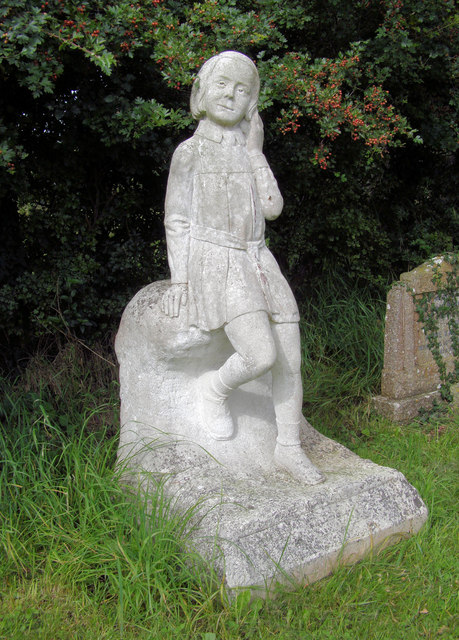
{A child's tombstone in Boldre Church, Hampshire, England. Image from geograph.}


Back To Top
Context

This is another thing that's come out of the local writing group. If you've got one in your town, then I heartily recommend attending it. Writing groups are a great way to boost your productivity and to find inspiration through challenges and through sharing perspectives.

Anyway, the exercise that resulted in this piece of writing comes from Pat Schneider's Writing Alone and With Others, a guide to getting into the writing habit and to starting a writing group.

What the specific exercise that lead to tonight's piece involves is simple: take a song or prayer or poem that you know by heart, and use its lines as a refrain for whatever it is you write.

My own result is a short horror story, but the same song in another's hands might have lead to something a little more innocent and pitched to the audience of the song that I used. Also, Wikipedia was used as a reference for the full song.

Back To Top
Vous Allez Dormir (You'll Be Sleeping)

Frère Jacques...

The sound spewed out from the top of the door jamb, an empty space of just a few centimeters – but enough for the sound wiggle through and into the room. Clarence held his fingers in his ears and hoped that it would mute the sound enough to let him think. To come up with a way out.

Frère Jacques...

It didn't seem to be working. The melody pinned all of his muscles to the spot and made his arms feel as heavy as the furniture he had pushed up against the door. At the time he hadn't considered the use of the towel that Joyce had offered, screaming as the song ate at her from the inside out, turning her every movement into a concentrated step and swing in time with the schoolroom chant.

Dormez vous?...

Clarence wondered how much more pressure his inner ear could take before it burst. He cursed himself for refusing the ear plugs, though by the state of the house, it seemed like no one here had taken them either. And why would they?

Dormez vous?...

Who would have believed the news reports and status updates and tweets? That there was a song in the air and it was out for human blood?

Clarence was beginning to feel woozy, and he staggered backwards, his elbow striking a lamp, the thing bursting on the floor.

Sonnez les matines...

It was getting clearer now, trying to pour its whole essence through the crack at the closed and [fortified] door's top. Clarence imagined that he could see the vibrations as each recognizable word lilted through the air, tugging at his own childhood memories of its recital like French Canadian nuns pulling at taffy.

Deafness was better than this.

Death was better than this.

Sonnez les matines...

Clarence forced his fingers harder against his ears, until he could feel both digits compressing the ears' inner chambers. It felt like two walls were being pressed down into the same room – he wondered which would top which.

Din, dan, don...

He wondered and pressed.

He pressed and wondered.

Din, dan, d-

Back To Top
Closing

Check back here on Wednesday for an editorial on some of the newest news, and on Friday for a hunt for the good in the 1993 Nicolas Cage film noir, DeadFall. Also, be sure to come by the blog tomorrow and Thursday for more Annotated Links.

And, if you'd like to leave me some feedback on today's story (positive or negative, but only constructive, please), feel free to add a comment below.

Back To Top

Wednesday, June 27, 2012

[Wōdnes-dæg] Ebooks: Easing Working as a Writer

Introduction
The Article Summed Up
Not New, But Great
Publishing's Next Stage and Mainstream Acknowledgement
Closing

{A simple and intriguing image, from a simply intriguing blog: These Are My Days....}


Back To Top
Introduction

On the front page of the Globe and Mail Arts section of Wednesday 27 June 2012, is an article about a 14,000 word ebook and what it means for journalism, as well as for writers more generally.

Back To Top
The Article Summed Up

The article delves into the story behind Paula Todd's ebook about Karla Homolka, Finding Karla. Todd discovered that Homolka has been living in Guadeloupe with three young children, and wanted to get the story out more quickly than the standard months-long magazine publishing schedule permits.

So, she published her story as an ebook with Amazon. It's been in the top 10 list of Kindle Singles since its release on Thursday. Combine that ranking with the price tag of $3, and Todd must be seeing some tidy returns on her three-week, NaNoWriMo-like efforts

Simon Houpt, the article's writer, then goes on to explain and illustrate that this means that writers can take back some of the power - and the profits - that they formerly had to relinquish to publishers. Specifically, he notes that ebooks have helped writers to fight for the electronic rights to their works.

Back To Top
Not New, But Great

This is great news.

Not because it's anything especially new, but because this information's being printed in a high profile newspaper suggests that indie authors can expect to get a little bit more cred in the publishing industry. This is definitely a good thing, since those who take the ebook route are generally painted with a very broad brush previously dipped in a wide, deep pot of scorn by more than a few in the mainstream publishing industry.

Though there are some who might validly argue that along with the market for ebooks, a market for ebook editors needs to be established.

Back To Top
Publishing's Next Stage and Mainstream Acknowledgement

One article is not going to change that entirely, but the acknowledgement of indie authors' successes does suggest that traditional media and those representing it are starting to take ebooks seriously.

Does this mean that indie authors might not be able to add that adjective to their title soon? Likely not.

The printing press made it possible to create multiple copies of a book relatively quickly and cheaply. This meant that more people could put their ideas and stories to paper - hence the propagation of pamphlets and broadsheets and books from the 16th century onwards. But using a press is a process that requires time, special training, and specialized equipment.

E-publishing requires nothing so hard to get and efficiently operate as a printing press. It just requires a computer capable of word processing and connecting to the internet. More and more people are able to say that they have this equipment, and so there are more and more e-books being published on a daily basis.

So many are these e-authors, in fact, that the ebook industry might just be impossible to regulate in the same way as the traditional sort of publishing is with its queries and editors and budget considerations.

So, the "indie" label isn't going anywhere. But just as the case has been with indie musicians going mainstream, the growing recognition of ebooks as a serious alternative source for longer pieces of writing means that it may just get easier for indie authors to go mainstream.

Back To Top
Closing

Check back here on Friday for a hunt for the good in Wrath of the Titans, and tomorrow for another edition of Annotated Links.

Back To Top