Showing posts with label statistics. Show all posts

Monday, April 16, 2012

[Moon-dæg] Winding up for Wind Power

Introduction
Megawhats?
Causes for Concern
More Information
Closing
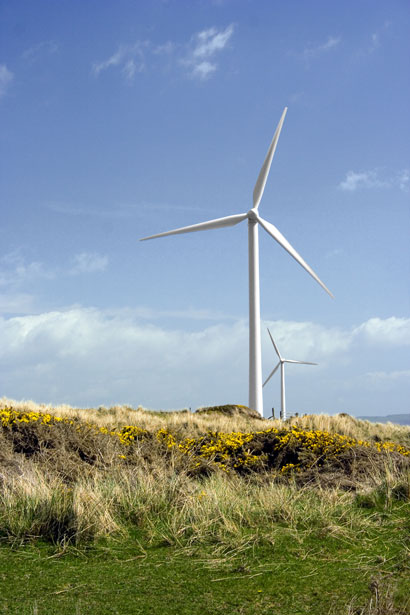
{Typical turbines. Image from publicdomanpictures.net, taken by Peter Kratochvil}


Back To Top
Introduction

As the first part in the next four part series here at A Glass Darkly, and since the new moon means a lack of light, this entry is a pooling of information about wind farms - specifically in Ontario. However, it is by no means complete and will point to things that are a little more complete when necessary.

So what's the skinny on these three-armed towers cropping up over the countryside in recent years? In short, they're part of the Liberal party's plan to help Ontario to go green. The cost has turned many off of the idea, and the noise that they are reported to cause has turned off a few more.

However, according to the IESO website's tracker, this is how much energy Ontario's turbines are currently outputting:


Back To Top
Megawhats?

A megawatt is 1 million watts, and according to WikiAnswers, one megawatt could power 1000 average American homes for 1 hour. Or, it could power an average home for 1000 hours. Since Americans and Canadians have roughly the same power consumption habits (multiple computers, TVs, charging devices like phones and iPods, and electronic kitchen and cleaning implements) using American statistics doesn't seem particularly off.

An estimate of 750 homes on the megawatt by the Toronto Star, gives a similar picture.

Back To Top
Causes for Concern

What gets people's dander up about wind farms, though, is that they've come in at tremendous cost. Whereas other generators get about 7.4 cents on the kilowatt hour, wind generators get 12 cents.

As Ontario swings into more wind power generation, though, A.J. Goulding of the consulting firm London Economics believes that there's potential for a vicious cycle in which the burgeoning wind industry would create jobs that would only compensate for those lost in other energy sectors.

Among those on the ground, so to speak, there are also concerns that wind turbines are responsible for headaches, dizziness, sleep disturbance, and/or hearing loss. Though these concerns are addressed in a report issued by the Chief Medical Officer of Health of Ontario, the conclusion appears to be that wind turbines are not responsible for adverse health effects from a strictly scientific standpoint.

Back To Top
More Information

Nonetheless, the groups for and against wind power in Ontario dot the province's landscape as much as the mills that are the cause of their reactions. These include Wind Concerns Bruce, Ontario Wind Resistance, Harvesting Wind Support, and Ontario Highlands Friends of Wind Power.

For more stats check out thewindpower.net, canwea.ca, and/or centreforenergy.com.

Back To Top
Closing

Check back here Wednesday for an entry on some of the newest news and on Friday for the search for the good in Clash of the Titans.

Back To Top

Monday, February 20, 2012

[Moon-dæg] New Moon, New Stats: The Teacher's College Route

It seems that now is not a good time to be looking into teaching English or History - traditionally over-supplied subjects - in high schools in Ontario.

For the past five years, if the Maclean's and National Post articles on the subject are any guide, teachers in general have had a hard time finding work. This is less true of those teaching technology, sciences, or French, but I am none of those and so there's no need for me to go too far down that road.

The Transition to Teaching 2010 report also paints a bleak picture.

To sum up the report, new teachers across the board were optimistic about their next five years, but largely un- or under- employed.

26% of those new teachers surveyed for this report stated that they had full time contracts, while in 2009 that number was 31%. Piecework is where the teaching jobs seem to be, with about 42.5% working part time, about 39% working with multiple schools, and about 37% working as on-call supply teachers. About 17.5% of new teachers in 2010 were working in non-teaching jobs to pay the bills.

Amidst the Intermediate-Senior certificate holders (my potential peers), 30% are unemployed (or just not working as teachers, I'm guessing), 48% are underemployed (they need to work a non-teaching job to supplement their teaching income), 20% are teaching daily supply, and 30% have regular jobs. Thankfully, I'm not trying or planning to get into teaching math and stats, because I know that those numbers add to something greater than 100 - but that's just how many teachers are out there, I guess.

So, using the Toronto District School Board's collective agreement with the Ontario College of Teachers as a standard for urban earnings, I could expect to make $45,709 a year as a teacher starting out with little or no experience.

That's for full time work.

Part time work is something that I could consider, and realistically I should look into it, but it's not really something that I think I'll be doing. That's also for work in Toronto. The Big Smoke. Ol' TO. But what would I be making in the country? or in the northern reaches of Ontario?

Barrie/Guelph/K-W aren't exactly the rural areas of Ontario, but they aren't Toronto either. In these areas my salary could range from $29,747.20 to $56,320. My calculations are based on this table, a 40 hour work week, and 32 weeks of work per year.

Going further away from TO, I think that it's fair to guess that starting salary for a high school English/History teacher would hover around $45-50,000. But does Northern Ontario, as represented by North Bay and Thunder Bay, hold the standard of living I've come to expect?

Both cities have at least five bookstores that stock used books (though North Bay, surprisingly, seems to have more). They both have a Bulk Barn - essential for cheap groceries). And they both have movie theatres (though North Bay has a non-chain venue with 6$ tickets and a slick site). But Thunder Bay has 16 regular city bus routes while North Bay has only 11.

Blame it on my fascination with Twin Peaks (despite the differences between the NW US and Northern Ontario), but Northern Ontario holds a strange romance to me. Yet, Victoria (and BC itself) also held that - and still does - though living there for 2 years certainly tempered that romance with the province's cold, grey reality.

Working with the Transition to Teaching's 2010 report, it looks like I've got a 3 in 10 chance of landing something full-time right out of teacher's college. Odds that are not particularly strong, but that would improve, slowly but surely (perhaps, optimistically, at 5% a year) over the course of the five years that my internet searching and chatting up friends and relatives who are recent graduates or currently teachers leads me to expect as a wait time between graduation and full time employment.

But all of this becomes most relevant after I've finished teacher's college. What's a standard one year program going to cost?

At the schools that I've applied to, tuition runs the gamut of $6-8,000 for full tuition. Add $1000 for textbooks. Living costs per month sit around $1,500 (based on the fact that most apartments do not have utilities included in their rent). So then, for the full teacher's college experience I would be spending about $27,000. A tidy sum, and one that could see me getting a loan or two.

And now, for the next week, I'll mull over just what these numbers actually mean to me. So check back then for my logical analysis of going to teacher's college. In the meantime, Wednesday's entry will be about pot-popped popcorn and this Friday I'll try to find some good in a film that made a whopping $947 at the US box office: Burke and Hare.

Do you have any stats on teacher's college and/or teaching that I've missed? If so, drop them in the comments.

Monday, January 23, 2012

[Moon-dæg] Some Stats on and Costs of Teaching ESL in Korea

Because the other two days of the week have a slightly more defined theme, I'm trying something new with Mondays over the next month.

Because it's the day named for the moon, I'm going to write four entries on one topic that follow the phases of the moon.

The new moon will be the factual entry, the one where I try to dredge up stats and figures and look at things as objectively as possible. The first quarter will be the first look that is logical, but also personal. The entry posted around the full moon will be the most personal of the entries. And the final entry, that posted around the last quarter, will be another logical look at the issue. In this last entry I'll also try to reach a conclusion about the month's issue.

This lunar month's theme is ESL teaching in South Korea.

According to Gone2Korea ESL Employment Services 17,273 westerners were teaching in South Korea in 2007. The unofficial number cited by the same site for 2011 is 30,000 (and includes those teaching without the proper visa).

On a smaller, more contextualized scale, the major player in Japan, JET, claims 1753 teachers in its program in 2011 while Korea's big name GEPIK claims 2252 for 2010. That GEPIK only covers the north-western province of Gyeonggi rather than the whole country (like JET), it seems that Korea has become an equal, if not bigger draw than Japan (full info here).

This is observation rather than fact, but it's safe to say that a considerable amount (at least 50%) of those who are teaching ESL in South Korea are there temporarily. Maybe they're working to clear some debt, to save some money, or just to take a year or two off from their regular lives. This means that there's a pretty big turnover rate. However, this turnover is also due to the burnout that some teachers planning a longer stay experience.

The job pays well, but having just two weeks of paid time off divided between vacation and sick days (sometimes also need for field trips), having to put up with ridiculous demands from faculty, and dealing with parents that can be as difficult as some students would make anyone bleary eyed.

I mentioned the pay in passing in the last paragraph, and now will get into it more seriously.

As a holder of both a BA and MA in English I can expect my salary to be around 2.4-2.7 million won a month (based on the 2.0-2.7 million won range given on the Seoul Metropolitan Office of Education site) as long as I can find work in Seoul. At the current exchange rate that works out to something between 2149.00 and 2417.74 Canadian dollars.

Taxes run at about 3.5-7% of monthly income (according to Gone2Korea). So the median cost of taxes would be about 113.50 (=2270x0.05) Canadian dollars. And regular utilities cost 162,217.14 won per month, or 145.24 Canadian dollars (thanks to numbeo for that figure). So the monthly deduction from my pay would be about 258.74 Canadian dollars, I'd be left with something between 1890.26 and 2159.00 Canadian. That is considerably higher than most entry level jobs here in Canada (please correct me if I'm wrong), and I'd be able to save most of it.

There are 317 colleges and universities in Canada and 415 in South Korea (thanks, Wikipedia). Considering that about 80 or so of those in Canada are entirely Francophone and my French skills allow me to read the language and follow along with songs but nothing more, Canada effectively has about 240 schools to which I could reply. But even Korean universities and colleges dedicated to art and design have English teaching faculty, so I'd dare say that I could work at any of the 415.

Why do these numbers matter? Because my aspiration, if I do go back, is to get into post-secondary ESL teaching in South Korea. This will likely take a year of working elsewhere, however, since most universities and colleges have in-person interviews as part of their hiring process.

So, those are the benefits and costs of living and working in South Korea. Yet there are also the costs of getting there.

These costs involve airfare (generally reimbursed by your employer) that starts at approximately 600 Canadian dollars for a one way trip (according to FlightNetwork). They also involve the paperwork needed for your visa such as a Criminal Background Check ($40), transcripts from all post secondary institutions that you have attended (15$ each), a set of passport photos (about $15), and the visa application form ($50), and potentially a new passport ($87). So the grand total of the "start-up" costs is $822. Add another $995 if a certification course needs to be retaken, to bring that cost up to $1817.

Any reimbursement for airfare or from the certification company notwithstanding, that's a cost that could be easily recouped within two months. Any other debt that may be incurred as a result of going overseas could also be easily paid back within a few more months, or, at the most, a year.

So, there are the facts as I've found them on the net. Next week I'll look at their relevance to my own situation. And maybe I'll add in a few more costs to reflect that as well.