Showing posts with label debate. Show all posts

Monday, May 7, 2012

[Moon-dæg] A Final Look at Wind Farms

Introduction
On Either Side
The Hazy Long View
Winding Down
Closing

{Ontario Premier Dalton McGuinty giving a brusque, verging on covert, mid-response thumbs up to wind farms. Image from the Globe and Mail.com}


Back To Top
Introduction

People's positions on wind farms are hard to change. But what really underlies the passion on either side of the debate?

Back To Top
On Either Side

Resistance to and/or acceptance of change is certainly a major factor in the matter of wind farms, but just as deep is a concern for the future.

Those who are for wind power are those who believe that it truly is for the best, and that it really is just what needs to be done in order to help prevent global warming, to make power generation more sustainable, and to just plain make the future a more hospitable place for the generations that will have to live there.

On the other hand, those people who are against wind farms in rural Ontario are those who believe that wind farms are just the choice de jour of a government that wants to bully those with less power than citizens living in cities, or who believe that wind farms and wind power are some kind of elaborate sham - no more efficient than coal power, and certainly no more green.

Back To Top
The Hazy Long View

Compelling evidence has been put forth on either side. Some research suggests that wind farms cause local warming, and other research suggests that wind farms are becoming cheaper and cheaper.

Although not nearly so charged as when debates involve things like the definition of life or when it starts, the place of wind farms in Ontario is definitely divisive.

However, taking the long view, wind farms seem beneficial. Are they expensive to consumers? Of course. Have they been forced on some municipalities by a government that some have decried as overly paternal? Sure.

Maybe it’s overly idealistic, but it seems that any transition into a new form of power generation is going to be painful - partly because of cost, partly because of inconvenience, and partly because of a perceived threat to the pastoral ideal, the old idea that any countryside is pristine and unblemished in every way possible - from its soil to its people to its skyline.

Perhaps a better question to ask than whether people should be for or against it is simply whether or not there will be any kind of benefit to it in the long run.

Bringing in wind farms with little negotiation might be a classically paternal move on the part of the McGuinty Liberals, or some stereotypical Liberal over-spending at the cost of bill-paying citizens, but in 50 to 100 years will it do as much harm as people are saying? or will wind farms have done some good - maybe making Ontario’s countryside more pristine than it was before?

Back To Top
Winding Down

Perhaps this issue has sparked so much debate because the only way an answer can be firmly grasped is more by feeling than by thinking. The future that Ontario wind farms might positively or negatively effect is so far off that trying to forecast just what will happen involves too many variables.

There are immediate woes and victories, but do either matter as much as either side make them out to?

Back To Top
Closing

On Wednesday check back here for an article on the newest news, and on Friday be sure to stop on by for a hunt for the good in London Boulevard.

Back To Top

Wednesday, May 2, 2012

[Wōdnes-dæg] A "Rebel" Gay-Straight Alliance in the Waterloo Catholic District School Board

Introduction
Interesting Local Developments
Over-Great Expectations
Closing
References

{A standard board for a Gay-Straight alliance group. Image from search.com.}


Back To Top
Introduction

The matter of "sexual minority youth" in Catholic schools came to the fore again recently.

This time, removed from the national coverage afforded the matter in Toronto schools, there seems to be at least some hope in the Kitchener region as this article in the Kitchener-Waterloo Record by Liz Monteiro implies.

One of the key players in this situation, Anthony Piscitelli, is undoubtedly right that it's a divisive issue that would do more harm than good for the students as camaraderie amongst teachers would certainly take a hit if they were forced to take a side.2

Nonetheless the presence of students with a variety of sexual orientations within Catholic schools is still an important issue that needs to be addressed.

Back To Top
Interesting Local Developments

What's most interesting here is the simple fact that Catholic groups around the Kitchener-Waterloo region don't seem to have any problem with it.

A consultant for the Waterloo Catholic District School Board from the Congregation of the Resurrection (an Institute of Consecrated Life for men), Rev. Fred Scinto, said that students shouldn't have to live in fear of being persecuted because of their sexual orientation - he even went so far as to quote St. Augustine, saying "We are a church of saints and sinners but Christ is still within it."3

In fact, this issue is particularly newsworthy because it's already playing out a little bit differently than it did in the province's capital. For the Kitchener-Waterloo region already has a school that has a group that is essentially the same as the oh-so-feared gay-straight-alliances. This school is St. Mary's High School and it sounds like the group there has done nothing but good for all of the students involved.

Back To Top
Over-Great Expectations

So why are gay-straight alliances still such a big deal elsewhere? It seems like there's very little justification for it outside of some kind of ungrounded fear that these alliances are going to serve as homosexual hook-up groups, at least that can be inferred from the emphasis that these articles put on the Church's message of chastity for adolescents.

I think that Luisa D'Amato hits the nail on the head when she writes:

"The central problem here is the medieval logic of Catholic thought, slammed into modern North American culture with its deep concern for human rights. According to Church teachings, every person must be loved, gay people included, but not their sexual acts, which the Church teaches are sinful and morally disordered, both because they occur outside Church-sanctioned marriage and because children cannot be born from them."4

The issue here is a weird paradox in Catholic teaching that allows for all sorts of people to be accepted by the Church but that denies that at least a part of every person's identity - what makes them a complete person - is sexual.

As D'Amato goes on to point out, the denial of this aspect of people as part of accepting them "hasn’t worked out so well for the priesthood and, it is increasingly clear, presents nothing more than a delusional fantasy in the real lives of real people."4

Real lives aren't so neatly compartmentalized. Nor can real people easily section themselves off. Trying to do both just makes for a hardened mass of knots that even Alexander the Great couldn't cut through.

Hopefully, the example set by St. Mary's will be seen by other schools and by other boards, and support groups for students of any "sexual minority" will spring up in other Catholic schools.1

At least then, as a new teacher, there'd be one less thing to disagree on with the majority of Catholic schools.

Back To Top
Closing

Check back with this blog on Friday for a hunt for the good in Johnny English Reborn.

Back To Top
References

1. Monteiro, Liz. "Kitchener Catholic high school already has a gay-support group." TheRecord.com 2 May 2012.

2. Simone, Rose. "Fear of ‘divisive’ discussion ends gay-straight alliance group motion." TheRecord.com 29 April 2012.

3. Monteiro, Liz. "Schools have duty to provide safe environment, former student tells board." TheRecord.com 30 April 2012.

4. D'Amato, Luisa. "D’Amato: Piscitelli has it right — the Catholic school board should listen." TheRecord.com 2 May 2012.

Back To Top

Monday, April 30, 2012

[Moon-dæg] "Switch off the Mind and Let the Heart Decide"

Opening Generalities
Wind Turbines Are Eyesores: Revisited
On Futuristic Landscapes
Health Effects Mini-Rant
Closing

What better way to start of a stream of consciousness/rant entry than with some of the electronic musical stylings of Mr. Thomas Dolby (specifically a song named "Wind Power")? At any rate, let's get right to it.

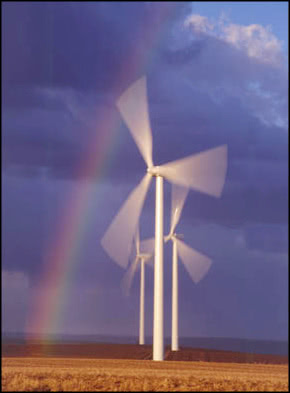
{Spinning blades and rainbow shades, a perfect day for a rant. Image from wpclipart.com}


Back To Top
Opening Generalities

This whole issue of wind farms and such in Ontario really seems to come down to a generational divide, at least in some senses.

Any generality is like a day at the beach - you're bound to get sand in your shoes if you make them, but sometimes they've got to be made, just as you might have to go to the beach to really relax.

Nonetheless, the older generation is generally opposed and the younger generation is actually for. But the sand's about to be kicked out of those shoes, since the reason behind this seems to be the simple fact: the old live in the country and the young live in the city.

Perhaps not major cities, like those clustered around South Western Ontario, but definitely in more densely populated areas where wind farms are quite removed from everyday sight.

This is another generalization, but it definitely holds true. There are, of course, the young who don't care for wind power and the old who are for it, and the young who live in the country and face the brunt of these wind farms and there are the old who live in cities and are removed from the physical presence of the issue.

Really, though, that's it. Those living in towns and in cities who are opposed to wind farms might be so because of the reasons cited in last week's blog entry, or because of others, but those urbanites are not quite in the fore of the issue.

Back To Top
Wind Turbines Are Eyesores: Revisited

Wind power, though, is definitely something futuristic, something that is at least a little bit inevitable, even if its greenness in both senses might be seen as a handicap by some. The biggest argument against them that carries any weight, and that seems to have no real solution is that they're eyesores.

In response to the eyesore argument, though, it must be said that the landscape is going to change no matter what kind of power is generated - green power or old power. The generation of power means that humanity is present, and as long as humanity is present there's going to be a need for power - so long as any kind of apocalyptic disaster doesn't render human society completely ignorant of electricity and its uses. Why not let the landscape change in a controlled way?

Back To Top
On Futuristic Landscapes

The change into a futuristic landscape, assuming that a "futuristic" landscape is indeed the end result of human progress to the "Future" of hover- and teleportation and meals-in-pills technology, is definitely going to be a long and slow one, but as long as wind turbines don't knock down any trees or destroy any escarpments or cause damage to homes, they're just another addition.

How did people feel about radio towers when they first went up in the countryside, with their constantly blinking lights?

How did people feel about the giant metal power lines and their supports which cut swathes through the Ontario landscape when they were first erected?

Progress means change, and if it's a change that can be controlled, isn't that for the better? Isn't that what should be striven for?

So what if solar panels and wind turbines change the face of the landscape just a little bit?

Back To Top
Health Effects Mini-Rant

As per the other effects that wind turbines are said to have, it seems that no evidence has come forth to back up claims of health problems due to them, and their effect on wildlife is considered in their construction and erection. 50-150 years ago when things were being built in the Ontario countryside, was wildlife considered? Were health concerns related to the impact of building a major issue?

It's the opinion of this blogger that the health issues that people attribute to wind turbines are the result of anxiety triggered by the presence of something new and radically different.

A power plant is sequestered and out of sight. A hydroelectric dam might be miles away from the homes and businesses that use its power. Wind farms are much more immediate, much more noticeable, and more more conspicuous.

If anything, the wind turbines are causing health issues not because of their motion - though being near any moving object like that does take some getting used to - as much as they are because of turbines' inescapable presence. They're there. They're always there, but unlike solar panels, they make noise and they move about. These facts may cause some people to become distressed, but they are what they are.

Back To Top
Closing

Check back here Wednesday for an article about some of the newest news and on Friday for a hunt for the good in Johnny English Reborn

Back To Top

Monday, April 23, 2012

[Moon-dæg] Logical Defenses Of Ontario Wind Power

Introduction
Wind Farms Forced on Rural Ontario
Wind Turbines Are Eyesores
Wind Turbines Don't Turn When Power's Needed Most
Closing

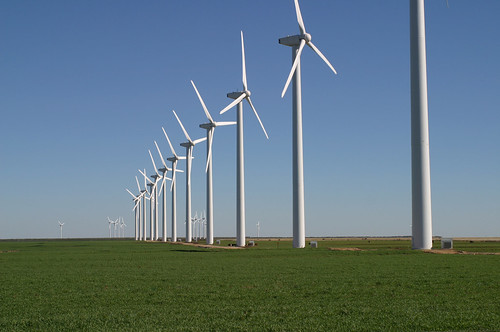
{Turbines aligned, like solid arguments for and against them. Image from an Earthy Day 2012 blog}


Back To Top
Introduction

There are a number of arguments that have been raised against wind turbines in Ontario. A mere three are that: The wind turbines were forced on residents of rural areas by the current Liberal government; the turbines are eyesores; the turbines don't generate power when it's needed most.

Back To Top
Wind Farms Forced on Rural Ontario

Although there appears to be little record of it on the internet, many residents of rural Ontario feel like the provincial Liberals have forced wind turbines into the landscape, giving the affected residents and municipalities little say in the matter.

At the least, Energy Minister Chris Bentley has said (in February 2012) that rural municipalities will have some say in the locations of wind farms, but there's little to suggest that rural municipalities will be able to outright refuse wind farms.

On the one hand, it makes sense that this lack of democratic choice has caused so much protest on the part of rural Ontario, but on the other it could be seen as a provincial government simply doing what a provincial government does: govern.

In a democratic society the governing process needs to involve the say of the governed, but going around that brings up one major question.

Were wind turbines, in any form, mentioned in any of the Liberals' platforms for the 2003 and 2007 elections?

No, not specifically, at least.

But a quick Google search turns up the 2003, the 2007, and the 2011 platforms.

A search for the word "energy" in these platforms reveals an emphasis on "clean" and "renewable" energy in the 2003 platform; the statement that the Liberals will

"Make our energy greener and cleaner, with the province’s first long-term energy plan in a generation. Our plan will replace coal by doubling renewables and doubling conservation" (page 6)
in the 2007 platform; and energy that's described as "clean," "green," and "renewable" is mentioned throughout the 2011 platform (which also includes dramatic shots of people in front of wind turbines).

The references to renewable power are vague, yes, but they do hint towards things like wind power - it may sound cruel, but Ontario got what it voted for.

Because the Liberals have had a majority in the past three elections, running on a platform with a mention of such energy (though not explicitly "wind power" or "wind farms"), it's logical to conclude that even if rural Ontario wasn't unanimously for the Liberals in the 2003, 2007, or 2011 election, the province at large was, and the Liberals could take that acceptance (even as narrow as it was in the 2011 contest) as a green light to do what they thought best for the province.

Back To Top
Wind Turbines Are Eyesores

To argue that wind turbines are eyesores and blots on the previously pristine Ontario countryside is to do what some likely did when skyscrapers first began to be built. City skylines have indeed been changed by the presence of the skyscraper, but these former eyesores have since become part of the cultural idea of what a city is - arguably worldwide.

Now, it's true that wind turbines can't exactly be compared to skyscrapers in all respects - it's much easier to make a building aesthetically pleasing because all it has to do is stand firm, when moving parts get added to the mix and these parts' motion needs to be efficient things get more complicated. However, places like Germany, where wind power is used to a great degree, don't seem to have much of a problem with the turbines and their appearance.

They're clumped together, sure, but that doesn't really make things that bad.

Anyway, having wind turbines dot the landscape is not a bad thing, it adds variety to an otherwise repetitive skyline. Forests and fields and cliffs and ravines are excellent, but adding in some wind turbines isn't necessarily that bad.

And though they may make some stretches of countryside less appealing to some people, they have attracted tourists to others, and will help to make those spaces left untouched even more prized than they are already.

Back To Top
Wind Turbines Don't Turn When Power's Needed Most

Another argument lobbed against wind power (in Ontario, at least) is that when the power that these turbines generate is most needed it's nowhere to be found. The best example of this are hot summer days where the oh-so-necessary wind isn't blowing, and the turbines sit idle.

However, if excess power generated by wind turbines is stored in the grid during peak hours/days, then this argument is rather toothless. On the other hand, if excess power from wind turbines is not stored in the grid (or elsewhere), then more planning in that regard is definitely necessary.

Back To Top
Closing

Check back here Wednesday for an article on the newest news, and check back on Friday for a hunt for the good in The Darkest Hour.

Back To Top

Monday, April 16, 2012

[Moon-dæg] Winding up for Wind Power

Introduction
Megawhats?
Causes for Concern
More Information
Closing

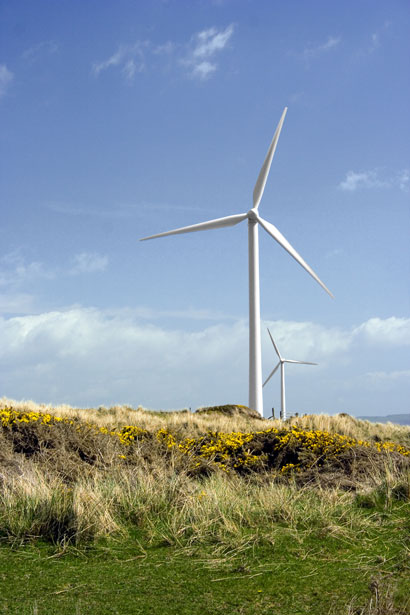
{Typical turbines. Image from publicdomanpictures.net, taken by Peter Kratochvil}


Back To Top
Introduction

As the first part in the next four part series here at A Glass Darkly, and since the new moon means a lack of light, this entry is a pooling of information about wind farms - specifically in Ontario. However, it is by no means complete and will point to things that are a little more complete when necessary.

So what's the skinny on these three-armed towers cropping up over the countryside in recent years? In short, they're part of the Liberal party's plan to help Ontario to go green. The cost has turned many off of the idea, and the noise that they are reported to cause has turned off a few more.

However, according to the IESO website's tracker, this is how much energy Ontario's turbines are currently outputting:


Back To Top
Megawhats?

A megawatt is 1 million watts, and according to WikiAnswers, one megawatt could power 1000 average American homes for 1 hour. Or, it could power an average home for 1000 hours. Since Americans and Canadians have roughly the same power consumption habits (multiple computers, TVs, charging devices like phones and iPods, and electronic kitchen and cleaning implements) using American statistics doesn't seem particularly off.

An estimate of 750 homes on the megawatt by the Toronto Star, gives a similar picture.

Back To Top
Causes for Concern

What gets people's dander up about wind farms, though, is that they've come in at tremendous cost. Whereas other generators get about 7.4 cents on the kilowatt hour, wind generators get 12 cents.

As Ontario swings into more wind power generation, though, A.J. Goulding of the consulting firm London Economics believes that there's potential for a vicious cycle in which the burgeoning wind industry would create jobs that would only compensate for those lost in other energy sectors.

Among those on the ground, so to speak, there are also concerns that wind turbines are responsible for headaches, dizziness, sleep disturbance, and/or hearing loss. Though these concerns are addressed in a report issued by the Chief Medical Officer of Health of Ontario, the conclusion appears to be that wind turbines are not responsible for adverse health effects from a strictly scientific standpoint.

Back To Top
More Information

Nonetheless, the groups for and against wind power in Ontario dot the province's landscape as much as the mills that are the cause of their reactions. These include Wind Concerns Bruce, Ontario Wind Resistance, Harvesting Wind Support, and Ontario Highlands Friends of Wind Power.

For more stats check out thewindpower.net, canwea.ca, and/or centreforenergy.com.

Back To Top
Closing

Check back here Wednesday for an entry on some of the newest news and on Friday for the search for the good in Clash of the Titans.

Back To Top

Monday, December 19, 2011

[Moon-dæg] December and Religion

The idea behind Monday entries is that they vary along a set pattern, just as the moon itself (Monday's namesake) does. So, seeing as how this Monday the moon will be in its last quarter here in Southwestern Ontario, my treatment of today's topic is going to be more critical than praise-filled, essentially bringing the idea of that topic into a waning state. But what is today's topic?

The idea that there is a "War on Christmas."

Currently living in Small Town Ontario as I am, signs and stickers with slogans like "Keep Christ in Christmas" are fairly common. But the idea that these signs put forth is not entirely as pure or wholesome as those posting the signs and stickers may think.

True. Within Christian faiths Christmas is a celebration of the birth of Christ and is so positioned to turn the symbolism of the days getting longer toward a Christian meaning, but secularizing the seasonal celebrations throughout the month of December has nothing to do with taking Christ out of Christmas.

First, Canada is often touted as a multicultural society. The last time I checked - fairly recently, by the way - Canada is still distinct from the United States and so the approach to different cultures here is supposedly to offer them a safe environment to practice their customs within the law of the land. The recent naqib controversy has stirred quite a bit on debate on this topic, but my point in bringing up multiculturalism here is that it is necessary to recognize that Christians (nominal or otherwise) may have built this country from settling it, Confederating it, and [] it, but they did so not so that it could be a safe haven for Christians only.

Much like our southern neighbours one of the ideas within the Canadian Bill of Rights and Freedoms is freedom of religion. Stephen Harper is a Christian. Sure. Okay. Dalton McGuinty is Catholic. Cool. Whatever. But the idea behind freedom of religion, at least in my own interpretation, is that explicit religion is to be removed from political policies. Religion - the governance of a soul - and politics - the governance of a people - are to be separate matters in that politicians recognize that their constituents are not necessarily all Catholics or Lutherans or Presbyterians or Jewsh or Muslim or Hindu. In this sense policies that keep Christmas and its vocabulary out of the public sphere of a community, or at the least out of a prominent place in that community are not meant as attacks on Christians by some sort of heathen governing body, but rather to remind Christians that there are other celebrations occurring in December that they should be mindful of.

I think that the idea that there is a variety of special events around the time of December also points to a major flaw in messages like "Keep Christ in Christmas." Those who don't celebrate Christmas, because they are of a different religion or of no religion at all, aren't going to care very much about keeping Christ in Christmas. Christians who acknowledge a nativity scene with a nod or a "that's nice," aren't going to need convincing. The signs, it seems to me, are not so much saying "Hey - keep Christ in your minds and hearts Everybody!" as they are "Hey you reading this sign, guess what - the people in this house/car are Christians." It's a kind of print form of the fire and brimstone which I hear in the voices of religious speakers in many debates and talks (for a good example of this listen to Rabbi Shemuly's tone in this debate with Christoper Hitchens at the 92nd Street Y a [listen<--Link] and compare it to his opponent's). Such a tone suggests that an ardent case is being enthusiastically made, but that enthusiasm does little to bring people who are diametrically oppossed to that stance, or completely unconcerned, into the fold. Moreover, this kind of tone does more damage than good in most debates because it puts the one using it in danger of sounding much less reasonable, while also potentially helping an opponent to seem calmer and more well-reasoned by comparison.

My next point comes in the form of an analogy, so brace yourselves.

It seems to me that religious expression that gets into people's faces or that politicians feel so uncomfortable with that they outright ban it from their communities, is a lot like a ball being tossed about violently by a group of kids. A parent comes along and takes away the ball saying something along the lines of "If you can't play nicely with the ball, you can't play with it at all." Just as the kids might feel slighted ("we were just playing!" "come on, just give us a chance!") the religious get upset and start to feel like they're being singled out (hello "War on Christmas"). But I think that taking the ball away is an effective measure. If one religious group is pushing their message in such a way that it seems to be encroaching on other religions, then no one should be able to push a message. Efforts and messages from governments should be secularized.

It's true that a tenets of many sects of Christianity is to go out and tell people the good news of Christ and such, but I think that an being an exemplary Christian is better than being one with some words for those who disagree or differ with you. This rings especially true today, since modern cynicism can be more easily circumvented by actions than by words. People can say anything, but they will only do what they truly believe and have convinced themselves is true. That conviction is what's necessary for Christians to follow their mandate to spread the word, and being vitriolic or pushy about their ball being taken away is much more harmful to their cause than simply putting up a nativity scene or writing "Merry Christmas" in lights on their house or in a window. People will get offended, but if the message doesn't carry the fire of "Keep Christ in Christmas" then those who are offended won't spit the same back.