Showing posts with label religion. Show all posts

Monday, October 15, 2012

[Moon-dæg] From A Ship's Crow's Nest

Context
Blue Bricks
Closing

{A replica of a medieval ship. Image found on the Seasalt Cornwall blog.}


Back To Top
Context

Today's story is one of the many shorts that offers some insight into the backstory of the fantasy series that I'm currently working on. In fact, it's a kind of world building story, in the sense that it (once it's as finished as it can be) will offer a glimpse into a major aspect or two of my created world.

To date the process of writing this series has been drafting it book by book (as a "discovery" writer) to figure out how the world works. However, after taking a fair bit of time off from writing this series during my MA, I've gotten to the point where the discoveries made by writing the larger books need to be refined through shorter stories. These shorter stories will also, ideally help me to see how these aspects of the world I'm creating can feed back into the five books of the series.

This story was written based on a prompt at the local writing group, and just evolved from it. The prompt was to write a story in which each paragraph starts with a colour. It's still a draft of sorts, but much of what the story is is already here.

Back To Top
Blue Bricks

Blue bricks are a rare sight but still seen. The walls around the island city of Shev have them near their bottom, though other sailors said they were just turned that colour by the sea.

Ermina believed instead what some of the Shevites themselves told her. That the blue bricks around the bottom of their city's wall were made of the purest stone found in all the caves that wended through the cliffs over which the city sat. Caves where the more superstitious among them said they would never dare to tread. But even from her place at the top of every ship she ever sailed in, Ermina had never seen anything beneath the city's walls but breaking waves. Part of her wondered about the stories she had heard in the city's inns where the crews she had been with stayed. She believed what she would about the bricks, despite the evidence of her eyes, but the stories were always such a deep red.

She knew that red stories were not necessarily better than any other, but she loved them the most. They almost never moved at a slug's pace. Since she was a child the red stories always moved faster than gulls diving for fish, and their heroes and villains always came up from the plunge with their prey.

Ermina watched such gulls now. They looped and glided, all immaculate white tipped with grey, yellow and orange. Not the kind found around lakes but the sort that would give dull old hawks fair competition - the sort found by the sea, flying between white sails, white masts. She wondered why the place where she stood, her arms on its railing, was even called a "crow's nest." She'd never seen any crows flying out at sea, or even heard stories of such things.

The gulls's cries drowned the waves' crashing against the ship's side. The ship's sides that were still the colour of the meadow honey they made on the Kael Isles, despite recent layers of pitch. While the familiar sound of someone climbing rung over rung snuck in beneath that of the gulls she imagined herself back on those Isles.

“We’ve only just reached the green water and already this one is off beyond the Crumbs.”

Ermina stirred. “Oh, Cyril. There’s not as much to see out there as you and yours’d like to." She didn't bother to turn or straighten from her place at the nest's edge. "What’s got you up here?”

Cyril looked back down the way he had come. Beneath him the ship’s sides rose and fell. “Just to remind myself that even green has its limits.”

“Your maps'd tell you that just as easy.” She turned back to the water. “What’s the real reason?”

"We are bound for Shev. I thought you should know."

Ermina hunched her shoulders. "I already know. I'll get another look at those blue bricks, and hear some more stories about the creatures or gods or demons that gave them."

"And?" Cyril fingered a loose thread in his sleeve.

Ermina said nothing. Why does he press me on this? "And I'll be sure to shout down real loud when I see it all."

Ermina heard Cyril's leather jerkin creak before she heard any of his footsteps back to the ladder. She refused to look back, though she knew that he would linger before heading down. When she finally straightened and turned, she could hear him back down on the deck, giving commands and sending orders. She tried to think of the best red story from past voyages to Shev, but could only fear that with Cyril along the only one to be told would include them both.

Back To Top
Closing

Check back here on Friday for Part Three of Shocktober, a peek into the perils of Silent House. For mid-week stuff, check out Tongues in Jars on Tuesday (Latin) and Thursday (Old English).

Back To Top

Monday, October 8, 2012

[Moon-dæg] Some Lines about Laity?

Context
Child in a Church
Closing

{The sort of chancel that a child might run up to. Image found on chancel.org.uk.}


Back To Top
Context

A poem that was written a few months ago, and that is based on some lines that came my way one day.

I can't say what, if anything, directly influenced this poem, but I had the image of a child walking up to the front of a church and just let a pen finish the thought. Maybe it's got deep resonances with modern day religious situations, or maybe it's just a configuration of words that sound pleasant together - after you read it, leave a comment to let me know what you think!

Back To Top
Child in a Church

There is a child in a church
Raising and felling eye-sized feet
To claim further carpeted ground.
Before the front pew now,
An edge more shear than a fall from grace.

She turns back to titter and gibber at
Parents seated
Where only she can see.
Then back to the front and further stalking
But no more footfalls.

Giggles
As unlined hands grasp without cross
to reach the wooden table
From which her sight
Slips to the smithed cupboard lock
set as high as her apartment.

No man in any dress all of one colour to stop her,
She clamours to the ground floor of that ceiling scraper,
But begins to cry when no doorman smiles the wooden entrance open.

Back To Top
Closing

Check back here on Friday for a search for what's truly scary in Leprechaun in the Hood, and on Saturday for Annotated Links #21!

In the meantime, head over to Tongues in Jars for my dead language translation posts on Tuesday and Thursday.

Back To Top

Saturday, September 29, 2012

[Sæternes-dæg] Annotated Links #19: Wonders Outwards, Inwards, and Engineered

1. "This is Not a Real-Life Pokemon, Just the Poodle Moth." TechEBlog 23 September 2012. Web. 29 September 2012.

This article focuses on an image of the poodle moth in nature, and as a pokemon card. It's a brief article that includes no extra description of the animal or an external link.

Nonetheless, this link is included because of its weirdness and how it shows the world's wondrousness.

2.Marable, Eileen. "This Nazi Space Buddha isn't science fiction — it's real." DVICE 27 September 2012. Web. 29 September 2012.

According to this article, information on a Buddhist statue made from meteorite iron was recently released by researchers. This statue is from the 8th-10th centures, but the iron itself fell some 10,000 years ago, along the Siberia-Mongolia border. During the late 1930s it was brought to Nazi Germany, possibly because of the swastika on its chest. This article is written in a sensationalist, yet level-headed style.

This article is included because of its bizarreness.

3. Taylor, Kathleen. "The Brain Supremacy." Huff Post Science 24 September 2012. Web. 29 September 2012.

An article that proposes that the field of neuroscience is going to be a hot spot for future scientific development - as the brain is increasingly better understood, the more it will be treated directly, and the more it will be pleased directly (with things like artificial experiences or direct thought-editing). At the same time, this piece raises the ethical questions important to a world where neuroscience can do all of these things. Taylor writes in a lecture-style register but keeps things moving along smoothly.

This one is included because the matter of brain manipulation is a curious thing.

4. Adams, James. "Why reading more carefully is better." The Globe and Mail 21 September 2012. Web. 29 September 2012.

Adams explains the importance of reading slowly based on observations of reading brains and circulatory systems. According to this article, slow reading gives blood flow to all of the brain, whereas skimming something only gives a blood flow to certain parts of the brain. He writes in a casual but tidy style.

I had to include this one because any research into the body's reaction to reading needs to be shared. Especially when it proposes such positive benefits to slow reading.

5. Kooser, Amanda. "Nintendo zapper hacked to shoot high-powered laser." CBS News 26 September 2012. Web. 29 September 2012.

Over at North Street Labs in Portsmouth, VA, engineers have hacked an NES Zapper to fire a powerful laser. This laser can set things on fire, damage eye sight, or burn skin. A video demonstrating some of its applications is included with this article, and it's written in a direct, simple style.

Because this one is so amazing, it's included.

Back To Top
Closing

Tomorrow, watch for the next look-back/look-ahead entry!

Back To Top

Wednesday, June 6, 2012

[Wōdnes-dæg] Abortion: Politics of, and Reasons to be Pro-Choice

{An Ontario Conservative MP takes part in the March For Life anti-abortion rally on Parliament Hill, 10 May 2012. Image found on theglobeandmail.com from Sean Kilpatrick/THE CANADIAN PRESS.}


Quick Warning
Introduction
Summary
Reason One
Reason Two
Reason Three
Afterword
Closing


Quick Warning

A quick warning - parts of this entry may be more graphic than you're comfortable with. If the discussion of abortion, especially when sarcasm and analogy are involved, makes you squirm, then you may just want to skip this one.

Back To Top
Introduction

It’s heartening to know that abortion is a sheerly political thing among Conservatives at the party level. At least, that’s what this article from today’s Globe and Mail suggests.

Back To Top
Summary

The article explains that a lone Tory has put forth a motion to redefine when human life begins, and that the Prime Minister’s Office has tried to keep this motion from getting support. The official line is that a vote for what is essentially an anti-abortion motion is a vote against Mr. Harper’s wishes, but senior party members have also said that it is a vote against Mr. Harper himself.

So what could be triggering party member Stephen Woodworth’s desire to re-open the abortion debate in Canada? Some sort of high morality founded on invented dogma? Nope. Not explicitly so.

Apparently, this MP knows that his re-election in 2014 depends on anti-abortion supporters. And he wants to make it clear to them that he really is the man they voted for.

This story ran on page A4 of the print edition, so isn’t big news (rightly so, since Toronto is still reeling from Saturday night’s Eaton Center shooting). But it is good to hear that Canada’s legalized abortion will not be coming under federal scrutiny any time soon.

So why am I, a Catholic of many years, thankful that the debate will lie dormant for now? For three reasons.

Back To Top
Reason One

I agree with the current Canadian law that states that a fetus becomes a human person after it has exited its mother’s birth canal.

I agree with this law because it makes concrete sense. Yes, the different stages of development have been mapped out and know that such a vital thing as the heartbeat starts at 6 weeks, can begin to hear at 18 weeks, and can potentially respond to your voice at 25 weeks. But if you put a seed in the ground and peek in on its progress as it sprouts into a tree, once the seed breaks open, but the sprout still has to get through to the earth's surface, can what's come out be declared a sapling or a tree?

Until a fetus has left its mother it is a part of her, just like any organ is a living part of any other human being. It’s not a pleasant analogy because babies are so cute and full of potential, but could a tumor be declared a human being if it grew its own working heart or lungs or mind?

(The tree and tumor analogies may be crude, but defining "human life" is a sticky thing to do with some degree of objectivity.)

Back To Top
Reason Two

Fetuses are very much a part of their mothers up until the point when they’re born or brought into the world. Because of this, if you remove the mother, then the fetus would not be able to survive. A baby couldn’t be expected to survive if left alone either, but the key difference is that a baby is no longer hooked into the human female’s automatic feeding system after it’s born. The cord is cut, and it becomes it’s own separate entity.

Whether you consider a fetus a part of a woman’s body or not, it is living inside of a woman’s body and that woman should be able to decide what she wants to do with it. And that’s not playing god, it's simply altering the body, something people do all the time in ways both obvious and not.

Further, abortion is not a recent invention. Though where surgery or one sort or another is the norm today, in earlier times it was much more common for a woman to abort a fetus through one of several folk methods like fasting, hard labor, taking diuretics, or getting an enema (check Wikipedia for a full list).

Back To Top
Reason Three

Making abortion illegal would do more harm than good.

If abortion is made illegal that won’t stop people from getting them - even though making drugs, extortion, and rape illegal certainly has stopped people from getting and doing them.

But what’s truly dangerous about making abortion illegal is that it would force those who seek them out to go underground, and methods hidden in the darker parts of society are not going to be as clean and safe as those practiced in well-lit clinics.

Though, considering the economy’s current state, maybe abortion should be made illegal - it might give the wire coat hanger industry a boost.

Back To Top
Afterword

This editorial also appeared in today’s Globe and Mail, and it nicely sums up what Catholics really should consider when it comes to real world issues like abortion and the LGBTQ presence in schools.

Gay, straight, Catholic
Re Catholic Schools Fear Fallout From Bill 13 (June 5): In 2008, Georgetown became the first Catholic university to open an LGBTQ resource centre. As a Georgetown student, a Canadian and a Catholic, this meant the world to me and my friends, several of whom are gay and practising Catholics. Why did the Washington university open the centre? Because the violence that emerges from ignorance and intolerance violates Catholic teachings. Because love, respect and growth are cornerstones of Jesuit teaching. Because we are men and women for others.
After donating $1-million for LGBTQ programming at Georgetown, former NFL commissioner Paul Tagliabue explained: “The Center is inspired by Catholic and Jesuit principles of respect for the dignity of all and education of the whole person …” It is upsetting that Ontario’s Catholic school boards are unwilling to act on the core values of Catholicism: tolerance, non-judgment and love.
Kelsey Spitz, Toronto
Back To Top
Closing

Check back here Friday for a hunt for the good in the newly released thriller Gone.

Back To Top

Wednesday, March 21, 2012

[Wōdnes-dæg] Dead and Buried, But Lying in Bed

Introduction
Christian Significance of Burial
Bed Burials
Her Golden Cross
Conclusion
Wrap Up
References

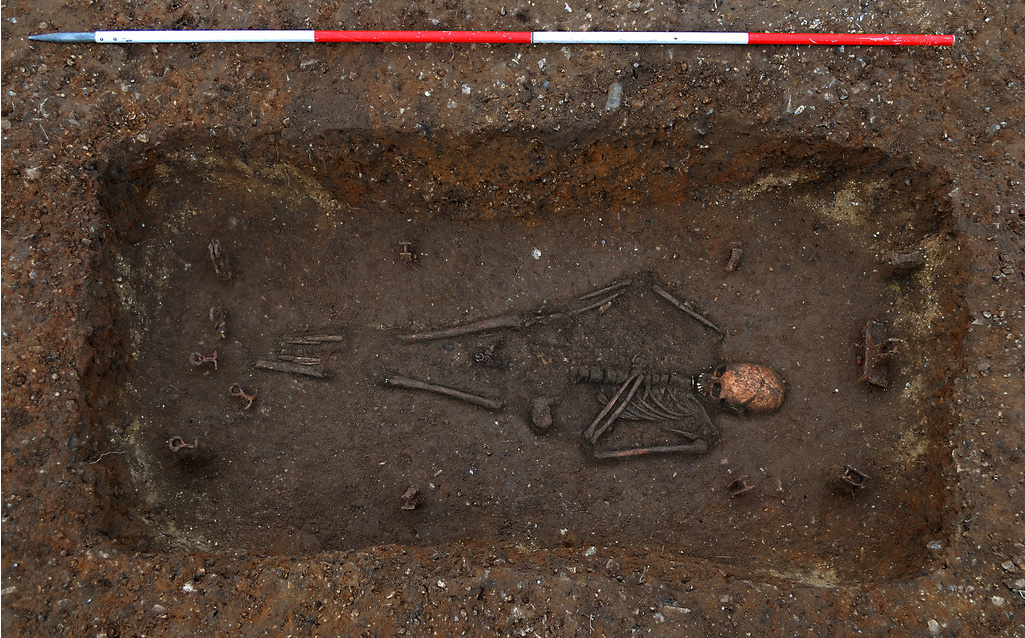
{The bed-burial grave at Ixworth. Image from The History Blog.}


Back To Top
Introduction

The native speakers of Old English known as the Anglo-Saxons are long gone. But, as with so much ancient history, they just can't help but be brought back into the present every now and then. As a recent article in the Hamilton Spectator reveals a new find in the field,1 now might just be the second most exciting time to be an Anglo-Saxonist or somebody just fascinated by old burials and treasure hoards.

The most recent Anglo-Saxon find is the burial of a teenage girl. What's so special about her burial? After all, many people were buried then as they are now. Especially since she's been pegged as living in the 600s, when Christianity was coming back to Britain. Riding this tangent out, what's Christianity got to do with a girl being buried?

Back To Top
Christian Significance of Burial

Cutting straight to the quick, burial is essential according to traditional Christian belief in the Final Judgment. For, it is at the time that Christ comes back that all the dead shall rise and have their sins and virtues weighed and the lambs and the goats will be separated and so on. But if your body was cremated (or burned on a boat set out to sea - I'm looking at you, Vikings), then your soul won't have anything to wear to the final judgment. Traditionally, nothing is said about bodies reconstituting themselves from ashes and then rising for the last judgment.

So this Anglo-Saxon teen would have been buried in accordance with the new faith of the land. What's peculiar about her case though, is what she was buried with, and what she was buried in.

She wasn't buried in a coffin, no, she was buried in a bed.

{A drawing of a bed burial. Image from Wessex Archaeology}


Back To Top
Bed Burials

Bed burials among the Anglo-Saxons seem to be quite rare. To date only 13 have been found.2

Nonetheless, these bed burials have a some things in common. Most involve women, many include jewelry that suggest a high social rank.2

Most interesting about this practice is the fact that the Old English word "leger" ("a place where one lies") could refer to either a bed or a grave.2 This crossing of the two ties in nicely with a lot of the enduring associations of sleep and death. Such things definitely go back to the time of Christ as he says "Our friend Lazarus sleepeth" when he is talking with Mary and Martha.3

But for the pagan Anglo-Saxons what might the connection between sleep and death mean? Sleep and death are visible in the seasons, certainly. The earth seems to sleep beneath blankets of snow in the winter when many plants die out, and then wakes again in spring.

Getting a bit more personal, sleep and death were also closely connected in pagan ideas of death. Similar to the Christian idea of the soul carrying on to another place upon the death of the body, Norse pagans believed that some part of the person journeyed to some form of the afterlife. The beliefs of the Anglo-Saxons may have differed from this, but certainly only slightly - especially as they would have been in close contact with the Norse throughout the 6 and 700s.4

The fact that the Anglo-Saxon word "leger" was used to signify both sleep and death during the 7th century also attests to Anglo-Saxon ideas of the two being connected. As the two are connected, though, what did the Anglo-Saxons think happened when people awoke from death? Or did they think that the afterlife was a dream had by the dead? These nuances of Anglo-Saxon belief are unclear, but when Christianity becomes widely adapted they must have either been completely consumed or maybe blended with the perspective of the new religion.

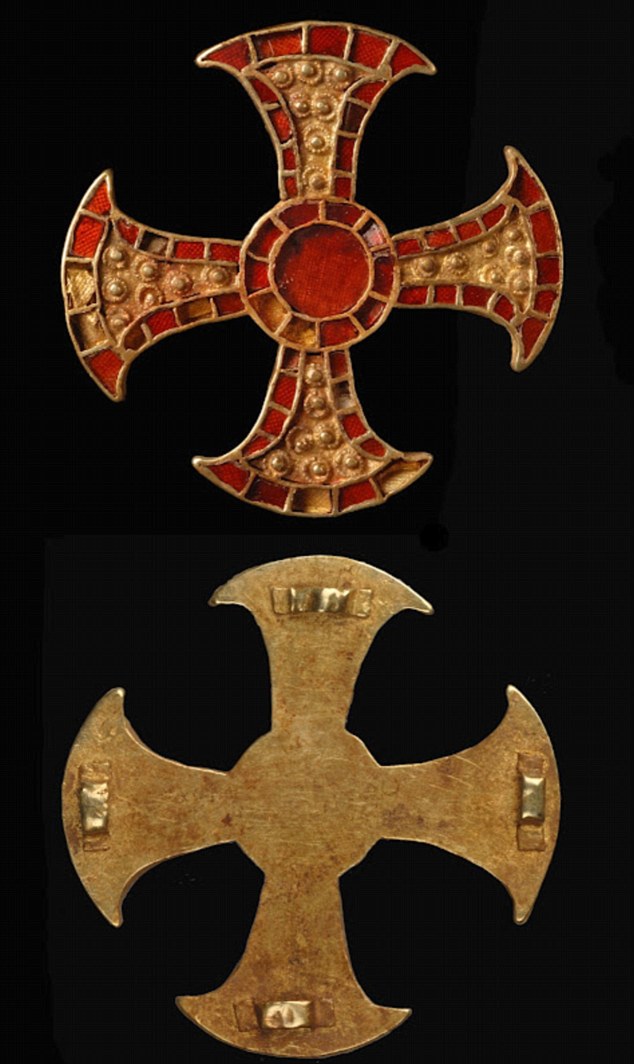
Back to the Ixworth teen and what she was buried with. As a young woman of power in a Christian nation, she was buried with what else upon her chest but a golden cross.

{The cross found as part of the bed-burial in Ixworth. Image from The History Blog.}


Back To Top
Her Golden Cross

The artistry of the girl's golden cross is incredibly fine. The mix of gold base and cut garnets is indeed striking. But, what does it mean?

The cloisonné style (art consisting of multiple cells) of it shows the intricacy that 7th century Anglo-Saxon artisans were capable of, but why gold and garnet?5

Gold has always been regarded as valuable, and indeed the Anglo-Saxons prized it among treasures. A quick read through the first part of Beowulf, where Heorot is described as a hall decked about with the stuff (on line 308) makes its value clear.6

Garnet on the other hand seems more obscure. If you allow there to be a connection between modern pagan practices and ancient ones, then the garnet stone seems to be most closely related to repelling evil and helping with blood flow.7 That such material be used for a cross, and one that was sewn onto the girl's clothes, no less, suggests that it may have been worn for spiritual protection. Perhaps as an aid against the temptations of the world. This works well with the current theory that this girl was associated with a nearby abbey - possibly even as the abbess herself.

Back To Top
Conclusion

So this find is a little bit removed from what's generally associated with Anglo-Saxons. There isn't a great treasure hoard here or a lot of ornate armour or weaponry. Instead, this teenage corpse sheds light on the more refined side of Anglo-Saxon culture. The side that's often lost amidst the images of wenching, ale-ing, and fighting, but that's no less important. For starters, it definitely civilizes the Anglo-Saxons to some degree. It shows that outside of their shield-play and bard-song they had some refinement.

Perhaps this other side's being revealed in this teenage girl's burial is due to a different set of values having been ascribed to women. Not necessarily by the Anglo-Saxons (let's not forget that there were some very powerful Anglo-Saxon women), but within the Christian system that was in place by this time.

In fact, given that garnet was a stone associated with protection, perhaps this young woman was as much a warrior as a male could have been. Only, rather than fighting on the field of grass and dust, hacking through bone and flesh with iron, she was fighting on the field of litanies and vespers, lunging at sin with paternosters.

Back To Top
Wrap Up

What's your favourite archaeological find of all time? Feel free to post about it in the comments.

And check back on Friday for an attempt to find some lasting good in the movie, Battlefield Earth.

Back To Top
References

1. Raphael Satter. "Archaeologists discover seventh-century teenager buried in bed." TheSpec.com. 16 March 2012.

2. "Bed Burial" Wikipedia. 20 March 2012.

3. Bible, The King James Version.

4. "Norse activity in the British Isles." Wikipedia. 8 March 2012.

5. "cloisonné." Merriam-Webster Dictionary Online. 2012.

6. Beowulf in Hypertext. McMaster University.

7. Cresentmoon2007. "Garnet and Its Magical Properties." HubPages. December 2011.

Back To Top

Monday, January 16, 2012

[Moon-dæg] Same-Sex Parents And the Idea of "Family"

By the time that this is posted Christmas will have come an gone yet again, but I still want to take a moment to write about an idea that many associate quite closely with the holiday, at least since the 19th century if not earlier. That idea is family. Simple, direct, easy to figure out. But complex, nuanced, and something tricky to really prove.

The first sort barely really needs any explanation. Blood relations are family for sheerly biological reasons at the least. It's our gene pool and we're swimming in it constantly. Even if you differ from your parents in some way or another, barring a negative paternity test, they are the ones who conceived, bore, and (probably) raised you. But this would be an uncharacteristically short entry if I just ended it here.

What about the families that are based on less concrete biological data? Couples that can't have children of their own or who prefer to adopt and do so? Very few would question their being a family in a sense that is on par with those who are joined by clear red or blue lines. There are things in common, the parents raise the children, the children teach the parents in one way or another. The two different sorts of families are very similar.

Now here's the beef in this issue of what a "family" is.

If it's pretty widely accepted that adopted children are as much, legally, morally, and socially, the children of their adoptive parents as biological children are of biological parents then why is there such a kerfuffle around same-sex couples adopting children?

Same sex couples are subjected to the same sort of tests and screenings to ensure that a hopeful adoptive couple must undergo to prove that they are stable and child-friendly. All of the same legal paperwork needs to be completed. And so I really don't see why there is still a societal stigma around same-sex couples adopting children. Or rather, around children raised by same sex couples.

The myth that having two fathers or two mothers will somehow twist a child's mind or morals is entirely unfounded. In fact, I would say that it's as true as thinking that "gay" is a thing that can be cured through prayer and religion. Mental contortion of the sort that covers over biological facts and natures is an amazing human feat, and if we are only using 10% of our brain most of the time it is even more so.

If you have your doubts about how having two same-sex parents take a look at this video.

Granted, the young man making the statement in that clip is one of his parent's biological children. But, speaking in terms of contrast to the traditional nuclear family, that still stands as stark proof that one parent of each gender is not needed to raise to a well-adjusted member of society.

So what's the point of all this? What am I getting at here?

In the end, what I'm working towards is the idea that, yes, the social construct known as the family is changing, but that change isn't a bad thing. Many moral philosophies and religions are based on the family as the microcosm of a society.

Confucianism, for example, teaches that if you want peace in the state you need peace in the family. At the center of Christianity (even if these parents are shunted aside in some sects) is the trio of Mary, Joseph, and Jesus.

There's no doubt that in civilization as it has been known throughout recorded history the family plays an important role. But I don't see the changes to the family (or "attacks on" depending on who you're talking to) as being particularly detrimental to the overall continuation/progress of humanity at large.

In a nuclear family if you strip away the blood ties you have a social system with two authority figures in varying capacities. Plus one or more civilian, if you will, who is to be educated in the ways of the world by those authority figures. And you have this unit in mundane situations through which all of those involved need to navigate and rely on each other in varying combinations to ensure the success of all involved.

Start up something similar, but don't bother with the blood ties, and the same thing remains true. Authority figures. Civilian(s). Situations and interdependence among the units of a society/family.

They aren't very frequent, but every now and then an article about the need to teach younger generations empathy through reading or other in-depth interactions comes in a newspaper or through email. This is really where people concerned with the crumbling of society or harmonious togetherness need to concentrate their efforts.

Families without blood ties between parents and children, or even without a male and a female parent aren't going to steer their children down any more blind alleys than tidy upright goodie ablewife and primington husband, Bible thumpers extraordinaire.

Leviticus doesn't just condemn gays, after all. If you've ever gotten a little trim or shaved your beard you'll also need to get used to searing temperatures and long-lasting torment (Leviticus 19:19 states "Ye shall not round the corners of your heads, neither shalt thou mar the corners of thy beard").

So actually read the Bible, with all of its books and letters and stories, and characters. And really get in touch with narrative and with imagining the joys and suffering of others. After all, that same Confucian maxim about a peaceful family leading to a peaceful state goes further and says that a peaceful individual needs to have a peaceful mind. It's hard to war within your mind when you've read of bloodshed and felt the lines of anguish in a person's face through the lines of text in a book.

Monday, December 19, 2011

[Moon-dæg] December and Religion

The idea behind Monday entries is that they vary along a set pattern, just as the moon itself (Monday's namesake) does. So, seeing as how this Monday the moon will be in its last quarter here in Southwestern Ontario, my treatment of today's topic is going to be more critical than praise-filled, essentially bringing the idea of that topic into a waning state. But what is today's topic?

The idea that there is a "War on Christmas."

Currently living in Small Town Ontario as I am, signs and stickers with slogans like "Keep Christ in Christmas" are fairly common. But the idea that these signs put forth is not entirely as pure or wholesome as those posting the signs and stickers may think.

True. Within Christian faiths Christmas is a celebration of the birth of Christ and is so positioned to turn the symbolism of the days getting longer toward a Christian meaning, but secularizing the seasonal celebrations throughout the month of December has nothing to do with taking Christ out of Christmas.

First, Canada is often touted as a multicultural society. The last time I checked - fairly recently, by the way - Canada is still distinct from the United States and so the approach to different cultures here is supposedly to offer them a safe environment to practice their customs within the law of the land. The recent naqib controversy has stirred quite a bit on debate on this topic, but my point in bringing up multiculturalism here is that it is necessary to recognize that Christians (nominal or otherwise) may have built this country from settling it, Confederating it, and [] it, but they did so not so that it could be a safe haven for Christians only.

Much like our southern neighbours one of the ideas within the Canadian Bill of Rights and Freedoms is freedom of religion. Stephen Harper is a Christian. Sure. Okay. Dalton McGuinty is Catholic. Cool. Whatever. But the idea behind freedom of religion, at least in my own interpretation, is that explicit religion is to be removed from political policies. Religion - the governance of a soul - and politics - the governance of a people - are to be separate matters in that politicians recognize that their constituents are not necessarily all Catholics or Lutherans or Presbyterians or Jewsh or Muslim or Hindu. In this sense policies that keep Christmas and its vocabulary out of the public sphere of a community, or at the least out of a prominent place in that community are not meant as attacks on Christians by some sort of heathen governing body, but rather to remind Christians that there are other celebrations occurring in December that they should be mindful of.

I think that the idea that there is a variety of special events around the time of December also points to a major flaw in messages like "Keep Christ in Christmas." Those who don't celebrate Christmas, because they are of a different religion or of no religion at all, aren't going to care very much about keeping Christ in Christmas. Christians who acknowledge a nativity scene with a nod or a "that's nice," aren't going to need convincing. The signs, it seems to me, are not so much saying "Hey - keep Christ in your minds and hearts Everybody!" as they are "Hey you reading this sign, guess what - the people in this house/car are Christians." It's a kind of print form of the fire and brimstone which I hear in the voices of religious speakers in many debates and talks (for a good example of this listen to Rabbi Shemuly's tone in this debate with Christoper Hitchens at the 92nd Street Y a [listen<--Link] and compare it to his opponent's). Such a tone suggests that an ardent case is being enthusiastically made, but that enthusiasm does little to bring people who are diametrically oppossed to that stance, or completely unconcerned, into the fold. Moreover, this kind of tone does more damage than good in most debates because it puts the one using it in danger of sounding much less reasonable, while also potentially helping an opponent to seem calmer and more well-reasoned by comparison.

My next point comes in the form of an analogy, so brace yourselves.

It seems to me that religious expression that gets into people's faces or that politicians feel so uncomfortable with that they outright ban it from their communities, is a lot like a ball being tossed about violently by a group of kids. A parent comes along and takes away the ball saying something along the lines of "If you can't play nicely with the ball, you can't play with it at all." Just as the kids might feel slighted ("we were just playing!" "come on, just give us a chance!") the religious get upset and start to feel like they're being singled out (hello "War on Christmas"). But I think that taking the ball away is an effective measure. If one religious group is pushing their message in such a way that it seems to be encroaching on other religions, then no one should be able to push a message. Efforts and messages from governments should be secularized.

It's true that a tenets of many sects of Christianity is to go out and tell people the good news of Christ and such, but I think that an being an exemplary Christian is better than being one with some words for those who disagree or differ with you. This rings especially true today, since modern cynicism can be more easily circumvented by actions than by words. People can say anything, but they will only do what they truly believe and have convinced themselves is true. That conviction is what's necessary for Christians to follow their mandate to spread the word, and being vitriolic or pushy about their ball being taken away is much more harmful to their cause than simply putting up a nativity scene or writing "Merry Christmas" in lights on their house or in a window. People will get offended, but if the message doesn't carry the fire of "Keep Christ in Christmas" then those who are offended won't spit the same back.