Showing posts with label Fantasy. Show all posts

Monday, October 29, 2012

[Moon-dæg] The Box and the Monk

Context
The Monk and the Box
Closing

{A mysterious box, and a bit of foreshadowing. Image found on the blog Siblingshot.}


Back To Top
Context

Tonight's story is a bit of a long one, and, as was the case two weeks ago, it is an early version of a short story related to the larger world that I'm building for my novel series. It's something that could maybe be a prologue or first chapter to a novel in the future, but more than likely it will be the first part of a short story told in three parts.

Check it out, and let me know what you think in the comments.

Back To Top
The Monk and the Box

"Come on, Let’s go.”

The light outside stung his eyes. He still remembered his writing desk - filled with notes that he had been copying and illuminating. But that was before the burning, the beating, and the bag.

He had no idea where he was now. only that the sun beat down so heavily as to make his formerly cool robes feel like a bear pelt.

"Hey! No lagging.” The speaker’s foot found his thigh without problem. After all, there was enough of it to strike, but he was glad of the boot's missing his backside. Spending so much of his life sitting seemed to have tenderized more than harden it.

At the least, he reflected, it was good to be able to stretch out once more. Hunching over the illumination desk for all of those winters had never crumpled his back and he continued to enjoy a height that intimidated most other men. Let alone women.

Though that had never been much of an issue. He remembered what his mother had said of him the night before she sent him to the monastery as the men in hauberks and greaves shouted at him and each other.

“All that fine skin. But no grace. And all that great height and no strength. You’re a misshaped one Hugh, but you’re my misshaped one. Maybe that mind a' yours is at least put right.” He remembered her gnarled cane raising to tap his forehead, “Least it never seems to have pointed you wrong. And it gave you the sponsorship of that roving Friar.

Least ways we can send you off to where the misshaped don’t matter long as the mind is sound. You’ll make me proud yet, you will.”
He brushed a lock of hair out of his eyes as best he could. His hands, tied together as they were, looked oddly over-large to him, as if he hadn’t seen them for days or even weeks. Of course, they were all he'd seen - he never was admitted to the Abbot's order, though he had read and heard about the herbs they used.

“Kneel here.” The man leading Hugh pulled on the rope tied to his bound hands and he fell forward. Unable to catch himself his face broke his fall. He thought he could smell blood, but when he opened his eyes he saw that the flagstone he knelt on was only splotched with dried red patches.

All he had wanted was to be as his elder sister was. Kind and shapely, admired by all - even if, as the brother Olaf had told him in confession, that admiration was only with the eyes. “Eyes make better company than mites.” Hugh had mused to himself then, though he never uttered the words aloud. Only when he was in his cell, struggling to sleep on a bed lengthened with uneven stones. A place whence he knew himself to be entirely alone.

That was still all he wanted, admiration of any sort. But the other brothers only gave congratulations and the Abbot only a wry smile whenever he saw Hugh’s illuminations. Hugh could appreciate their thankfulness for his gifts, but still felt unfulfilled by it. He wondered if any of is work would have survived the fire. He wondered if hoping to find out would help him to do so.

“Say these words.” The rope was yanked again and a piece of parchment was thrust into Hugh's face. Hugh reocgnized the characters but stared at the shapes before they registered.

Something cold reached under his chin. “You can read, can’t you?” The man’s dagger point pricked the excess skin about Hugh’s throat.

“A monk who can’t read? Maybe one of us might as well try to open the damned box. It’s all ended already.” The voice was new and faceless.
“Shut up, Reg. This needs to be seen with fresh eyes. The wise woman said so.”

Reg muttered something as the sound of steel sliding back into a sheath came from his direction.

“You can read, right?”

Hugh looked up into the eyes of his captor.

They were small beady things that looked like the chapel tower windows as the fire licked through the yard. They may even have belonged to the man that burst into the library chamber and threw him from his chair.

“Yes I can read. The brothers taught me.”

“Good. That saves us from cleaning our damn swords later.” The man frowned deeply. “Maybe. Read it.” He pressed the parchment closer into Hugh’s face.

The words had finally settled and they gave Hugh no challenge though he had never seen many before. The parchment was not written in the common tongue, but in the same dialect as some of the older folios and sheaves that he had worked through. Living most of his life with regular prayers in the language made reading the parchment especially easy.

As he began to intone the words, he felt the kiss of steel at his throat.

"Read it to yourself! None of us want to get caught in this, otherwise we wouldn't need an other!" Hugh dared not look up, but a pause suggested a look passed between Reg and Grenn. When he spoke again, Reg's voice carried with it a low grumble, "just move your lips if you have to. Read it t'your self!"

After Hugh had finished reading and looked up, Grenn looked stymied for a moment before pulling his sword from its sheath and raising it over his head.

Hugh threw his hands over his own as he saw and heard the sword swooshing down upon him. He had seen many falcons and owls strike their prey from above but never before suspected that he’d find himself in the role of the rat.

After the sword flashed in its arc one of Hugh's thumbs throbbed, but his wrists felt freer.

“Grenn. Is that a good idea? Letting him loose like that after all his reading?”

“Relax Reg. He’s not about to go anywhere. Not just yet.” Grenn turned to Hugh. Sorry about the thumb, mate. I’m not so used to being precise with this thing.” His sword was swallowed by its sheath.

Hugh lowered his hands and said “It’s alright. What’s this about a box?” He popped his thumb into his mouth. The blood quenched a thirst he hadn’t even been aware of. The flap of his thumb was still well enough attached to keep, he felt. It’s just the end anyway. He pulled his thumb from his mouth, “what, then, about the box?” He still knelt.

“It’s right there. A thing that only the right person can open, at least so Slovan says. But you’re the closest they ever got.” Grenn threw his thumb over his shoulder. “The rest couldn’t read it. Or plain couldn’t read.”

“So what do you expect me to do?” Hugh rubbed his wrists.

“Open the box”

“Why should I do that?” Hugh tried to stand, but a hand from behind him fell onto his shoulder and pushed him back down.

“Hey now. We can end this well for everyone, if you just open the box. No need to get up so fast.”

Hugh heard steel ring against steel all around him. He noticed Grenn reading the parchment as his lips fell into a solid line.

“Now get up. But take it slow. Slow. Just to the box.”

Hugh made his way to where the box sat step by step. The place was completely walled in, yet but there was no echo. He swore he saw water dropping from the ceiling, but he never heard the sound of dripping. His steps were short and shallow, and he realized that his feet were still bound together.

He stopped at the box and looked at it. A large stone contaier of one sort or another. He reached for its edge but Grenn shouted him out of it.

“Wait. Wait. Here” He handed Hugh the parchment. “Hold it while you open it.”

Hugh searched the man but found no answer in his face. He held the paper in oe hand and dedicated the other to the box’s lid. It looked and felt as heavy as the bell rope in the chapel tower. But it moved so quickly that Hugh wondered if it was fleeing his hand rather than being pushed by it.

As the lid slid away, the box’s interior was revealed. A hollow dull space, occupied only by a bundled folio.

Back To Top
Closing

That's it for this blog until my review of The Room and Annotated Links #24 are posted on Friday and Saturday respectively, but don't miss out my Latin and Old English translations and commentaries on Tuesday and Thursday over at Tongues in Jars.

Back To Top

Saturday, October 27, 2012

[Sæternes-dæg] Annotated Links #23: Chameleon Communications

1. Anders, Charlie Jane. "What would a Random House/Penguin merger mean for science fiction and fantasy?" io9 25 October 2012. Web. 27 October 2012.

Anders offers a handful of insights into what a merger of Penguin and Random House might mean for publishers, imprints, writers, readers and those aspiring to be writers. She also includes a link to an in-depth article about what mergers in general mean for science fiction and fantasy, and another link to a 2007 interview with Ace/Roc editor Anne Sowards. This article is written in a easy-going, conversational style.

This one is included, and set into the first place, because the possibility of a Penguin/Random House merger is huge news for anyone keeping an eye on the publishing industry.

2. Sullivan, Tim. "'Gone With The Wind' In North Korea An Unlikely Cultural Phenomenon." HuffPost World: Canada 24 October 2012. Web. 27 October 2012.

Sullivan writes on an array of reasons why Gone With the Wind is so popular among North Koreans. Among these reasons, he gives in depth treatment to the book's Civil War setting and its tough, hardship-enduring characters. He writes in a smooth style and uses a handful of quotations to underline his article's narrative quality.

This one's included because it's a great example of how cultural products can cross cultures and end up thriving in places that you would simply not expect.

3. Peng, Kan. "How to hard sell China's soft power." China Daily 26 October 2012. Web. 27 October 2012.

Peng begins by summarizing the Psy/Gangnam Style phenomenon, how social media has played an integral part in the phenomenon's popularity, and how the phenomenon has helped to promote South Korean culture and products across the world. He then moves into how China has tried and failed to do promote their soft power via cultural exports in the same way, but have failed because they've kept their attempts too official. Peng writes in a punchy, to-the-point style.

This article is included because of the contrast that it sets up between two nation's strategies for increasing their soft power. This contrast underlines the usefulness of pop-culture.

4. Rector, Gene. "'Science fiction' becomes 'science fact' following Utah test." WRWR The Patriot 23 October 2012. Web. 27 October 2012.

This is a brief article about a new microwave emitter-equipped missile (called CHAMP, or the Counter-electronics High powered Advanced Missile Project) that is designed to disable electronics. According to the article, the titular test in Utah saw this technology not only shut down all of the computers in a target building but also the camera recording the experiment.

As a technology article amongst articles about books and publishing, this one might seem out of place. However, at its heart it's about a missile that has the potential to take out communications systems - and what are publishing and books if not just friendly means of communication?

5. Perlow, Jason. "Computing's low-cost, Cloud-centric future is not Science Fiction." ZDNet 21 October 2012. Web. 27 October 2012.

This article looks at Stanley Kubrick's 2001: A Space Odyssey and Ridley Scott's Blade Runner as examples of futurism. Specifically, Perlow goes over the aspects of each movie that, some 50 and 30 years before the present, accurately depict technological aspects of our daily life and those elements of the movies that aren't here just yet. Perlow writes in an expositional style, using a generous number of links to his own and others' writing.

This one is included because it shows the importance of fiction as a way to explore ideas that seem far removed from reality, just one of fiction's enduring uses.

Back To Top
Closing

That's it for this week in the blog, but check back here next week for another short story draft, a review of the recent cult classic The Room (Monday and Friday), and, over at Tongues in Jars, more of "Dum Diane vitrea" and Beowulf (Tuesday and Thursday).

Back To Top

Monday, October 15, 2012

[Moon-dæg] From A Ship's Crow's Nest

Context
Blue Bricks
Closing

{A replica of a medieval ship. Image found on the Seasalt Cornwall blog.}


Back To Top
Context

Today's story is one of the many shorts that offers some insight into the backstory of the fantasy series that I'm currently working on. In fact, it's a kind of world building story, in the sense that it (once it's as finished as it can be) will offer a glimpse into a major aspect or two of my created world.

To date the process of writing this series has been drafting it book by book (as a "discovery" writer) to figure out how the world works. However, after taking a fair bit of time off from writing this series during my MA, I've gotten to the point where the discoveries made by writing the larger books need to be refined through shorter stories. These shorter stories will also, ideally help me to see how these aspects of the world I'm creating can feed back into the five books of the series.

This story was written based on a prompt at the local writing group, and just evolved from it. The prompt was to write a story in which each paragraph starts with a colour. It's still a draft of sorts, but much of what the story is is already here.

Back To Top
Blue Bricks

Blue bricks are a rare sight but still seen. The walls around the island city of Shev have them near their bottom, though other sailors said they were just turned that colour by the sea.

Ermina believed instead what some of the Shevites themselves told her. That the blue bricks around the bottom of their city's wall were made of the purest stone found in all the caves that wended through the cliffs over which the city sat. Caves where the more superstitious among them said they would never dare to tread. But even from her place at the top of every ship she ever sailed in, Ermina had never seen anything beneath the city's walls but breaking waves. Part of her wondered about the stories she had heard in the city's inns where the crews she had been with stayed. She believed what she would about the bricks, despite the evidence of her eyes, but the stories were always such a deep red.

She knew that red stories were not necessarily better than any other, but she loved them the most. They almost never moved at a slug's pace. Since she was a child the red stories always moved faster than gulls diving for fish, and their heroes and villains always came up from the plunge with their prey.

Ermina watched such gulls now. They looped and glided, all immaculate white tipped with grey, yellow and orange. Not the kind found around lakes but the sort that would give dull old hawks fair competition - the sort found by the sea, flying between white sails, white masts. She wondered why the place where she stood, her arms on its railing, was even called a "crow's nest." She'd never seen any crows flying out at sea, or even heard stories of such things.

The gulls's cries drowned the waves' crashing against the ship's side. The ship's sides that were still the colour of the meadow honey they made on the Kael Isles, despite recent layers of pitch. While the familiar sound of someone climbing rung over rung snuck in beneath that of the gulls she imagined herself back on those Isles.

“We’ve only just reached the green water and already this one is off beyond the Crumbs.”

Ermina stirred. “Oh, Cyril. There’s not as much to see out there as you and yours’d like to." She didn't bother to turn or straighten from her place at the nest's edge. "What’s got you up here?”

Cyril looked back down the way he had come. Beneath him the ship’s sides rose and fell. “Just to remind myself that even green has its limits.”

“Your maps'd tell you that just as easy.” She turned back to the water. “What’s the real reason?”

"We are bound for Shev. I thought you should know."

Ermina hunched her shoulders. "I already know. I'll get another look at those blue bricks, and hear some more stories about the creatures or gods or demons that gave them."

"And?" Cyril fingered a loose thread in his sleeve.

Ermina said nothing. Why does he press me on this? "And I'll be sure to shout down real loud when I see it all."

Ermina heard Cyril's leather jerkin creak before she heard any of his footsteps back to the ladder. She refused to look back, though she knew that he would linger before heading down. When she finally straightened and turned, she could hear him back down on the deck, giving commands and sending orders. She tried to think of the best red story from past voyages to Shev, but could only fear that with Cyril along the only one to be told would include them both.

Back To Top
Closing

Check back here on Friday for Part Three of Shocktober, a peek into the perils of Silent House. For mid-week stuff, check out Tongues in Jars on Tuesday (Latin) and Thursday (Old English).

Back To Top

Saturday, September 22, 2012

[Sæternes-dæg] Annotated Links # 18: Cultural and Career Vehicles

1. Skelding, Conor. "K is for Kapital, and Not in a Marxist Way." BWOG 22 September 2012. Web. 23 September 2012.

Professor John Lie gave a talk at Center for Korean Research’s Colloquium Series on Korean Cultural Studies in which he didn't speak about K-Pop. Instead, Lie spoke about how Korean pop music is an entirely market and capitalist driven endeavour that is hollow culturally. His evidence is all of the financial backing that the industry receives and its stark contrast to Korea's straightforward and simple traditional music.

This piece is written in a casual style befitting a blog, but with authority. It's included because I find the different perspective on K-Pop's importance refreshing.

2. Cho, Chung-un. "Hallyu can help spread Korean: Minister." AsiaOne 18 September 2012. Web. 23 September 2012.

Choe Kwang-shik, Korean Culture Minister, claims that the world's initial interest in K-Pop is spreading to other cultures. Yet, he posits that even more important than the spread of K-culture in general is the spread of the interest in the Korean language, what he calls the "most important cultural product."

Written in a direct, journalistic style, this article is included because it celebrates the Korean language, a thing truly worth studying.

3. Sofge, Erik. "What Would a Starship Actually Look Like?" Popular Mechanics 20 September 2012. Web. 23 September 2012.

Real physics and space dangers are considered in what an interstellar ship might just look like. The fact that there is no air in space, and so aeordynamics aren't relevant, as well as the problem of space dust perforating sails and hulls because of ships' high speeds are among the things considered.

Sofge wrote this piece in a technical style, but in a tone that is readable - even if some of its paragraphs tend toward lumpiness. Its included because the realities of space-travelling vehicles are excellent things to know for writing science fiction.

4. Hanna, Jeff. "Fantastic Poetry: W&L's Wheeler Uses Terza Rime to Spin a Sci-Fi Story." Washington and Lee Universities: News and Media 20 September 2012. Web. 23 September 2012.

Leslie Wheeler, the Henry S. Fox Professor of English at Washington and Lee University, has just published a collection of speculative fiction poetry. The title poem ("The Receptionist") is set in a fantastical academia, where fantasy creatures and figures stand in for the usual group found in universities.

This article doubles as a light overview/review of the collection and an informative piece. It's included because I find it encouraging that something close to one of my own projects has been carried out and published.

5. Hagy, Jessica. "20 Ways to Find Your Calling." Forbes.com 26 June 2012. Web. 23 September 2012.

This article gives readers a list of 20 questions to ask and things to think about to figure out what you want to do with their lives. The things on this list aren't earth shattering but they're the sort of things that can help to shake loose what might be rattling around in your head.

Written in a casual, easy-going style, this article is included because it offers a way to potentially figure out where your natural skills lay.

Back To Top
Closing

Check back here tomorrow for the week-in-review/week-ahead entry!

Back To Top

Sunday, September 16, 2012

[Sunnan-dæg] The First of many Lights

Welcome to the first Sunday Edition of A Glass Darkly.

In keeping with the themes of my other entries in this blog, since Sunday is named for the Sun, these entries will shine a light on what I did related to my writing over the previous week, while also using that light to peer ahead into the next. Yes, there will be lists, but there'll also be a little bit of description. Let's get to it.

As you might remember from the last "Update Entry" I made, I wrote that I was going to provide an update every three days rather than every two. That was back on Monday, and so things have sort of slackened on that end of things.

However, I'm now yanking that slack and drawing in the last parts of that blog update for this Sunday entry. So, in the future, those sorts of blog updates will come out every Sunday. In the meantime, these entries will be all about my writing efforts.

Over the past week, here's what I've done for the sake of my fiction and poetry writing:

  • Re-organized the schedule of A Glass Darkly to better accomodate my fiction and poetry writing;
  • Come up with the climactic moment for my current fantasy novel (Working title: Dekar 4);
  • Made notes for a number of short stories;
  • Done some world building for that fantasy series I'm working on (the world's cosmology, history, and magic system, specifically);
  • Compiled a list of Canadian science fiction magazines.

As a refresher, here are the things still outstanding from the blog update of August '12:

  • Send out two short stories to magazines
  • Outline entirety of the fantasy novel I'm writing
  • Completed 10 of those chapters
  • Completed the next act (4 scenes) of an audio drama I'm working on

It's my hope that I'll have all of these wrapped up come next Sunday.

Until then, don't miss tomorrow's creative writing entry and Friday's look at Luke Wilson and Samuel L. Jackson's Meeting Evil here at A Glass Darkly. Plus, on Saturday, you'll be able to find the newest "Annotated Links" here as well.

And keep an eye out for Tuesday's translation of a poem possibly written by Peter Abelard (of the famed pair of star-crossed medieval lovers Héloïse and Abelard), "Dum Diane vitrea," followed by Thursday's look at Beowulf's burial instructions at Tongues in Jars.

Oh, you might also have remembered that I mentioned a video game blog that I'd be starting up soon. I still intend to start it sooner rather than later, so watch for a link in future entries.

Back to Top

Friday, September 14, 2012

[Freya-dæg] An Audience With Your Highness

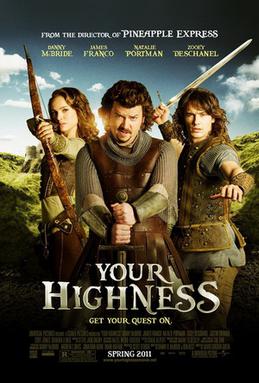
{Your Highness' movie poster, found on Wikipedia.}

Plot Summary
The Good
The Bad
Judgment
Closing

Back to Top
Plot Summary

There is an ancient prophesy in the land that says that if a great warlock can lay with a virgin when the two moons meet, he will create a dragon. The Order of the Golden Knights has stopped the warlock before, but many years later all of the knights of the Order have been wiped out, a great warlock has arisen and the moons begin to converge.

Of course, none of that matters to the brash prince Thadeous (Danny McBride), son of King Tallous (Charles Dance) and brother of the all-favoured Fabious (James Franco). He's about as concerned with prophecies and quests as a bear is with a block of cheese. But when his brother returns from yet another successful quest with the virgin Belladonna (Zooey Deschanel) only to have his wedding crashed and his bride carried off by none other than the great wizard Leezar himself (Justin Theroux), Thadeous is forced by his father to join Fabious on his quest to save his bride and ultimately the kingdom.

Will Fabious be successful in averting a doom that will envelope the land, though he is beset on all sides by villains both traitorous and bad? Will Thadeous grow to be more than a spoiled bawd of a king's son? Or will Lazeer prevail?

Only by watching can you find out if this disparate bunch of questors can break Leezar and make him scream Your Highness!

Back to Top
The Good

Your Highness's cast is simply star-studded. Zooey Deschanel, James Franco, and Charles Dance — all of them have sizeable roles in the film and bring all of their acting chops to bear on the film as a whole. What's more, even the lesser known Danny McBride does a great job as Thadeous.

But what really sends this movie over the top in terms of the acting is the sheer devotion that all of the players show to keeping things medieval. The dialogue, the delivery, everything is nicely tinged with the very stuff of high fantasy. It isn't necessarily accurate to actual historical fact, but neither are many high fantasy stories, and neither are many of the medieval romances on which they're based - something which this movie gets quite close to being.

However, rather than being written by some gallant-minded self-styled bard, Your Highness is closer to what might have come about had Geoffrey Chaucer ever wrote a non-historical verse romance.

The movie's writing is also quite strong, and though the plot develops in a more or less expected way, there are enough fantastical elements to keep your interest throughout all of its 100 minutes.

The movie also nicely straddles the line of satire while also keeping the movie's illusion in tact. Watching it, it's very easy to get the sense that the actors know that they're playing in roles and through ridiculous situations, but they maintain their act all the same. The fourth wall is left firmly in place, so much so that the best analogy is that this movie is the way that players of a D&D game might imagine their own games as they're playing them.

And, just like many a D&D game, the movie has some unexpectedly dark moments, such as when the quest seems to be entirely hopeless and Fabious exclaims that "Belladonna will get raped and die" if they don't get to her in time.

But, most importantly, setting this movie apart from In the Name of the King, is that nothing in it is contrived for the sake of action or a good laugh. Instead all of the jokes arise out of the characters' personalities and the setting itself.

Back to Top
The Bad

However, Rotten Tomatoes' consensus on this movie does have it right - the jokes here are almost all based on the same theme. In this regard it's kind of like something that Trey Parker and Matt Stone might have written, and it does run the risk of getting a little thin by the end. Though that remains as only a risk.

Also, there are some things in the movie that are pretty outlandishly off when it comes to medieval culture, even that of a fantasy realm. Such as this:


Powdered wigs and pale faces weren't quite a male fashion statement until the 18th century, which is just a few centuries too late.

There are also some elements introduced early on in the movie that could use some more explanation: Thadeous' distaste for mechanical things (focused entirely on his brother's mechanical bird companion), and why the "triangle face" that Courtney (Rasmus Hardiker) pulls scares him.

{The horrific "triangle face" in action.}


However, as the film picks up and goes on, these things are forgotten by viewer and writer alike. Adding them into the development of Thadeous would have made this movie all the stronger, though. Perhaps, in fact, instead of just temptations to indulge himself, he could have had to face a mechanical being with a "triangle face" in the labyrinth where he and the party find the Blade of Unicorn.

Back to Top
Judgment

Your Highness is a grand farce of a medieval romance comedy. The humour can be overbearing, but the actors, the script, and the chemistry between them all keeps things going at a lovely trot from start to finish. What's more, this movie passed one of the ultimate tests: it was as fun to watch a second time as it was the first.

So, Freya, don't mind the lewd way in which this one comes on to you as you scoop it from the Field of Fallen Films, nor its lascivious words as you fly with it from there to where all great movies deserve to be.

Back to Top
Closing

A Glass Darkly is going to be undergoing some changes starting next week.

Monday's and Friday's entries will continue as usual, but instead of Annotated Links throughout the week and an editorial in the middle, Annotated Links will be moved to Saturday and expanded to five links from three. The editorial is being dropped and will be replaced with a brief update on my writing endeavours that goes live every Sunday.

Check out the first of these Sunday entries on the 17th of the month!

Back to Top

Friday, September 7, 2012

[Freya-dæg] A Good Reason to Swear In the Name of the King

{In the Name of the King's's movie poster, found on Wikipedia.}

Plot Summary
The Good
The Bad
Judgment
Closing

Back to Top
Plot Summary

Trouble is brewing in the land of Ehb and realm-wide unrest is afoot. Though usually unarmed and disorganized, hordes of Krug are ravishing the land, destroying villages, and, strangest of all, taking prisoners. Duke Fallow (Matthew Lillard), the nephew of king Konreid (Burt Reynolds) may have a hand in these goings on. Or perhaps it is the mysterious magus Gallian (Ray Liotta), who has secretly taken the warrior/enchantress Muriella (Leelee Sobieski) as a lover who is pulling the strings.

All that's clear is that amidst this strife the humble Farmer (Jason Statham) seeks only to live a quiet life with his wife Solana (Claire Forlani) and son Zeph (Colin Ford). This idyllic life doesn't last, however, as it's not long before the Krug attack Farmer's village.

Now, with his family dispersed, and a desire to restore order to the land in his own way, Farmer sets out with Norrick (Ron Perlman) and Bastian (Will Sanderson) to set right what seems to be so very wrong.

Will this trio be just another group stricken down by powers beyond mortal control, or will they be the ones to catch the villain behind it all and cry "Stop, In the Name of the King"?

Back to Top
The Good

In the Name of the King boasts some of the best acting talent in a fantasy movie (not based on any written/drawn work) of recent memory. We've got Jason Statham on action, Ron Perlman and John Rhys Davies (the king's magus, Merick) on all-around-awesome, Matthew Lillard on ham, and Burt Reynolds on kingly bearing. It's a great ensemble and quite a treat to see them all together.

Plus, Statham in the role of Farmer, gets into the thick of some pretty good action sequences, but more than anything he weilds a boomerang in this movie. A boomerang. He definitely must have stopped off at his local wind temple before the events of this movie began.


What's more, this movie was filmed in Hollywood North - Vancouver and Victoria British Columbia, Canada. And more business for Canadian film is always good, right?

Back to Top
The Bad

As you might have guessed from the lack in the previous section, this is not a movie with a lot of inherent redeeming features. So, let's start working through where this one failed, starting with the most nit-picky and working our way toward the more general of the film's flaws.

First and foremost, sumptuary laws, the medieval codes governing the clothing colours and styles and accessories that can be worn by different parts of society, are not observed.

Solana, Farmer's wife, is the worst violator of these laws. Not only does she have her face done up to look like a noble woman throughout the movie, she also wears purple throughout the movie. Peasants were not allowed to wear purple under most medieval sumptuary laws since it was considered a regal colour. Therefore, either she is a noble woman and we're never told about it, or she's a peasant and somebody on this movie's production team didn't do their research.

Similarly, Statham's use of a boomerang can slide, since for a medieval (European) setting it's a nice exotic touch. But, his possession of a sword, even if it looks like an old and worn one, wouldn't be permitted. Medieval law restricted the ownership of swords to the noble classes, partially as a status symbol and partially because they could be expensive to make. Now, a counter-argument could be made here, but it involves spoilers. So, skip the next paragraph if you'd rather not have this film's plot ruined.

<*spoilers*>It turns out that Farmer is the son of the king. This makes him a noble by blood, and therefore allows him a sword. But, the thing with that is, he isn't recognized as the king's son until a fair bit of wrangling goes on in the last third of the movie. Up until that point he is, even in his own mind, just a peasant, and therefore has no business owning a sword.

Speaking of the classic medieval weapon: Though they make for decent spectacle, the movie's sword fights are far too simple.

Instead of the movie showcasing sword-fighting as an art, what the movie shows is more of the hack-and-stab school of swordfighting. This style kind of works for Farmer, since, even if he's always had his sword, he may not have ever learned how to use it, but the generals, soldiers, and wizards in the movie definitely ought to be beyond the most basic of sword strike-sword counter drills that are prominently featured in each fight.

Perhaps the action choreographer (Tony Ching Siu Tung) was going for a simpler, grittier style of sword-fighting to match the grit implied by the movie's generous smatterings of greys and browns, but people who fight with swords for a living aren't going to make wide, large, unnecessary swings - they're going to make precise, small, movements that give them exactly the power, energy, and force that they need in any given situation. And, when life-long swordsmen and women make such movements, they're going to look far more graceful than they do in this movie.

Now, it must be granted that the movie's actors all get a fair shake at showcasing their talents in a fantasy setting, but Ron Perlman is cheated in this movie. <*spoilers*> Norrick dies near the end of the movie, but we're not given any kind of scene centering on this. We see him get hit, we see him go down, and then we see Bastian, who's with him, declare that he's dead. There's no big speech, there're no tear-felt last words, Perlman's Norrick just dies and then that's it.

Also, more a matter of casting or make-up than acting, Ray Liotta's Gallian shouldn't be in command of planar magic, he should be too busy with a show in Vegas to learn such things. Just look at his mug:


Moving from acts, action, and acting, to the movie's screenplay, it's about as solid as the non-existent forest canopies that the movie's Amazonian elves use to swing down from during a major battle sequence.

As a writer, I can understand any storyteller's fear that loading the beginning of their story with exposition will leave audiences confused, disconnected, and disinterested. But that doesn't mean that you should put most of this exposition (especially those things that you could use to lead to some really amazing plot and character developments) into the last 20 minutes of your movie.

Nonetheless, in In the Name of the King, it is within the last 20 minutes that we learn how the world's magic works, that Gallian somehow made himself king over the erstwhile kingless Krug, that there are only two magi left in the world, that magi can transfer their powers to one another, and that Farmer knows what to do with a sword both in melees and in single combat.

Putting all of this up front, or at least spreading it out could have made the movie much more interesting. Instead, what carries us forward through it is the promise of action and nothing else. What's more, we never learn anything about the world, outside of what we learn in those final 20 minutes, that relates to anything that isn't directly involved in the story.

{Not Isengard.}


Adding insult to the injuries already inflicted on its audiences' sense of taste, the movie rips off Lord of the Rings fairly openly. Galleon's keep is practically Isengard, and the Krug seem to be multiplying beneath it, just as orcs do in Sauroman's domain. Star Wars is also plagiarized, but there are already dozens of movies with protagonists whose fathers turn out to be very prominent figures.

Rather unsurprisingly, In the Name of the King also suffers from something I like to call Titan-itis. This movie malady is named for Clash of the Titans and Wrath of The Titans since both of those movies focus almost entirely on their male characters and their relationships, only bringing female characters into the story when necessary for romantic or plot reasons.

In the Name of the King does the same thing. It may even have a worse case of this illness, since Muriella, a capable, strong woman (warrior/sorceress) seems like she's been torn right from the pages of medieval romance, but she is never actually shown doing anything in the realm of men.

And, topping off all of the movie's shortcomings, its relative production values are likely trumped by those of the two Blind Guardian songs that play over its credits.

Back to Top
Judgment

Epic fantasy movies are a difficult bunch. Other films in the genre, like Labyrinth, or The Never Ending Story, have it pretty easy since they weave their worlds carefully, draw their audiences in, and tackle some dark themes while being disguised as "kids' stuff."

In the Name of the King does none of that.

Even worse, In the Name of the King has almost no redeeming qualities if looked at as a whole. Its storytelling is backwards, its dialogue is awkward and out of place, its world is poorly constructed, and its characters, unfortunately, show almost no growth whatsoever.

Even after becoming king, it seems that Farmer just stays as he is. In fact, aside from Farmer's new title, things will probably wind up as they were at the movie's beginning since Gallian, upon delivering one of the movie's weirdest lines to Solana ("I can feel him in you"), reveals that she is carrying another of Farmer's children.

The movie's action keeps it going, but if you happen to turn your brain on at all during the proceedings you'll quickly find that doing just about anything other than watching this movie would be a better use of your time.

So Freya, avoid In the Name of the King at all costs, and let it rot where it lay. The Field of Fallen Films is truly the best place for it, though even there it may keep some of the others from fertilizing the earth beneath them.

Back to Top
Closing

Check back here next week for a look at another ill-thought of fantasy movie, However, if you really want to see a good underdog fantasy movie, check out Your Highness.

Also, the blog update continues, but it doesn't look like my regular entries will become regular again just yet. Follow me on Twitter (@the_penmin) or follow this blog via email by typing yours into the box to the right of the top of this entry to keep on top of the happenings here at A Glass Darkly!

Back to Top

Friday, August 24, 2012

[Freya-dæg] All-Request August Pt. 4: (Legend of) Earthsea

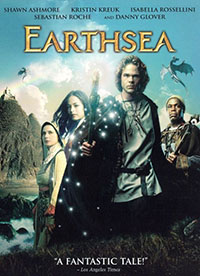
{The Legend of Earthsea's DVD cover, found on Wikipedia.}

Introduction
Plot Summary
The Good
The Bad
Judgment
Closing

Introduction

Normally, I don't do things that aren't movies, but when a request for the Legend of Earthsea (later shortened to Earthsea) came through, I simply could not refuse. Ursula K. Le Guin is a master of the crafts of fantasy and science fiction, and anything based on her work is something that I was sure I could find some good in.

So, let's see what I came out with.


Back to Top
Plot Summary

Ged (Shawn Ashmore) is a typical young man living in a small village. He's skilled with magic and learning from a local wise woman while his father (Dave 'Squatch' Ward) tries to corral him into blacksmithing. Amidst it all though, Ged would rather be spending time with his best friend, Diana (Erin Karpluk). However, beyond the island of Gont, trouble brews. The king of the Kargides, Tygath (Sebastian Roché), is plotting to bring all of the 1,001 islands of Earthsea under his command for the sake of peace.

The king's campaign eventually brings him to Ged's village, where the young wizard uses his wiles to outwit the king's soldiers, but at a terrible cost - the loss of his place as a mere blacksmith and the fulfilment of his greatest desire: to be somebody known and important.

With the promise of his powers pulling him onwards, Ged is thrust into a world of magic and wonder that he cannot begin to comprehend. At the same time, the Kargide king's plan to seize an ultimate, dark power from an order of priestesses is in full swing. Can Ged learn to control his power in time? Will the Kargide king's evil schemes come to fruition? The answers are sure shake all of Earthsea!

Back to Top
The Good

The mini-series begins with some typical fantasy things: the village boy with great hidden power, a mysterious old wise woman, and a call for adventure (some key ingredients in Joseph Campbell's theory of the "Hero's Journey"). Yet these elements are presented in a way that develops them.

We see Ged and Diana (with some of the best chemistry in the series) live out a relationship that's similar to Link and Saria's in The Legend of Zelda: Ocarina of Time.

In fact, the scene where Ged and Diana part ways is just as effective as that in which Link and Saria do the same. We also see Ged and his father's relationship very quickly develop as the two are brought into conflict over the death of Ged's mother and their differing views of what's best for Ged. Plus, the introduction of the great wizard Ogion (Danny Glover) is quite well done.

Earthsea's effects are also quite well done, considering that this was produced in 2004 and on the sort of budget that SyFy (formerly Sci Fi) seems infamous for providing its many mini-series.

In some ways these effects are reminiscent of the animations you'd find in Baldur's Gate on the PC, or of those seen in Hercules: The Legendary Journeys or Xena: Warrior Princess.

The effects aren't breathtakingly realistic (for the most part) but they aren't enough to break the magic and wonder that the mini-series is trying to portray.

On that subject, the world's magic is indeed interesting. Being based on the idea of all things having true names, it doesn't go out of its way to be terribly original (the idea was all the rage among Renaissance thinkers), but it does deliver some intrigue here and there.

The matter of Ged's summoning a shadow - a nameless one - is absolutely fascinating. In fact, this might be the single, best-done part of the movie since his shadow, the Gebbeth (Mark Acheson), is a very effective villain. He's just like Ged, but also always lurking and always threatening until the very end. Unsurprisingly, this is one of the few things brought over from the original novels.

The mini-series' climax definitely delivers, largely because it's the only instance of a real sword fight in the whole thing. This brief duel between Ged and the evil king Tygath is a great fight - possibly because it's the only one we see. Nonetheless, it's definitely a good sign when the series' writers and producers don't go and make their hero an instant swordmaster, and when fight choreography goes fairly smoothly.

Back to Top
The Bad

But the same can't be said for directors and those in charge of casting.

The mini-series' major characters (Ged, Tenar (Kristin Kreuk), Tygath, Thar (Isabella Rossellini), and to some extent Ged's fellow wizard Vetch (Chris Gauthier)) are fairly well-cast, but almost every other actor on screen just doesn't seem to be into it.

One of the essential things that an actor must do in any fantasy movie/mini-series is sell that fantasy; they need to become their character more than ever. This need for an actor to get lost in their role is essential because fantasy stories by their very nature ask their audiences to suspend their disblelief. If the actors aren't entirely into their characters or their lines, that disbelief will be awakened.

It's fair to aim the same sort of double-edged comment at the world's magic system.

The idea of "true names" is a good one to work with, but the reason why it was so popular historically is because it was explained. The original "true language" was thought to be some variation of Hebrew (or, in an eccentric case, Old High Dutch) since that's what the Old Testament was written in, or some sort of celestial or angelic language, since lost to humanity.

Regardless of the varying opinion of whatever the true language is, the point is: People latched onto the idea of an original, Adamic language during the flourishing of humanistic thought in Europe because there were logical speculations about which language is the true language. Not so in Earthsea.

Never are we told who spoke the language of the true names originally, nor how anyone learns true names for things (though there does appear to be a wizarding specialty in true names).

Because we don't get any kind of explanation for this concept it falls flat. Magic can be on the edge of logic (and often is), but it's still within logic. If you don't try to explain it, or even simply have a character say something like "that information is forever lost," then it suggests that you just don't care about keeping your magic system logical.

Moreover, late in the mini-series we learn that faith and magic are somehow opposed to each other. This could make sense if it was explained, but once again no effort is made to explain why there's a rift between two things that are ostensibly forms of extreme concentration.

The other major problem with this mini-series is that it simply tries to do too much. Up until the point where Ged leaves Ogion for the first time, we see enough that we can digest and understand and believe. But once he gets to the magic school the mini-series tries to encapsulate more than it can handle.

Where we could have had a fully realized school with a student body that's as dynamic as that in any of the Harry Potter movies, we get one where we only know the headmaster, Ged's fellow wizard Vetch, the bully Jasper, and a bookish girl who may as well have had a spell of silence on her.

{The redhead on the left communicates almost entirely through looks.}


What's more, the other side of the story, that which is going on with the Kargides and the order of priestesses in charge of protecting the seal on the nameless ones just drags and drags and drags.

Nothing of interest or intrigue is successfully accomplished in this plot-line because it's been done before in its entirey, and, what's more, everywhere it's been done it's been done better. Kossil (Jennifer Calvert) and Tygath's plot to force the high priestess into choosing her as her successor so that she can learn the words to break the seal and she and Tygath can become immortal is played out so predictably that it's almost cringe worthy to watch the transitions from Ged's plot-line to that of the order. Though what Kossil does with one of the women she has to murder along the way is kind of interesting.

Back to Top
Judgment

The TV mini-series Earthsea has its strengths and its weaknesses. It presents some decent actors and some curious characters and wraps them in a fantasy world based on one of the greatest works in the genre, but the essential thing to remember is that it's just that: Based on those books.

What the mini-series fails to capitalize on is the main focus of Le Guin's Earthsea: the conflict between Ged and the Gebbeth that he inadvertently conjures. The otherwise cookie-cutter fantasy story that we get is just filler, essentially. Though why they'd want to do this is beyond understanding.

The cost of making a high-intensity drama where a young wizard faces his inner demons couldn't be that large, and the cast of characters could be unaffected, since that wizard and his demons would have to interact to get across what Le Guin's words did in her writing. Yet this is what we get, this is the Earthsea that was committed to film and publicly aired.

It's an all right mini-series, but it just doesn't bring enough of its potential to bear. Alas, like the wizard that never finds a teacher, this mini-series never found a competent team to bring it together effectively. Watch it for its great beginning, cool climax, and excellent magic, but in between these high points be ready to feel like Ged and Vetch do throughout much of the movie:


So, Freya, grasp this one by the hand if you happen to pass over it, but don't pull, lest its muscled and mighty arm come off of its rotting, leprous corpse.

Back to Top
Closing

Next week, check back here for Part Five of All-Request August: a look for the good in This Means War. Also, check back here every two days for updates on the progress of my blogs' updates.

Back to Top

Saturday, August 18, 2012

Why the Blog Break? (Update Entry #0)

My taking a break from these blogs is nothing new. I've done it before a few times but, since each of those breaks has been motivated by an unfulfilled desire to tidy things up and to post new pages, I've decided to stop regular updates to both this blog and Tongues in Jars until I've:

  • Recorded, edited, and uploaded all of the missing translation recordings (over at Tongues in Jars);
  • Created and posted a hyperlinked portfolio page on these blogs;
  • Made all of the titles of entries uniform across both blogs;
  • Sent out two short stories to magazines;
  • Created a central, personal blog on tumblr;
  • Created a Facebook Writer/Author page;
  • Outlined the next 10 chapters for the fantasy novel I'm writing;
  • Completed five of those chapters;
  • Completed the next act (four scenes) of an audio drama I'm working on;
  • Completed my two outstanding commissions;
  • Created a Commissions page (accessible through every blog) to accept new commissions.

I might not be regularly updating these blogs for the next week or two, but I want it to be clear that, despite more than half of the list being indirectly related to my blogs, these blogs (and those reading them) haven't been forgotten. So, as I complete each of these tasks, I'll post an update explaining how the process as a whole is coming along.

Plus, because they're often the most anticipated and the most fun to put together, I'll continue to post my weekly movie redemptions/condemnations while I work on these various tasks.

That said, watch this space for updates on my progress, and for this Friday's attempt to redeem the TV mini-series Earthsea.

Thursday, August 16, 2012

Annotated Links #17: Writing of Rarities and Hard Finds

1. Doctorow, Cory. "Great writing advice from this year's Clarion Science Fiction and Fantasy writing workshop." Boing Boing 14 August 2012. Web. 16 August 2012.

The title really says it all for this one: it's a short collection of some great advice from this year's Clarion workshop. It's written in a straightforward style and includes a link to the blog of Sam J. Miller, one of this year's participants and a stalwart notetaker who's been benevolent enough to post most of his notes online.

Because this one showcases some great writing advice that will probably still be new to you if you've only read how-to guides and gone to a few general writing workshops it's leading off today's Annotated Links.

2. "South Korean writer to take 'Persian Myths Tour.'" Tehran Times 7 August 2012. Web. 16 August 2012.

Briefly relates the plans of Gong Wonkuk, the South Korean "walking mythologist," to visit historical sites in Iran as part of his Persian Myths Tour. It also explains that Gong will give lectures and interviews during his travels, and will ultimately write a book in 10 volumes that summarizes his tour called "Eurasian Myths." The article is written in a bare-bones style with a handful of grammatical and stylistic errors - but nothing that gets in the way of coherency.

This made it into today's Annotated Links because it offers a look into the literary culture of South Korea, and into what one of the country's literati is up to at the moment.

3. Kennedy, Maev. "Soldiers injured in Afghanistan make surprise find on UK archaeology dig." The Guardian 7 August 2012. Web. 16 August 2012.

Soldiers who had returned to the UK after serving in Afghanistan found the remains of an Anglo-Saxon warrior on a dig as part of their rehabilitation to civilian life. Their find is in the area of an ancient burial monument dating from 2000 BC. Because of the thrill of a successful dig, eight of these soldiers are now going on to study archaeology at Leicester University. This article is written in a straightforward, journalistic style.

It's rounding off today's set of links because it shows how transformative discovering something can be. In this case the discovery is archaeological, but I think the same thing can happen if you discover something amazing to write about (as Gong Wonkuk might) or how to write more effectively (following that advice from the Clarion workshop).

Back To Top
Closing

Have your galoshes ready for tomorrow - Part Three of All-Request August will be posted then. This week's movie is the Deep-South horror venture Squirm!

Back To Top

Thursday, August 9, 2012

Annotated Links #15: Refreshing Language, Renewing Knowledge

1. Doll, Jen. "A Dictionary of Despicable Words." The Atlantic Wire 7 August 2012. Web. 10 August 2012.

This is a list of despised words that readers of The Atlantic Wire have contributed. Each word's entry includes a brief description of why it is so reviled. The list and its introduction are written in a conversational, lightly humourous style.

This article is included because it offers a cross-section of the English words that many would like to see left behind.

2. Carswell, Beth. "Singularity & Co: Saving Out-of-Print Science Fiction." Abe Books 8 August 2012. Web. 10 August 2012.

Details how a group called Singularity & Co. is going to start a bookstore online and in Brooklyn, New York that will feature one new, formerly out-of-print science fiction book every month. Each month the group is accepting votes and suggestions on titles to bring back and has pledged to bring back whichever book has the greatest support. The article is written in a straightforward style and includes a lengthy excerpt from Singularity & Co. themselves.

The article is included in this Annotated Links because this project is incredible and deserves as much support as possible. It's also in keeping with today's theme of refreshing old knowledge. If they expand into fantasy, it could make Eve Forward's Villains By Necessity much easier to find.

3. "Cataclysmic volcano wreaked havoc on medieval Britain." Medieval News 6 August 2012. Web. 10 August 2012.

A volcano that erupted somewhere in the tropics during the 13th century is believed to have affected distant London. This eruption may be the reason for the heavy rains, crop failure, and famine noted in thirteenth century records, or so archaeologists who have been baffled by medieval London burial pits believe. This article is written in a crisp, English style of reportage.

Although it's not about language, this article is all about new discoveries altering existing knowledge.

Back To Top
Closing

Tomorrow, be sure to come by the blog and join me for a look for the good in the Sci Fi Channel's Alien Apocalypse.

Back To Top

Monday, August 6, 2012

[Moon-dæg] Fiction in a Melodramatic Flash

Context
A Long-Awaited Kiss
Closing

{Genies are generally benevolent when found in lamps, but what about when found in pens? Image found on askbrianmartin.com.}


Back To Top
Context

Today's piece of writing came from a writing prompt that called for describing multiple simultaneous actions and embellishing those descriptions with the senses. A kiss was given as an example of a scenario, and I ran with that.

Describing multiple things is a great challenge for any writer because of the limitations of the medium. Unlike art, music, or film, words alone can convey one thing at a time (or two, if you count what a word on the page is not saying as well as what it's saying).

This piece doesn't exactly exemplify the ability of the written word to express multiple simultaneous things, but it does introduce a curious plot that definitely deserves expansion.

Back To Top
A Long-Awaited

Their eyes met and locked shortly before their lips. She noticed that he closed his eyes seconds before she did so herself, but she didn't mind. An extra few seconds, however short, of gazing into his kaleidoscopic hazel eyes, knowing that his lips were already closed around hers - just as their arms, and shortly she blushed, their legs, perhaps, were - heightened all of her senses.

That's why, as their lips locked, and their eyes closed, she finally noticed a pen in her pocket jabbing into her leg. It can't be drawing blood, no - she thought, struggling to keep her arms around his shoulders, her hands at the middle of his back.

But if it's jabbing me that must mean it's open.

And if it's open...

The stream of her thoughts hit a rock as she felt their lips parting slightly and his tongue edging through them. She sent hers to meet his, but wondered if she'd done it too quicky, if she'd maybe thrown him off. She soon realized that such was not the case.

Oh well. As long as he's distracted he won't notice me being distracted. Maybe I should just tell him.

As their tongues embraced and broke apart and embraced again, she thought she caught a whiff of ink. She mentally waved it away and tried to relax her shoulders, her thighs.

Yet, as she felt the rush of the outside air coming into her mouth from over her teeth and past their tangling tongues, she imagined herself pulling away, looking at the man as seriously as she could, and telling him that they needed to stop what they were doing right away because an interdimensional menace might have escaped from a sealed click pen she kept in her pocket.

The image lingered.

No. No that just wouldn't do.

Back To Top
Closing

Check back here tomorrow for Annotated Links #14. Come Wednesday, I'll have posted the editorial, and on Thursday watch for Annotated Links #15. Then, Friday will see the uploading of Part Two of All-Request August: Alien Apocalypse.

Back To Top

Wednesday, August 1, 2012

[Wōdnes-dæg] Fantastic Fantasy and the Grit of Popularity

Introduction
The Article Summed Up
Fantasy and Cynicism...Hand in Hand?
The More Names, the More Things
Closing

{Who is the knight standing over, and will he or she hang as well? Image found on the blog A Fantasy Reader.}


Back To Top
Introduction

The subject of today's editorial comes from the website Fantasy Faction - a site that hosts articles, interviews, reviews, forums, and a podcast that are all about the fantasy genre.

This article by Douglas Smith caught my eye because it attempts to explain the current trend away from "classic" tales of black-and-white good versus evil in modern popular fantasy. The article also grabbed my attention because it speaks to the variety that can be found in the fantasy genre.

These elements aren't just interesting, but are also quite relevant to me since I'm in the midst of writing my own fantasy universe into existence.

Back To Top
The Article Summed Up

In his article Douglas Smith notes the growing popularity and presence of gritty, realistic fantasy and tries to explain it.

Quite deftly Smith looks at the trends in entertainment more generally, and concludes that what we watch and read to relax as a whole has become grittier as the world around us has changed into something a bit grittier, too.

Gone are the days of massively popular soap operas and police procedurals, and now things are more about characters so real we might bump into them on the street and involve plots so intricate that it's as easy to become entangled as it is to become immersed.

Smith concludes with the statements that writers of gritty fantasy are reinvigorating the genre, that it's cool to read fantasy again, and that this might just be "a second 'Golden Age' for fantasy."

Back To Top
Fantasy and Cynicism...Hand in Hand?

As far as its explanation of why gritty fantasy is now popular goes, this is a great article.

The world certainly has changed, and, as those of older generations have said from time immemorial, it may actually be worse off (in some ways). Technological advances aside, events like "9/11" have made people more readily dubious of others and paranoid enough that fear could now be considered a small animal living in most people's heads as much as a human emotion.

Older stories that follow a straightforward plot and shimmering, clean-cut characters are definitely no longer enough to put this animal to sleep for a time so that the human host can truly enjoy an escape.

Instead, worlds and characters need more depth. In fact, this might be an analogue to the extra cynicism in a lot of people's worldviews. Just as more scrutiny and attention is paid to the real world and goings-on therein, so too in entertainment are characters and plots under more and more scrutiny.

The best way to meet that scrutiny, so far, has been to present things that are more layered and more like the world that can be seen all around. Instead of escaping into worlds that contrast the real one, the increasing popularity of gritty fantasy suggests that people are more willing to escape into worlds that are like their own.

Back To Top
The More Names, the More Things

Another factor to consider when looking the rise in gritty fantasy is the ever-increasing drive to categorize literature and entertainment. Particularly, the urge to separate the "adult" literature from the "children's" literature.

Both fantasy and science fiction have always been perceived as children's literature.

They aren't set in the real, contemporary world.

They aren't written by those who aspire to write capital-L literature.

But at the same time, there have always been adults who enjoy fantasy and science fiction more than other forms of not-true stories. These adults would read Frank L. Baum, they would flip through Asimov, they would delve into the world of the Harry Potter series.

At times these stories, labelled as being for "children," would be adapted into re-tellings or versions that were more "grown-up," and at other times they would be distributed with darker, more "adult" covers. Anything to appeal more directly to those who were outside of the original key age demographic but nonetheless liked what they read for whatever reason.

Enter gritty, realistic fantasy.

Just like that, there's now a fantasy sub-genre for adults, those who'd been generally perceived as "too old" for stories about magic, heroes and villains, Good and Evil. And where there is a supply to fill a hitherto unfulfilled demand that supply will soon prove insufficient.

After all, give something a new, more specific name, and those previously too shy to admit to liking that something under it's old, general name (let's say fantasy) will come out and help push demand even further.

Back To Top
Closing

Don't miss tomorrow's Annotated Links (#13), and keep an eye out on Friday for the first part of All-Request August, featuring a search for the superb in Plan 9 From Outer Space!

Back To Top

Wednesday, July 25, 2012

[Wōdnes-dæg] The E-Book Shades and the English Classics

Introduction
The Article Summed Up
A Classical Fixation?
Fan-Fiction and a Possible Future
Closing

{All three books in the Fifty Shades series, covered. Image found at the telegraph.co.uk.}


Back To Top
Introduction

Fifty Shades of Grey and its sequels are exploding all over the internet. Though some might be too shy to buy it from brick and mortar stores, they will soon be able to use convincing cover stories when buying other racy reads.

Back To Top
The Article Summed Up

In today's Globe and Mail, Russell Smith reports on Total E-Bound's announced e-book series of re-vamped literary classics.

These re-releases aren't abridged versions, or copies re-written with androids, zombies, or werewolves (that's all been done, after all), but instead will have "graphic sex scenes" added to them. Rightfully so, this series of e-books will be called "Clandestine Classics." According to Total E-Bound, the series was planned before Fifty Shades came out.

Smith ultimately regards the re-release of classics with addition prurient bits as positive as it potentially brings new readers to the English classics.

Back To Top
A Classical Fixation?

Smith definitely has a valid point in his closing paragraph. Total E-Bound's altered classics do have the potential to draw new readers to the established classics of English literature. But is that really a good thing?

Some might say that the English classics are horribly under-read nowadays, and as a result the Western world's literacy and taste are slowly slipping. Genre fiction is eroding what was once a great literary tradition.

But what the apparent manipulability of English classics suggests is that they're anything but un-read.

Back around 2009 and 2010 we saw nineteenth century novels re-written with horror and science fiction elements added to them. Now, sex is being explicitly added to them, and they'll be read anew.

At its heart, the desire to see the classics read and thus to add things to them to entice new readers seems like a sound strategy. But, it also seems like sugar is being added to medicine. English classics are considered classical because they speak to various aspects of human nature in a rather direct way, and shed light on much of the foundation of Western society. Yet, there's no end to new books that do the same, both those considered genre fiction, and those considered regular fiction.

And that's where the focus needs to be. Nineteenth century classics are a fine literary cornerstone, but that cornerstone has plenty of sound material built on top of it as well. Why not look up?

Back To Top
Fan-Fiction and a Possible Future

Although Smith only mentions it briefly, fan-fiction, a form that often involves the "a gleeful uncapping of [established] texts’ repressed fountains of desire" merits expansion.

Fifty Shades of Grey started out as Twilight fan-fiction. Many young writers cut their teeth writing fan-fiction under an alias or anonymously. Projects like Total E-Bound's "Clandestine Classics" are definitely a variety of fan-fiction.

Yet, they're obviously something more - most people on fanfiction.net aren't getting paid for their efforts, after all.

And so, the question that we need to ask is: To what extent does the success of Fifty Shades of Grey and the existence of a project like "Clandestine Classics" validate fan-fiction?

Ultimately, though industry-validated fan-fiction might see success and may open for more in the future, the track that some publishers seem to be on now seems dangerous. Re-hashing classics by adding what is essentially fan-fiction portions seems to be a perilous few steps away from going the way of Hollywood and making a senseless number of sequels and re-makes rather than focusing on original ideas.

Though, at the same time, were the mainstream to become more predictable, all of the vibrancy and life that's to be found in genre fiction would get more and more exposure.

Back To Top
Closing

Don't miss tomorrow's Annotated Links #11, or Friday's Nicolas Cage Month finale featuring Seeking Justice! Watch this blog!

Back To Top

Wednesday, July 18, 2012

[Wōdnes-dæg] A Well Placed Documentary Makes Science Fiction Science Fact

Introduction
The Article Summed Up
Not New, But Great
Publishing's Next Stage and Mainstream Acknowledgement
Closing

{Screenshot from the documentary "Mermaids: The Body Found," posted with the original article.}


Back To Top
Introduction

This past Sunday, the Discovery Channel aired a documentary that has stirred up controversy. The program in question is called "Mermaids: The Body Found," a work of science fiction in the form of a documentary.

Back To Top
The Article Summed Up

The article (from The Christian Post) gives an overview of the controversy and sums it up by stating that the documentary's description and creators said that it is "based on some real life events." Whether or not this is a case of misdirection is not made clear.

Making things even more provocative, the article ends with some statements from the Discovery Channel that present logical arguments for the possibility of mermaids existing.

Back To Top
Not New, But Great

The controversy here isn't so much about whether or not mermaids are real, but about media literacy. And, much more specifically, about the power of the claim that things are "based on some real life events" (or "based on a true story" or "based on real events," whichever variation you might encounter).

This intertitle has become so overused that it's almost meaningless. Anything can be "based on a true story." In fact, any story that is in any way metaphorical (such as science fiction and fantasy stories) is "based on" reality, otherwise its metaphor is useless. The same can be said for comic book stories like Batman - society is faltering because good people do nothing, and then those good people stand up (only in an extreme way that goes beyond what most people would do).

Moreover, it's human nature to relate things to what we know, and most of us know some sort of "real life."

This connection might not seem like a strong argument against specifying that certain things are 'based on reality,' but just as people are apt to read things into various stories, so too are stories apt to feed these readings. Stories that don't have some relation to "real life" often don't make sense and often don't become very popular.

To take a risk and go out on a limb, stories that are successful speak to people's basic desires. Many stories that are coming out now are complicating these desires and the road to their fulfilment.

Christopher Nolan's Batman trilogy, or Geroge R.R. Martin's A Song of Ice and Fire series are good examples of these desires being complicated. Yet, even they still come down to basic desires like wanting to be the hero, personal growth, or safety.

Back To Top
Publishing's Next Stage and Mainstream Acknowledgement

In terms of the documentary form itself, especially regarding the "Mermaids: The Body Found" documentary featured in today's article, it is an especially powerful tool for science fiction and fantasy.

These genres are so continuously popular because people are always looking for more than what they have.

As humans we're always trying to reach beyond our grasp. Putting this desire for more into a form that purports to give straight facts says to people, "hey, you know that thing that you really want to be real? Well, it is, and here are the facts."

That we're so willing to believe is also a great sign of our open-mindedness. Some might say that this willingness to believe is something that people need to guard against when it comes to the stuff of fantasy like mermaids and supernatural cures, but open minds are as necessary for advancement as they are for distraction.

Back To Top
Closing

Don't miss my look at 2011's Trespass for part three of Nicolas Cage month, and be sure to catch tomorrow's Annotated Links!

Back To Top

Thursday, July 12, 2012

Annotated Links #7: Old Things Found New

1. "Climate in Northern Europe Reconstructed for the Past 2,000 Years: Cooling Trend Calculated Precisely for the First Time." Science Daily 9 July 2012. Web. 13 July 2012.

Professor Dr. Jan Esper and his team from the Institute of Geography at Johannes Gutenburg University Mainz have used tree-ring density measurements to reconstruct Northern Europe's climate as far back as 138 BC. This research has shown that the coolness of Roman and medieval periods were previously over-estimated, and that there has been a cooling trend of -0.3 °C each millenia over the past two (global warming is credited with causing a rise of less than 1 °C). The article is written in dense paragraphs that summarize and skim the full journal article, a link to which is provided at the end of the article

2. Moore, Karl. "Transcript: Tapping the potential of bi-cultural employees." Globe and Mail 11 July 2012. Web. 13 July 2012.

Karl Moore of the Desautels Faculty of Management at McGill University talks with Mary Yoko Brannen, a professor at one of the world's top business schools, INSEAD. They talk about the value of bi-cultural people to businesses and the workplace. The article is a transcription of the conversation between these two academicians.

3.Mulrine, Anna. "Army uses 'Xena: Warrior Princess' as inspiration for new body armor for women." Christian Science Monitor 9 July 2012. Web. 13 July 2012.

Men's body armor is not optimized for women's use, and now female-specific armor is being developed by the US Military. The armor worn by Lucy Lawless in Xena:Warrior Princess is being used as an example of female armor that is comfortable and maximally effective. This article is written in a narrative style that delivers the Five Ws while relating how the story has developed.

Back To Top
Closing

Don't miss the search for the good in Season of the Witch (Part Two of Nicolas Cage month) - it'll be posted here tomorrow!

Back To Top

Monday, July 9, 2012

[Moon-dæg] A Convention, A Challenge, and A Poem

Context
A Ballad of Polaris
Closing

{Polaris 26's logo. Image found on the Polaris 26 website.}


Back To Top
Context

Tonight's piece is an early draft of a poem written specially for the 26th Polaris convention. It was held this past weekend (July 6-8), and I wanted to challenge myself to write something narrative about it before it faded into memory.

So I wrote a ballad about Polaris 26 tonight (taking about an hour to get it from brain, to page, to post-able form).

The ballad chronicles the trip to Polaris on Thursday and part of Friday; the convention itself on the rest of Friday, Saturday, and Sunday; and the departure on Sunday. It begins with a refrain, and then a verse about Thursday and repeats that pattern for Friday, Saturday, and Sunday.

Some poetic license is taken with form (there are some long lines, irregular rhyme) and content (for the sake of brevity and of rhyme). However, where necessary, I've added hyperlinks to clarify references.

Enjoy, and feel free to let me know how I can improve this one.

Back To Top
A Ballad of Polaris

A special thing, held but once a year,
Hosted where a cultural heart is,
Full of friends and bright of cheer,
A convention called Polaris.

One leg's journey done and gone
And then a brief respite
First con fellow was well-met
While anticipation reached new heights.

A special thing, held but once a year,
Hosted where the cultural heart is,
A place where fandom runs ever clear,
A convention called Polaris.

The city heart was sought and found,
The lady love to the party was added,
With an old friend we dined, and had
Were funds that would that very night
In the Sheraton's halls resound.

A special thing, held but once a year,
Hosted where the cultural heart is,
To which many a spec fic fan does steer,
A convention called Polaris.

The con was off to a rumbling start,
Friday's karaoke gave voice to our hearts,
But Saturday was solitary,
Though distant victory did carry

Through Ms. Munteanu's editing 'shop great,
Where was found help enough to save
An old story from its sorry state.

A special thing, held but once a year,
Hosted where the cultural heart is,
Place of artists, editors, writers dear,
A convention called Polaris.

All was quiet in the final day's late morning,
The dance and six six three were sweated
Through and past. Bamb'ry on social media
Was clear, and shared how to make people online see ya;

While learning of when best
to leave readers to a guess
Was a fine thing over which to mull
As con and city both from view did fall.

A special thing, held for the year,
Now done and gone; farewell Ms. Lin,
All other guests and staff without peer,
Until, when in a year, comes Polaris 27.

Back To Top
Closing

Check back here on Wednesday for an editorial on the newest news, and on Friday for part two of Nicolas Cage Month: a search for the good in Season of the Witch. And be sure to come back to the blog on Tuesday and Thursday for more annotated links.

Back To Top