I know that I originally planned to re-launch this blog and Tongues in Jars for December, but recently my time has been short. I'll spare you the regular spiel about working three jobs and planning to move out and etc., etc. The shortest possible version is that I just haven't really figured out exactly what I want to do with A Glass Darkly going forward.
Now, I'm still going to blog (as is plain in my resuming regular updates at Tongues in Jars).
However, the big difference between my blogging in the future and my blogging in the past is that I'm only going to dedicate 1/4 of my writing time and energy to blogging. The other 3/4 are going to my novels, short stories, and poetry. Nonetheless, I want to keep updating these blog regularly. The best way to do this, as far as I've been able to figure, is to simply write more fluid entries.
So, rather than sitting down, planning out, strenuously editing and drafting each blog entry, from now on my entries will be shorter. Ultimately, the purpose of these blogs is to publicly indulge my hobbies, and to give you all a way to get to know me and what to expect from my writing. My blog entries will still have the usual polish, though the fiction and poetry I post here will still be drafts and thus a little unpolished. Think of them as the sketches that artists might post on their sites.
The new year's also going to bring some changes to A Glass Darkly's design and, possibly, name. I'll still post creative writing on Mondays, editorials will return on Wednesdays, and reviews will go up on Fridays. These reviews will mostly be of books, but there'll still be some movie reviews sprinkled in for good measure. But, these entries won't necessarily be regular.
Along with these irregular entries, the plan right now is to post thought pieces based on what I'm playing and reading every day. I've got a crazy book/video game backlog, and so there's plenty of fodder for free-writing. The difference between these entries and Wednesday's editorials will be that the former will be free-flowing wanderings with words, while the latter will usually be more concentrated mini-essays that try to make a point.
So, now that all that's out there - what about the rest of December? Well, for now all I can say is that I don't expect to get much up and running here. I might do one final movie review, either of a bad Christmas movie or of the famous flop Ishtar, but doing either seems unlikely. Instead, I can say for sure that Tongues in Jars will keep getting updated on a weekly basis, and I'll be publishing an article over on examiner.com every week as well.
So, watch this space, gentle reader, and something will appear!
Back To Top
Showing posts with label review. Show all posts
Showing posts with label review. Show all posts
Wednesday, December 12, 2012

Friday, November 2, 2012
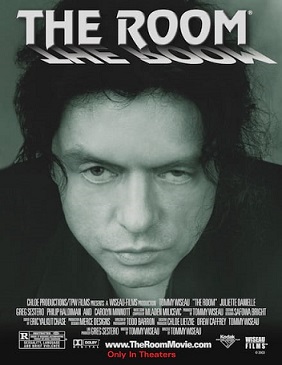
[Freya-dæg] The Room: "Leave your stupid comments in your pocket!"
 |
The Good
The Bad
Judgment
Closing
Back to Top
Plot Summary
Everything in the life of Johnny (Tommy Wiseau) seems to be going well: he's lined up for a promotion at work, he's about to marry his girlfriend of seven years (Lisa, played by Juliette Danielle), and he's surrounded by friends. However, little does Johnny know that his world of easygoing trust is about to collide head on with the truth of a betrayal of all he holds dear.
Although he lives there, Johnny risks it all when he enters The Room!
Back to Top
The Good
The first 30 minutes of The Room are a bizarre quasi-softcore porn hurdle (sex scenes make up 1/3 of it at least) that needs to be leaped in order to arrive at the movie's middle. And what a middle. Although it should really take a viewer out of the movie, this movie's middle is like a sweet cream filling while the first and last 30-35 minutes are like a low-grade chocolate shell. What matters, though, is that this set up works.
As the movie's events heat up and become more dramatic Wiseau's curious delivery makes all of his intense lines unintentionally hilarious. This is, after all, the home of the internet-famous
 |
Speaking of Lisa, it's refreshing to see an average, real woman featured in the female lead role of a movie such as this.
 |
Back to Top
The Bad
Although Wiseau's acting often has a tinge of the (unintentionally) comedic, the movie as a whole doesn't share in the same off-yet-endearing quality.
For starters, several side characters are introduced and then forgotten like so many Scooby-Doo villains, and quite unnecessarily. For example, we're introduced to Mike (Mike Holmes) and Michelle (Robyn Paris) fairly early in the movie, but they don't survive into the third act, as Mike is nowhere to be seen at Johnny's party.
What's more, Mike and Michelle, as a fellow couple, could easily have been the source of advice for Johnny and Lisa. Instead, for the space of a couple of scenes we get Peter (Kyle Vogt), the psychologist friend. Even stranger is the third act introduction of a mysterious man in a white button up shirt at Johnny's party who is the one who finds out about Lisa's and Mark's betrayal.
Much more importantly for a movie called The Room, the setting is really unclear. We're definitely watching a story in San Francisco, and that takes part in an apartment building of some sort for the most part. But what kind of apartment is difficult to nail down. Some establishing shots suggests a modest apartment building:

Others suggest a townhouse:

Perhaps the movie's uncertain setting is simply meant to make the titular room more expansive than one four-walled enclosure, but this lack of clarity is distracting.
Along with the uncertain setting and character introductions, a couple of side plots are mentioned but then just forgotten.
Denny's run-in with drugs and owing drug money? Apparently solved after Johnny and Mark attack the drug dealer.
Claudette's troubles with her brother and a house she's looking to sell? Just noted, and never returned to.
Both of these sideplots feed into the movie's drama, but developing and integrating either or both would have given it a much more consistent feel.
Back to Top
Judgment
Decidedly a weird one to watch, The Room has its merits (it inspired its own indie flash game after all).
Wiseau's strange, quasi-high/drunk, almost entirely eye-contact-less acting style makes all of his dramatic scenes utterly laughable. But as a result the movie's drama is almost always turned on its head and rendered ineffective. Coupled with an awkward handling of what can only be assumed to be an attempt to make Johnny's apartment a main character, too much of the movie's acting and writing undermine the possibility of it all being taken seriously.
The Room is good for a laugh, but its uneven characters, settings, and side stories hamstring its ability to be anything more.
So, Freya, let this one be. It lay already in a prominent place, splayed across a crumbling battlement - there shall all who desire to shall see it, but it simply is not the sort to be raised up.
Back to Top
Closing
Leave your thoughts on this internet cult classic in the comments, and watch for tomorrow's Annotated Links - especially if you're drawn to weird science!
Back to Top
Friday, October 26, 2012
[Freya-dæg] Shocktober Pt.4: The unconventional arc of The Convent
 |
Plot Summary
The Good
The Bad
Judgment
Closing
Introduction
In today's entry, we take a look at the Mike Mendez' horror flick, The Convent. With its low budget effects and costumes, it's a great film for the end of October (and Part 4 of Shocktober) since the best Halloween costumes are often made on a budget.
So, let's see if the same is true of B-Horror movies, as we settle into weighing the good and the bad of this flick,
Back to Top
Plot Summary
In the middle of the 20th century, a convent of nuns ran a school - until one of the students went mad and slaughtered them all before setting the place aflame.
Come 2006, it's tradition for the local universities' sororities and fraternities to try to paint their letters on the old convent's bell tower. Clarissa's troop of newly minted preppy friends is new exception, and everything is going great for her until an old friend from a past she'd rather forget asks to go with them to the old, burned out convent.
In the end, Clarissa's old friend Mo (Megahn Perry) comes with them, and they all wander through the convent. However, instead of finding the bell-tower, they find Satanists who are trying to bring forth the devil himself. Instead, chaos is brought into the old hilltop religious building - unleashing a demonic deluge that surely no-one will survive.
Clarissa and her friends are about to find out that no matter how hard you pray, you're damned when you enter The Convent!
Back to Top
The Good
This movie wastes no time whatsoever setting things up or putting things in motion.
The opening scene gives us one perspective of the urban myth about the titular convent, and from there we're immediately introduced to Clarissa's trying to gel with a new set of friends. This quick and dirty introduction is appreciated, because it gives the movie a great deal of room to expand things - maybe introduce competing perspectives on what happened in the convent, or really get into why Clarissa is looking for new friends when the old ones still seem to be around. But more on that later.
After this quick introduction things move along at a steady clip. The spooky convent and the woman responsible for the shooting at it are visited, and a great deal of tension is built up around the old burned out building. There's also quite a bit of humour and self awareness involved in these first tens of minutes. Some examples are:
 |
 |
And, without pictures, an exchange between the group's men that ends with the conclusion that they need to go back for the druggie's stash; plus a brief and direct Scooby Doo reference.
All of this humour and self-awareness make the movie feel like it's getting to something, like it's really on its way to telliing a horrific story that plays with the audience's expectations.
Back to Top
The Bad
However, The Convent never gets that far.
After the movie's introductory moments are gone, they're never revisited. Instead, we're left with two thirds that could double as a Benny Hill sketch with just a little bit of redubbing.
Now, this shift to true b-movie stuff wouldn't be so bad if the start of the movie hadn't been so promising.
If the movie opened with cheesy lines and demons trying to convert the living, then that's being the focus of the last two thirds wouldn't be an issue. What's worse though, is that once the movie's big bad demons appear it becomes terribly uneven.
One minute, we're skulking about the convent with one of the gang, trying to find the others, the next we see the demons traipsing about and doing whatever it is that demons do in this movie (their workings/weaknesses being explained not being one of these things).
By the time the final scenes of the movie show us some genuine b-movie badassery, things have been too incoherent for anyone other than the most diehard of horror fans to have lost interest and dismissed this movie as nothing more than a disappointment.
Back to Top
Judgment
The Convent is simply a letdown. It's a movie that clocks in at just slightly over an hour, and opens with such snap and self-confident ease. But that confidence erodes by the time the demons appear.
However, the erosion of a movie's confidence and atmosphere is one thing, frustrating an audience's expectations only to later follow some of the laziest horror tropes is the mark of nothing more than a bad movie.
There's really no other way to say it. If it had gone all out on its tropes or been as original as possible within the limits of its story, then it could have been a great bit of entertainment like Leprechaun in the Hood, or a neatly layered horror tale as was Silent House.
So, Freya, there's no need to skim the stinking Field of Fallen Films for the sake of The Convent. Let it be where it lay, and may its name be reluctantly whispered even among midnight cauldron stirrers.
Back to Top
Closing
Check back here tomorrow for Annotated Links #23, a collection of five links that share some common thread and that are also pretty cool!
Back to Top
Friday, October 19, 2012
[Freya-dæg] Shocktober Pt.3:Making some Noise about Silent House
 |
Plot Summary
The Good
The Bad
Judgment
Closing
Introduction
Based on Gustavo Hernández's independent horror film, Casa de Muda, this week's movie is a chilling one.
Back to Top
Plot Summary
Sarah (Elizabeth Olsen), her father (Adam Trese), and her uncle Peter (Eric Sheffer Stevens) have returned to their old vacation house to prepare it for sale. But, if working in a big, old house isn't bad enough, there are stories of people who have been squatting in this vacation home while Sarah and her family have been away.
What's more, Sarah hears things as she works her way through sorting old possessions. Her father and her uncle say it's just an old house, but Sarah's ears aren't the only thing deceiving her when she begins to see people who, on second glance, appear not to be there at all.
When faced with strange stories, noises only you seem to hear, and things that only you can see what could be worse than a Silent House?
Back to Top
The Good
The overlooked indie horror movie of 2012, Silent House, has quite a bit to offer.
Much like The Screaming Skull it shows its mastery of atmosphere early on, but rather than pumping up the tension to the point where our patience bursts and we wind up with something comedic rather than horrific, Silent House knows how to moderate its tension. In that regard, this movie is to The Screaming Skull as Edison's DC electrical system is to Tesla's AC system.
Helping to maintain this atmosphere is ace camera work by Igor Martinovic. His handling of angles and long shots is not only effective but convincing when it comes to showing us what perspective we're seeing everything through. Much of the movie is shot so that Sarah is the focus, and paired with the single camera approach, this is a dynamite movie for cinematography. In fact, it should definitely be looked at as a reference for communicating perspective through film.
 |
Of course, the bread and butter of any horror movie couldn't be moderated by cinematography alone. The movie's script and direction are also great at stringing out just enough frights throughout the movie to release excess tension and to make way for more.
Back to Top
The Bad
However. Silent House's strengths are met by its major flaws.
As an experiment in what I'd consider first person film, we aren't given the same information that we'd get if we had different character perspectives or even a script that allowed for omniscient (or near omniscient) story telling/filmography. Because we lack the sort of information that could only be delivered explicitly if we were privy to another character's perspective, we're given an ending that is a shock, but not in an expected way.
At the risk of spoiling the ending - here I go - rather than a final moment that sends shivers up and down your spine (as Paranormal Activity did for me), we get something softer, more akin to the ending of Shutter Island, or Inception even.
It's not a bad ending in and of itself, but it's not what's expected from a horror movie, especially one that tries so hard to combine jump scares with more psychological frights. Ultimately, however, the movie's attempt to balance these two makes it much more lopsided.
It also doesn't help that one of the actors simply has a presence that suggests his/her involvement in some unsavoury activities.
Back to Top
Judgment
Silent House is a sleek, and considerable horror/thriller.
It makes effective use of camera work to tell its story and to create atmosphere.
It withholds a little too much information, and its ending suggests that the next scene could be more interesting than everything that came before it.
This movie's a strange beast because it's really quite a strange movie when considered. Much like Shutter Island it plays with perspectives, and there are twists throughout, but the thing is that despite its admirable attempt to be a story told mostly in the first person, what's lost as a result leaves us to piece far too much together.
This challenge that Silent House presents is a welcome one, and can make for an engaging movie experience, but it's not engaging if you're not willing to do some speculating throughout your watching of it.
Nonetheless, it still offers some chilling scares and an ending that, as far as soft, conversation-generating endings go, is better than Inception's. And for that, as well as Igor Martinovic's masterful work behind the movie's single camera, this is one to save, I say, Freya.
So swoop low and lift this one from the muck and mire - it's a movie to be seen and to be talked about for what it does right as much as what it loses in trying to do too much.
Back to Top
Closing
Check back here tomorrow for Annotated Links #22!
Back to Top
Friday, October 12, 2012
[Freya-dæg] Shocktober Pt.2: Is Leprechaun in the Hood any Good?
 |
Plot Summary
The Good
The Bad
Judgment
Closing
Introduction
Welcome to Part Two of Shocktober - a look into the litanous Leprechaun series. Specifically, as requested, this week's review is a foray into the fifth movie in the Leprechaun franchise: Leprechaun in the Hood.
Interestingly enough, after four previous movies, this one's picked up the label of "comedy" as well as "horror," so let's just see how this freestyle film fares.
Back to Top
Plot Summary
It's the 1970s and the man who will soon be known as "Mack Daddy" O'Nassas (Ice T) strikes it rich when he finds a stash of gold and an ugly statue of a leprechaun. He learns the secret of the two, and uses a magic flute found in the leprechaun's (Warwick Davis) gold to drive himself to fame and fortune.
Flash forward 20 years. The rap trio of Postmaster P. (Anthony Montgomery), Stray Bullet (Rashaan Nall), and Butch (Red Grant), are trying to get on the hip hop scene but just aren't that great. Down on their luck, and looking for some quick promotion to earn money they need to repair their equipment, they turn to rap mogul Mack Daddy.
But Mack Daddy's help will come at a cost: the trio will have to change their entire image! The trio's de facto leader Postmaster P. objects, and they're thrown out. Having no other alternative, the three plan to steal the medallion they saw hanging on a grotesque leprechaun statue in Mack Daddy's office.
Their heist is a success, but when they remove the medallion, the leprechaun comes back to life and begins hunting down everyone the trio's pawned his gold to. On top of that, Mack Daddy starts after them as well to get back the flute that they stole - the very source of his fame and fortune.
Will the trio figure out how to use the flute to cause their own meteoric rise to stardom? Will Mack Daddy catch up with them and bust a cap in each of their asses? Or will the leprechaun succeed in stealing back his gold as he leaves a trail of bodies in his wake?
The only thing that's sure is that nothing can be good when there's a Leprechaun in the Hood!
Back to Top
The Good
First off, because this is a Leprechaun movie, it's an Irish exploitation movie to some degree. Add in the hood, and you get a modern blackspoitation film. Take them both together, and we get a heaping helping of rhyming lines. And any form of entertainment with rhyming couplets is as good as a cellar full of fine wines.
Additionally, we're treated to turns of phrase like this one:
 |
Further, we get to see Ice T show off his acting chops. For example, we see him reacting to his friend's death:

We also see him scrounging around his afro for another weapon:

And, we see him (for much of the movie) acting pretty full of himself:

It's not an Oscar-worthy performance, but it ups the comedy and campiness of the movie. These things are important ingredients for its potency because they really help to carry it along. After all, being the fifth in the series, it can't really be expected to be as terrifying as the last four movies. So, instead it goes for the base comedy so often found in B-movies. As a result, this movie's like a bag of popcorn: you take one handful and then by the time you actually check to see how much is left in the bag, you find it empty.
Beyond the movie's B-qualities, it has some surprisingly dark moments. These are both major plot points, but definitely work well both to bolster the movie's characters and to buttress its comedy and campiness by adding some variety.
Back to Top
The Bad
However, it can also be said that the movie's darker moments are there to make up for its lack of a "horror" element in general.
Leprechaun in the Hood follows the formula of a slasher or serial killer movie well enough (one person or entity is out to kill a group of people or an individual), but we're told right off the bat why the leprechaun goes after who he goes after. Because we know that whoever has the leprechaun's gold is going to buy the farm, the movie musters very little tension.
It doesn't help matters that the movie's titular villain isn't very menacing either. He's definitely brutal in the pursuit of those who have his gold, but otherwise he's as comedic a character as Ice T.

The other issue with the movie is that it doesn't really answer many of the questions it raises. Questions like: how did Mack Daddy know enough about the flute to only be interested in it when he first comes across the leprechaun's gold? Why is the flute's power selective in certain scenes? And how does the leprechaun manage to escape and hypnotize someone at the end?
Why all of these things happen is clear (convenience, convenience, and to leave it open for the next one), but the "how" is just as important because without that the movie loses its depth.
Explaining how the leprechaun's magic (and magic in general in the movie work) would add such depth, and help to build more tension as audiences tried to figure out the leprechaun's weak point for themselves based on what we're told. Instead, we're told nothing, and the movie becomes just a bit of light entertainment.
However, the worst part of the film is that the leprechaun isn't even really the main focus - instead, it's "The Hood." Since both things are in the title, both should share the spotlight, but the leprechaun is used as little more than a plot device.
He spouts off some dope rhyming couplets, makes cheerful threats, and then follows through with them. But he's really just the impetus for events, he never really gets into them. For example, the whole conflict between the rap trio and Mack Daddy barely involves him at all - he's just a third party that sometimes interferes with either side's plan.
Back to Top
Judgment
Leprechaun in the Hood is an light romp that mixes comedy, camp, and exploitation style film into one entertaining blend. But if you're looking for substance, you've got to go with an earlier Leprechaun movie, or an older horror film. This one's as substantial as blown smoke.
That said though, Leprechaun in the Hood is well-paced, and it does offer some rather surprisng twists near the end.
So, Freya, dust this one off, and lift it up (but be sure to set it along the lower seats of Filmhalla).
Back to Top
Closing
Check back here tomorrow for Annotated Links #21!
Back to Top
Friday, October 5, 2012
[Freya-dæg] Shocktober Pt.1: Some Screaming Skullduggery
 |
Plot Summary
The Good
The Bad
Judgment
Closing
Introduction
Well, it's October proper now, and so there are a few movies that I've scared up for the month that hosts Halloween that I've just got to check out. First up in the four part Shock-tober film fest is the 1958 fright-fest, The The Screaming Skull.
Back to Top
Plot Summary
Eric Whitlock (John Hudson), now happily married to his second wife Jenni (Peggy Webber), returns to his estate after some years away.
Everything within it is just as it was left, and the gardener has been keeping the grounds as if Eric - or his late first wife Marian who tragically died near the property's pond - never left. But as strange things begin to distract Jenni and she starts to see and hear things that Eric assures her are not there it seems that the estate is not yet finished with sorrow.
Bumps in the night become real reasons for terror, but is Jenni truly seeing and hearing things as they are? Or is Eric right and there's nothing at all the matter in their freshly minted marriage?
When it comes to matters of creepy gardeners, strange noises, and bizarre appearances of skulls everywhere, nothing can be certain - even the cry of a peacock could be the sound of The Screaming Skull!
Back to Top
The Good
For better or worse, this movie has one thing going for it: A 1950s car with seagull doors!

Neat props aside, The Screaming Skull definitely has its moments of mild fright. But what the movie does best is create atmosphere. The colonial estate on which the film is set already lends itself well to this, but the tension is also ratcheted up through Jenny's constant edginess.
Much like another ill-thought of movie from the middle of the 20th century - a little picture called Manos: The Hands of Fate - the best character in the movie are those who are on the sides.
The Reverend Edward Snow (Russ Conway) and his wife (Tony Johnson), are interesting, if static figures, but just as in Manos, the greatest character in the movie is Mickey (Alex Nicol), the estate's gardener (and the film's director). Just like Torgo, Mickey's motivations and personality are the most developed and worked through, and so likewise, he is always a curious figure to watch.
Back to Top
The Bad
However, the big problem with The Screaming Skull is that it fails to establish real relationships between its characters. The one between Mickey and the memory of Marian is the best in the film, but even it is terribly thin and shallow. We're basically given a Catelyn Tully/Petyr Baelish situation (if I may be so bold as to jump genres), but nothing as complex develops from it.
Worst of all, though, the one relationship that the movie really needs to make us care about, that between Eric and Jenni, gets no development whatsoever. Eric mentions once (once!) that she's moneyed, and she gives no real indication as to why she's interested in the man.
Despite the insistence of the script, this is not a good show of a madly in love married couple. That most of their scenes come across as reads rather than actual conversation between any truly in love couple does nothing to help their case.
 |
What's more, the characters of Jenny and Eric, again, those whom we should be made to care about the most, are pitiably underdeveloped. All we know about Eric is that he's been away from the estate for 3 years, he's re-married, and he must have some kind of job (right?).
To be fair, we do learn quite a bit about Jenny's past, but we don't get enough early on to really relate to her. Eric's under-development is disappointing, but with Jenny's downright terrible.
But why are relatable characters so important to horror movies?
Well, horror movies require characters that their viewers can relate to, since when those characters are in danger, or in tense situations, or scared, then we can feel those same emotions.
Jenny, as the new wife who is being introduced into the way of life that Eric is planning for, is the perfect audience proxy character. She, just as those watching, is being brought into a brand new scenario. But, because we're not able to really make a connection with her due to the mysteries of her background and attraction to Eric.
As a result, what is supposed to be a largely sympathetic genre becomes instead a plodding tense fest that comes across as comical rather than scary not because of the era's effects, but because without a character to see ourselves as or to empathize with, we the audience become objective observers, coldly removed from a movie whose genre requires emotional investment on at least some level.
Back to Top
Judgment
The Screaming Skull and Manos: The Hands of Fate are definitely of the same ilk.
Both movies are low-budget, poorly executed horror movies that are just plain bad.
Yet, the difference between them is that Manos is so bad that it's good - it can show people the absolute worst way to make a movie in all of its aspects.
The Screaming Skull on the other hand is badly done, but lacks the main thing that redeems Manos: Interesting characters that have dynamic relationships and that are fascinating in their own right.
Because The Screaming Skull is missing such characters the house in which much of it happens is a perfect self-reflexive metaphor. The estate house is frightening in its own right (it is a horror movie after all), but absolutely empty - and therefore entirely uninteresting. What's more, aside from two throwaway lines, we're never given any clear reason for Eric's actions - unless he is, in fact, bound for the loony bin.
So, Freya, leave this one below as you fly over the field of fallen films. Oh, and don't get too close, you might fall into its bubble of boredom and tumble to the ground.
Back to Top
Closing
Coming up tomorrow - Annotated Links #19. So be sure to watch for more wacky news and information!
Back to Top
Friday, September 28, 2012
[Freya-dæg] The (Good) Samaritan
 |
The Good
The Bad
Judgment
Closing
Back to Top
Plot Summary
Foley (Samuel L. Jackson) has just finished his 25 years in the joint and he's eager to start fresh. He meets with his parole officer, gets himself a job - and reconnects with his old partner's son, Ethan (Luke Kirby).
But Foley's chance meeting with Ethan almost causes his undoing, as it introduces the fiery Iris (Ruth Negga) into his life and threatens to pull Foley back into the very world that he wants so dearly to escape.
But meeting Iris quickly becomes a great thing for Foley. The two become more and more intertwined as a couple. In fact they become so close that there are no secrets between them. Except, as Foley finds out from Ethan, one. It's a secret that could tear Foley and Iris apart and twist the knife that knowing the secret himself has thrust into Foley's heart.
Ethan uses this secret as leverage to bring Foley in for one more big score. But will Foley go along with it? Will he be able to keep Iris in the dark or will she be able to handle the terrible truth? Most importantly, even if forced once more into the world that he vowed to leave behind, can Foley emerge once more as The Samaritan?
Back to Top
The Good
For a Canadian film, The Samaritan is a slick picture that weaves a wondrous atmosphere around its viewer. From the dank streets of Toronto to a moody, Peter-Gabriel-esque sound track, this movie is one that offers more than just an escape, it offers a rewarding journey through the darkest of places.
Samuel L. Jackson gives a much more muted performance than in most of his other movies, as his is a character who's more reflective than violent. But this works well with the other elements of the movie and really helps to sustain its atmosphere. Also, Luke Kirby plays a perfect slime ball, while Ruth Negga does well as an addled lost woman.
 |
But slick production values and strong casting aside, this movie pulls out one of the few trumps in the noir genre: the Oldboy card.
The twist that Oldboy deploys in its narrative is more elaborately delivered, but the pared down version found in The Samaritan is incredibly effective. What's more, it also takes some extra time to give greater depth to the entanglement between characters. Further, this device is such a rarity in Western cinema that it comes as a welcome surprise.
Back to Top
The Bad
At the same time, The Samaritan is not without its problems.
The pacing of Foley and Iris' relationship is too fast, for starters. Not that a guy who's just gotten out of prison wouldn't fall for a girl like Iris as quickly as he does, but rather there's very little chemistry between them until Foley takes the initiative.
This makes sense, since Foley plays as the world-weary and in-control ex-con all the way through, while Iris is very much caught up in the world of the pimp's fist: opening to dispense coke, and closing to dole out cruel slavery. This dynamic later becomes something more, as Foley strives to help Iris get herself straightened out, but their bumpy start can't be ignored.
The movie's initiating moment, the one that sets up Ethan's and Foley's motivation for the whole of the movie, is also questionable.
In this moment, Foley is faced with the choice of seeing his best friend and partner being killed before being killed himself, or killing that friend, taking the fall, and having to live through prison. The way that this moment is introduced and then developed over the course of the movie does nothing to show us why Foley chose to live rather than die a Roman death.
After all, when he comes out of prison everything has changed, everyone he meets from his old life says that what they did was "1000 years ago," and he has no connections on the outside whatsoever. We don't even see any reason for Foley to have killed Ethan's father aside from his own cowardice (or, in Ethan's words, "to save his sorry ass").
It could be argued that this is how we're supposed to regard Foley throughout the picture, but this doesn't jive with his actual character as we see him. Throughout the movie he's calm, collected, and entirely together - he knows exactly what he's doing, how to do it, and how to keep calm while doing it. His is not the shakey hand of the coward, but the steady one of the expert.
Maybe there was some pivotal, off-camera moment in prison that turned him from craven to maven, but we don't see it and this creates a distracting disconnect between his apparent motivation for saving himself rather than just dying with his friend. And since the moment in which Foley made this decision is what leads to the rest of the movie, the plot itself is undermined.
Back to Top
Judgment
The Samaritan is a movie that very clearly explains its own lukewarm reception.
Samuel L. Jackson is famous for starring in movies that grab your attention, shake you for an hour and a half and then leave you reeling. Likewise, film noir is a genre known for characters and plots that seize your interest and sweep you around from situation to situation until things conclude in a twist of some sort. Combine these two together, and you rightfully expect a twisted thrill ride that delivers atmospheric, hard-boiled action.
However, this just isn't the case.
The thrills are there, as are the twists and the characters, but nothing necessarily grabs and holds you. The whole movie is better described as a film that very clearly proclaims "I'm noir! ...and I'll just be right over there, okay?"
To really appreciate this movie, you need to be willing to take an active role. Not so that you can follow its complexities, but becuase the movie's not going to do much holding for you. It's a movie to get lost in rather than to be lost in. And that is a very refreshing change from movies in the action/noir genre that try to bludgeon their viewers with madcap sprees.
So, Freya, find this one brooding in the Field of Fallen Films, and bring it up, for it's truly a one that deserves to be seen.
Back to Top
Closing
Tomorrow, watch for Annotated Links #19, and on Sunday for a look back/look ahead entry.
Back to Top
Friday, September 21, 2012
[Freya-dæg] Indecision while Meeting Evil
 |
The Good
The Bad
Judgment
Closing
Back to Top
Plot Summary
John Felton (Luke Wilson) is a father, husband, and realtor floundering in the trough of the housing crash.
He's lost his job, his self-respect, and his passion for living. But on his birthday he crosses paths with a strange character known simply as "Ritchie" (Samuel L. Jackson). As John's attempts to help Ritchie lead from one thing to another John slowly realizes that something is terribly wrong - everywhere they go it seems that people are being killed.
Will the killer eventually strike out at John himself, or the family that he holds dear? Or will John eventually comprehend that in each encounter with Ritchie he's been Meeting Evil?
Back to Top
The Good
For a movie that looks like it was filmed on a steady, many mega-pixel handycam, Meeting Evil has some great cinematography and editing.
For example, after one of the murders, the body is splayed on the road and we get this transition to a convenience store where the scene's opening shot is of a barbie doll splayed out on the floor in the same way. And later in the movie when John is being questioned by the police we see some great use of lights and shadows. And in a similar vein, near the movie's climax there's one shot where the shadow of the falling rain looks like blood dripping down Joni's face.

But, the greatest thing that this movie has to offer is Samuel L. Jackson. He brings all of his chops to the table and really conveys a powerful sense of menace in so many of his scenes.
Just as he's bald in the role, you could say that he's been shorn of all of the ridiculous over-the-top-ness of his role as Jules Winnfield in Pulp Fiction. He still does push things, but each foray into the depth of feeling starts from a calm and centered performance as Ritchie who seems to be as in control of his personality and himself as a martial arts master in a Hong Kong action flick.
Back to Top
The Bad
Yet, at the same time, we're never really told much about Ritchie.
Near the film's end we get a tentative motive for his actions - but it comes from his own mouth, and one of the biggest things that we've learned over the course of the movie is that Ritchie is quite duplicitous. However, this opens up an important question for horror stories based on a single-entity: Is it more terrifying to know the evil that you're encountering, or to not know it at all?
On the one hand, if you know the horror in a clinical, or unremoved way, then it can become less of a threat. That sort of technical knowledge could lead to a technical way to destroy it, or be rid of it and so the threat might be diminished.
Though if the horror was known in a more personal way, then it can seem even more insidious, since it can leave us feeling defenseless and vulnerable. After all, it sets everything on its head.
On the other hand, if you don't know anything about the horror, it gains the element of more widespread surprise. It could come from any direction, it could come in any form, it could do anything. If your imagination has already been slapped across the flanks and sent running, then all of these possibilities give it ample springy space on which to sprint into wild frenzies.
One of the major problems with Meeting Evil is that it never really decides which way to go with its antagonist, Ritchie. It withholds a lot of information until near the end (if what he says about himself can be trusted), but there's also a vague suggestion throughout (made quite clearly as we hear him whistling Dixie throughout the movie and over the end credits) that he is the Devil.
Yet even that possibility isn't fully explored though there's a great set of scenes in which it could be very clearly, but indirectly, established.
Throughout the movie we're shown a little girl wearing red wellington boots who seems to be out walking a little dog. In our first encounter with her, she foils Ritchie's plan to shoot John outright (which is also kind of comical, at least for Ritchie's reaction).
 |
Then, as we look back at the house throughout the movie the girl's always there - like some sort of guardian angel or lurking demon. But even when she and Ritchie speak before he returns to John and Joanie's (Leslie Bibb) house in the last act, all we get out of the interaction is that the girl's dog sometimes bites. So, it's possible that she's an angel working against him, or a demon working with him, but that's all we're left with: a possibility.
The movie also doesn't do quite as much as you'd expect with the fact that John is a victim of the housing crash, and living in a neighbourhood that has been almost entirely cleared out.
In one sense, placing John in this situation might just be a super context-sensitive way to establish how depressed he is and the dire straits of his family, but since it's just there and taken as a given we don't really gain that sense of impending doom that would make Ritchie's confession of motive that much more believable. <*spoilers*>Though, if we really believed what he says about Joanie wanting to kill John, then the ending where they slip into bed and she just asks "everything is going to be okay, right?" before they flick off their lights would make no sense at all.
While we're at it, the way the American family is depicted in this movie is also a little strange. John and Joni are fit and attractive people while their children are both statistics in a survey on childhood obesity. Though the movie does suggest why childhood obesity is such a problem in America right now:
 |
Back to Top
Judgment
Meeting Evil is the sort of horror movie that lends itself well to discussions of the genre, what works, what doesn't, and what the merits are to either side of the "know the horror/don't know the horror" debate.
In spite of the movie's lending itself to discussion, it doesn't really offer up what a horror needs to: a solid scare that will make your skin crawl each time a stranger knocks on your door to ask for help with their broken down car, or each time you hear someone whistling "Dixie."
What's more, aside from some nice editing and camera work, Luke Wilson and Samuel Jackson not only make up the lion's share of the movie's acting chops, they also seem to have taken up the lion's share of the movie's budget.
So, Freya, it is without any sort of indecision at all that I say let this one be where it lay. Keep it in mind, that we may all discuss and dissect it and its situation in the great Halls of Filmhalla, but don't bother bringing it in from the Field of Fallen Films.
Back to Top
Closing
Check back here tomorrow for the next "Annotated Links," and on Sunday for a look back and a look at the week ahead.
Back to Top
Friday, September 14, 2012
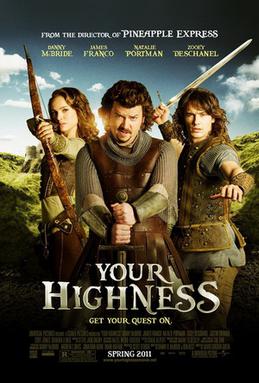
[Freya-dæg] An Audience With Your Highness
 |
The Good
The Bad
Judgment
Closing
Back to Top
Plot Summary
There is an ancient prophesy in the land that says that if a great warlock can lay with a virgin when the two moons meet, he will create a dragon. The Order of the Golden Knights has stopped the warlock before, but many years later all of the knights of the Order have been wiped out, a great warlock has arisen and the moons begin to converge.
Of course, none of that matters to the brash prince Thadeous (Danny McBride), son of King Tallous (Charles Dance) and brother of the all-favoured Fabious (James Franco). He's about as concerned with prophecies and quests as a bear is with a block of cheese. But when his brother returns from yet another successful quest with the virgin Belladonna (Zooey Deschanel) only to have his wedding crashed and his bride carried off by none other than the great wizard Leezar himself (Justin Theroux), Thadeous is forced by his father to join Fabious on his quest to save his bride and ultimately the kingdom.
Will Fabious be successful in averting a doom that will envelope the land, though he is beset on all sides by villains both traitorous and bad? Will Thadeous grow to be more than a spoiled bawd of a king's son? Or will Lazeer prevail?
Only by watching can you find out if this disparate bunch of questors can break Leezar and make him scream Your Highness!
Back to Top
The Good
Your Highness's cast is simply star-studded. Zooey Deschanel, James Franco, and Charles Dance — all of them have sizeable roles in the film and bring all of their acting chops to bear on the film as a whole. What's more, even the lesser known Danny McBride does a great job as Thadeous.
But what really sends this movie over the top in terms of the acting is the sheer devotion that all of the players show to keeping things medieval. The dialogue, the delivery, everything is nicely tinged with the very stuff of high fantasy. It isn't necessarily accurate to actual historical fact, but neither are many high fantasy stories, and neither are many of the medieval romances on which they're based - something which this movie gets quite close to being.
However, rather than being written by some gallant-minded self-styled bard, Your Highness is closer to what might have come about had Geoffrey Chaucer ever wrote a non-historical verse romance.
The movie's writing is also quite strong, and though the plot develops in a more or less expected way, there are enough fantastical elements to keep your interest throughout all of its 100 minutes.
The movie also nicely straddles the line of satire while also keeping the movie's illusion in tact. Watching it, it's very easy to get the sense that the actors know that they're playing in roles and through ridiculous situations, but they maintain their act all the same. The fourth wall is left firmly in place, so much so that the best analogy is that this movie is the way that players of a D&D game might imagine their own games as they're playing them.
And, just like many a D&D game, the movie has some unexpectedly dark moments, such as when the quest seems to be entirely hopeless and Fabious exclaims that "Belladonna will get raped and die" if they don't get to her in time.
But, most importantly, setting this movie apart from In the Name of the King, is that nothing in it is contrived for the sake of action or a good laugh. Instead all of the jokes arise out of the characters' personalities and the setting itself.
Back to Top
The Bad
However, Rotten Tomatoes' consensus on this movie does have it right - the jokes here are almost all based on the same theme. In this regard it's kind of like something that Trey Parker and Matt Stone might have written, and it does run the risk of getting a little thin by the end. Though that remains as only a risk.
Also, there are some things in the movie that are pretty outlandishly off when it comes to medieval culture, even that of a fantasy realm. Such as this:

Powdered wigs and pale faces weren't quite a male fashion statement until the 18th century, which is just a few centuries too late.
There are also some elements introduced early on in the movie that could use some more explanation: Thadeous' distaste for mechanical things (focused entirely on his brother's mechanical bird companion), and why the "triangle face" that Courtney (Rasmus Hardiker) pulls scares him.
 |
However, as the film picks up and goes on, these things are forgotten by viewer and writer alike. Adding them into the development of Thadeous would have made this movie all the stronger, though. Perhaps, in fact, instead of just temptations to indulge himself, he could have had to face a mechanical being with a "triangle face" in the labyrinth where he and the party find the Blade of Unicorn.
Back to Top
Judgment
Your Highness is a grand farce of a medieval romance comedy. The humour can be overbearing, but the actors, the script, and the chemistry between them all keeps things going at a lovely trot from start to finish. What's more, this movie passed one of the ultimate tests: it was as fun to watch a second time as it was the first.
So, Freya, don't mind the lewd way in which this one comes on to you as you scoop it from the Field of Fallen Films, nor its lascivious words as you fly with it from there to where all great movies deserve to be.
Back to Top
Closing
A Glass Darkly is going to be undergoing some changes starting next week.
Monday's and Friday's entries will continue as usual, but instead of Annotated Links throughout the week and an editorial in the middle, Annotated Links will be moved to Saturday and expanded to five links from three. The editorial is being dropped and will be replaced with a brief update on my writing endeavours that goes live every Sunday.
Check out the first of these Sunday entries on the 17th of the month!
Back to Top
Friday, September 7, 2012
[Freya-dæg] A Good Reason to Swear In the Name of the King
 |
The Good
The Bad
Judgment
Closing
Back to Top
Plot Summary
Trouble is brewing in the land of Ehb and realm-wide unrest is afoot. Though usually unarmed and disorganized, hordes of Krug are ravishing the land, destroying villages, and, strangest of all, taking prisoners. Duke Fallow (Matthew Lillard), the nephew of king Konreid (Burt Reynolds) may have a hand in these goings on. Or perhaps it is the mysterious magus Gallian (Ray Liotta), who has secretly taken the warrior/enchantress Muriella (Leelee Sobieski) as a lover who is pulling the strings.
All that's clear is that amidst this strife the humble Farmer (Jason Statham) seeks only to live a quiet life with his wife Solana (Claire Forlani) and son Zeph (Colin Ford). This idyllic life doesn't last, however, as it's not long before the Krug attack Farmer's village.
Now, with his family dispersed, and a desire to restore order to the land in his own way, Farmer sets out with Norrick (Ron Perlman) and Bastian (Will Sanderson) to set right what seems to be so very wrong.
Will this trio be just another group stricken down by powers beyond mortal control, or will they be the ones to catch the villain behind it all and cry "Stop, In the Name of the King"?
Back to Top
The Good
In the Name of the King boasts some of the best acting talent in a fantasy movie (not based on any written/drawn work) of recent memory. We've got Jason Statham on action, Ron Perlman and John Rhys Davies (the king's magus, Merick) on all-around-awesome, Matthew Lillard on ham, and Burt Reynolds on kingly bearing. It's a great ensemble and quite a treat to see them all together.
Plus, Statham in the role of Farmer, gets into the thick of some pretty good action sequences, but more than anything he weilds a boomerang in this movie. A boomerang. He definitely must have stopped off at his local wind temple before the events of this movie began.
 |
What's more, this movie was filmed in Hollywood North - Vancouver and Victoria British Columbia, Canada. And more business for Canadian film is always good, right?
Back to Top
The Bad
As you might have guessed from the lack in the previous section, this is not a movie with a lot of inherent redeeming features. So, let's start working through where this one failed, starting with the most nit-picky and working our way toward the more general of the film's flaws.
First and foremost, sumptuary laws, the medieval codes governing the clothing colours and styles and accessories that can be worn by different parts of society, are not observed.
Solana, Farmer's wife, is the worst violator of these laws. Not only does she have her face done up to look like a noble woman throughout the movie, she also wears purple throughout the movie. Peasants were not allowed to wear purple under most medieval sumptuary laws since it was considered a regal colour. Therefore, either she is a noble woman and we're never told about it, or she's a peasant and somebody on this movie's production team didn't do their research.
Similarly, Statham's use of a boomerang can slide, since for a medieval (European) setting it's a nice exotic touch. But, his possession of a sword, even if it looks like an old and worn one, wouldn't be permitted. Medieval law restricted the ownership of swords to the noble classes, partially as a status symbol and partially because they could be expensive to make. Now, a counter-argument could be made here, but it involves spoilers. So, skip the next paragraph if you'd rather not have this film's plot ruined.
<*spoilers*>It turns out that Farmer is the son of the king. This makes him a noble by blood, and therefore allows him a sword. But, the thing with that is, he isn't recognized as the king's son until a fair bit of wrangling goes on in the last third of the movie. Up until that point he is, even in his own mind, just a peasant, and therefore has no business owning a sword.
Speaking of the classic medieval weapon: Though they make for decent spectacle, the movie's sword fights are far too simple.
Instead of the movie showcasing sword-fighting as an art, what the movie shows is more of the hack-and-stab school of swordfighting. This style kind of works for Farmer, since, even if he's always had his sword, he may not have ever learned how to use it, but the generals, soldiers, and wizards in the movie definitely ought to be beyond the most basic of sword strike-sword counter drills that are prominently featured in each fight.
Perhaps the action choreographer (Tony Ching Siu Tung) was going for a simpler, grittier style of sword-fighting to match the grit implied by the movie's generous smatterings of greys and browns, but people who fight with swords for a living aren't going to make wide, large, unnecessary swings - they're going to make precise, small, movements that give them exactly the power, energy, and force that they need in any given situation. And, when life-long swordsmen and women make such movements, they're going to look far more graceful than they do in this movie.
Now, it must be granted that the movie's actors all get a fair shake at showcasing their talents in a fantasy setting, but Ron Perlman is cheated in this movie. <*spoilers*> Norrick dies near the end of the movie, but we're not given any kind of scene centering on this. We see him get hit, we see him go down, and then we see Bastian, who's with him, declare that he's dead. There's no big speech, there're no tear-felt last words, Perlman's Norrick just dies and then that's it.
Also, more a matter of casting or make-up than acting, Ray Liotta's Gallian shouldn't be in command of planar magic, he should be too busy with a show in Vegas to learn such things. Just look at his mug:
 |
Moving from acts, action, and acting, to the movie's screenplay, it's about as solid as the non-existent forest canopies that the movie's Amazonian elves use to swing down from during a major battle sequence.
As a writer, I can understand any storyteller's fear that loading the beginning of their story with exposition will leave audiences confused, disconnected, and disinterested. But that doesn't mean that you should put most of this exposition (especially those things that you could use to lead to some really amazing plot and character developments) into the last 20 minutes of your movie.
Nonetheless, in In the Name of the King, it is within the last 20 minutes that we learn how the world's magic works, that Gallian somehow made himself king over the erstwhile kingless Krug, that there are only two magi left in the world, that magi can transfer their powers to one another, and that Farmer knows what to do with a sword both in melees and in single combat.
Putting all of this up front, or at least spreading it out could have made the movie much more interesting. Instead, what carries us forward through it is the promise of action and nothing else. What's more, we never learn anything about the world, outside of what we learn in those final 20 minutes, that relates to anything that isn't directly involved in the story.
 |
Adding insult to the injuries already inflicted on its audiences' sense of taste, the movie rips off Lord of the Rings fairly openly. Galleon's keep is practically Isengard, and the Krug seem to be multiplying beneath it, just as orcs do in Sauroman's domain. Star Wars is also plagiarized, but there are already dozens of movies with protagonists whose fathers turn out to be very prominent figures.
Rather unsurprisingly, In the Name of the King also suffers from something I like to call Titan-itis. This movie malady is named for Clash of the Titans and Wrath of The Titans since both of those movies focus almost entirely on their male characters and their relationships, only bringing female characters into the story when necessary for romantic or plot reasons.
In the Name of the King does the same thing. It may even have a worse case of this illness, since Muriella, a capable, strong woman (warrior/sorceress) seems like she's been torn right from the pages of medieval romance, but she is never actually shown doing anything in the realm of men.
And, topping off all of the movie's shortcomings, its relative production values are likely trumped by those of the two Blind Guardian songs that play over its credits.
Back to Top
Judgment
Epic fantasy movies are a difficult bunch. Other films in the genre, like Labyrinth, or The Never Ending Story, have it pretty easy since they weave their worlds carefully, draw their audiences in, and tackle some dark themes while being disguised as "kids' stuff."
In the Name of the King does none of that.
Even worse, In the Name of the King has almost no redeeming qualities if looked at as a whole. Its storytelling is backwards, its dialogue is awkward and out of place, its world is poorly constructed, and its characters, unfortunately, show almost no growth whatsoever.
Even after becoming king, it seems that Farmer just stays as he is. In fact, aside from Farmer's new title, things will probably wind up as they were at the movie's beginning since Gallian, upon delivering one of the movie's weirdest lines to Solana ("I can feel him in you"), reveals that she is carrying another of Farmer's children.
The movie's action keeps it going, but if you happen to turn your brain on at all during the proceedings you'll quickly find that doing just about anything other than watching this movie would be a better use of your time.
So Freya, avoid In the Name of the King at all costs, and let it rot where it lay. The Field of Fallen Films is truly the best place for it, though even there it may keep some of the others from fertilizing the earth beneath them.
Back to Top
Closing
Check back here next week for a look at another ill-thought of fantasy movie, However, if you really want to see a good underdog fantasy movie, check out Your Highness.
Also, the blog update continues, but it doesn't look like my regular entries will become regular again just yet. Follow me on Twitter (@the_penmin) or follow this blog via email by typing yours into the box to the right of the top of this entry to keep on top of the happenings here at A Glass Darkly!
Back to Top
Friday, August 31, 2012
[Freya-dæg] All-Request August Pt. 5: This Means War
 |
Introduction
Plot Summary
The Good
The Bad
Judgment
Closing
Introduction
When I first saw the previews for This Means War I thought that Hollywood had finally moved onto something new in the rom-com genre. I thought that the usual romantic comedy formula had been done away with and things had begun to progress onto something more substantial. I thought, for a while, that we all had a bromedy (bromantic comedy) on our hands.
Of course, thoughts and reality aren't always in accord, I thought as I sat down to watch this movie to round off All-Request August. Let's see just how much my thoughts and the reality of this movie jive.
Back to Top
Plot Summary
Tuck (Tom Hardy) and FDR (Chris Pine) are two of the CIA's top agents. They're great in the field together, and back at the office they're some of the most popular guys in the agency. But there's something that can tear even the closest of friends apart, something that can be more heinous that a plot to destroy the world, more scheming than any mastermind looking to destroy the diamond market, or more maniacal than a mogul interested in assassinating the leader of the free world. A woman.
Lauren (Reese Witherspoon) is busy at being a product testing executive. Maybe a little too busy, or so her friend Trish (Chelsea Handler) thinks. So she creates a profile for Lauren on an internet dating site - and, seeing the same ad on television, so does Tuck!
But little do either of them know that this will lead to a three-way meeting that might just tear apart the two fastest of friends and put the whole of America at risk. In fact, if they can't resolve their differences it might be more than just these two rivals in love declaring: This Means War!
Back to Top
The Good
Full disclosure, I thought right. This Means War does actually do things a little bit differently from the standard modern romantic comedy. Rather than focusing on a couple who has lost their spark, this movie focuses on two friends and what happens when a woman comes between them. Plus, we do see a little bit of a bromance between Tuck and FDR.
It also sort of portrays some strong, independent women. In fact, all of what it says that's positive can be summed up in Lauren's friend's advice: "Don't choose the better guy, choose the guy that's gonna make you the better girl."
What's more, throughout the movie we actually see some real character growth in FDR. He starts off as a stereotypical American alpha male, but he winds up completely changed (more or less) but for the better. In essence, we actually see him grow up over the course of the film in a lot of ways.
Speaking much more broadly, the movie's premise of spies using their resources to woo the same girl could be interpreted as an evolution of Cyrano de Bergerac's romantic-helper sub-plot. However, instead of both friends working together, or in any otherwise strictly co-operative way, they act on a much more individual basis.
They both rely on teams to gather information on each other and on Lauren, but they use all of this information as individuals, subjecting the raw data to their own analysis, thoughts, and figurings. In that way, then, the premise of this movie lends itself well to a celebration of the power of the individual in the digital age (if say, we replace the teams of data miners with other people who provide people with information, like say, bloggers).
Add to all of this some frenetic action sequences that are intense but easily followed and all-around well done, and you've got yourself an incredible movie.
Back to Top
The Bad
However, in the case of This Means War you'll get all of that and about 30 minutes more. Or rather, too much.
The movie hums along nicely through its first act and most of its second act, with nary a care. There's some morally dark, privacy invasion issues raised by Tuck's and FDR's bugging Lauren's home (while she's in it, no less), but that sort of thing is built into the premise.
What's harder to get past is how the movie deteriorates as the third act comes into view and then crumbles entirely by the time it ends.
Up until the penultimate climactic scene where Lauren, Tuck, and FDR are all together for the first time the movie has, though slightly awkwardly, shown character growth, suggested that it's okay for women to be bold and independent, and made the wise-cracking friend role more of a wise-friend role. But, once the three meet all of this falls apart.
In this scene, Lauren becomes a hyperventilating mess, her friend goes back on everything she's said up to that point by saying "I told you you shouldn't have dated two guys at once," after towing the exact opposite line for the first 2/3 of the movie, and Tuck and FDR are broken up without any real threat to their relationship since the movie's big bad has been spotted and it's still their mission to take him down. What's more, the big bad kidnaps Lauren and Trish, as if they're perfectly helpless damsels in the face of gritty reality - contrary to what the rest of the movie has suggested.
What makes this reversal worse is that the movie telegraphs that it's coming almost from minute one.
The emphasis throughout the first two acts is firmly placed on the romantic stuff at the cost of the spy stuff - but the big bad that's out to get Tuck and FDR for what they did in the opening scene is still there, lurking just out of frame and begging to have his part of the plot resolved. This fulfilment comes in a rush of high-paced action. Up to this point the action's just been drizzled over the two agents' comic rivalry. So it's clear that he's going to be the focus of act three.
Between Tuck and FDR, FDR gets far more character development. We learn about his past, a little of what motivates him at present, and we actually see him change over the course of the movie.
However, Tuck remains largely the same as a character. Only his circumstances change, since after it's revealed that he's a secret agent his estranged wife and kid - whom he had formerly convinced that he was a travel agent - come right back to him, no questions asked whatsoever.
And as far as Lauren's character goes, she is portrayed as a successful career woman, but we also get glimpses of her being hung-up on an ex whom she followed to the city while they were still dating. This situation could be made to bolster her as the strong female figure that she more or less is, but at the same time this is clearly an illusion.
Without ever getting a reason for it, we're shown that she still has a thing for this ex in spite of his being engaged and, by the very rules of the movie, thus unattainable. You could argue that this unattainability makes her want him back all the more, but since it's not clear what made him so special in the first place Lauren's jealousy and desire aren't given enough motivation to take full advantage of the unattainability angle.
The negative transformation of Lauren's friend is a little less predictable. Yet, just before she turns into the "I told you so" character that rom-coms are well known for having, we see her in a setting that's more everyday than those in which we've seen her previously. This is also the scene where she gives Lauren her sage advice.
So what's the situation? Helping her son repair a baseball mitt, while sitting on the couch in her living room and talking about how she loves her husband because he's her own man, despite his faults. This is sweet and all, but it entirely contradicts the firebrand that we've seen her as before. This isn't to say that mothers can't simultaneously be firebrands and motherly (real people are complex, of course), but there's no build up to this scene.
Further, it suggests something curious about marriage that the rest of the movie works towards as well.
The motherly scene with Trish, Tuck's lack of development, FDR's full-on development, and Lauren's loosening up all suggest that marriage is some sort of solidifying ritual. That it somehow locks people into what's truly best for them and that this means, to varying degrees, that growth is no longer necessary for a person.
This is why I've taken this away from the movie: all of its unmarried characters change gradually, we see them grow, evolve, and become something different from what they were at the movie's beginning. Conversely, all of the characters who are married do not change (Trish's sudden change is out of character, but not unpredictable since the movie is constantly reminding us that she's married and has a kid).
It may not have been the movie's intent, but since we're given two main characters (Tuck and FDR) it's hard to not compare the two. And any comparison shows that while unmarried the one changes, and while married the other does not change.
Back to Top
Judgment
The story of two men competing for one woman is definitely nothing new.
Chaucer's Knight tells the story of Arcite, Palamon, and Emily in the Canterbury Tales - written in the latter half of the 14th century. And Chaucer didn't create the Knight's Tale from pure inspiration, it was a shortened version of a story by Giovanni Boccaccio, which itself probably has even deeper historical roots.
However, This Means War does show some character growth within its love-triangle.
Yet, at the same time, it's kind of surprising that this movie got made. Especially now, in a world of phone tapping and drone strikes, and all manner of privacy invasions being made possible by the internet and the degree to which we're all connected to it. It would've made much more sense had they explicitly addressed this in the movie rather than just calling it "immoral" right before an action sequence.
The movie also promotes some of the old curious romcom axioms: marriage saves, and women who are all about their career only mellow out once they meet a man.
There is potential in This Means War, but all of that potential, like an unsatisfying story draft, gets crumpled up by the end of the second act and intricately tossed into a decorative garbage can in the third.
So, Freya, this one may yet moan and move about on the littered ground of the Field of Fallen Films, but don't let yourself be fooled into raising it up. Ultimately, it's just muscle memory at work.
Back to Top
Closing
Next week, the blog update continues, but depending on how much of it gets done over the weekend, regular updates might just return to this blog. Regardless of my progress through that to do list, however, I'll be giving In The Name of the King a look next Friday, and am hoping to find something hospitable within it.
Back to Top
Subscribe to:
Posts (Atom)