Showing posts with label analysis. Show all posts

Friday, September 21, 2012

[Freya-dæg] Indecision while Meeting Evil

{Meeting Evil's's movie poster, found on IMDB.}

Plot Summary
The Good
The Bad
Judgment
Closing

Back to Top
Plot Summary

John Felton (Luke Wilson) is a father, husband, and realtor floundering in the trough of the housing crash.

He's lost his job, his self-respect, and his passion for living. But on his birthday he crosses paths with a strange character known simply as "Ritchie" (Samuel L. Jackson). As John's attempts to help Ritchie lead from one thing to another John slowly realizes that something is terribly wrong - everywhere they go it seems that people are being killed.

Will the killer eventually strike out at John himself, or the family that he holds dear? Or will John eventually comprehend that in each encounter with Ritchie he's been Meeting Evil?

Back to Top
The Good

For a movie that looks like it was filmed on a steady, many mega-pixel handycam, Meeting Evil has some great cinematography and editing.

For example, after one of the murders, the body is splayed on the road and we get this transition to a convenience store where the scene's opening shot is of a barbie doll splayed out on the floor in the same way. And later in the movie when John is being questioned by the police we see some great use of lights and shadows. And in a similar vein, near the movie's climax there's one shot where the shadow of the falling rain looks like blood dripping down Joni's face.


But, the greatest thing that this movie has to offer is Samuel L. Jackson. He brings all of his chops to the table and really conveys a powerful sense of menace in so many of his scenes.

Just as he's bald in the role, you could say that he's been shorn of all of the ridiculous over-the-top-ness of his role as Jules Winnfield in Pulp Fiction. He still does push things, but each foray into the depth of feeling starts from a calm and centered performance as Ritchie who seems to be as in control of his personality and himself as a martial arts master in a Hong Kong action flick.

Back to Top
The Bad

Yet, at the same time, we're never really told much about Ritchie.

Near the film's end we get a tentative motive for his actions - but it comes from his own mouth, and one of the biggest things that we've learned over the course of the movie is that Ritchie is quite duplicitous. However, this opens up an important question for horror stories based on a single-entity: Is it more terrifying to know the evil that you're encountering, or to not know it at all?

On the one hand, if you know the horror in a clinical, or unremoved way, then it can become less of a threat. That sort of technical knowledge could lead to a technical way to destroy it, or be rid of it and so the threat might be diminished.

Though if the horror was known in a more personal way, then it can seem even more insidious, since it can leave us feeling defenseless and vulnerable. After all, it sets everything on its head.

On the other hand, if you don't know anything about the horror, it gains the element of more widespread surprise. It could come from any direction, it could come in any form, it could do anything. If your imagination has already been slapped across the flanks and sent running, then all of these possibilities give it ample springy space on which to sprint into wild frenzies.

One of the major problems with Meeting Evil is that it never really decides which way to go with its antagonist, Ritchie. It withholds a lot of information until near the end (if what he says about himself can be trusted), but there's also a vague suggestion throughout (made quite clearly as we hear him whistling Dixie throughout the movie and over the end credits) that he is the Devil.

Yet even that possibility isn't fully explored though there's a great set of scenes in which it could be very clearly, but indirectly, established.

Throughout the movie we're shown a little girl wearing red wellington boots who seems to be out walking a little dog. In our first encounter with her, she foils Ritchie's plan to shoot John outright (which is also kind of comical, at least for Ritchie's reaction).


Photobucket

Then, as we look back at the house throughout the movie the girl's always there - like some sort of guardian angel or lurking demon. But even when she and Ritchie speak before he returns to John and Joanie's (Leslie Bibb) house in the last act, all we get out of the interaction is that the girl's dog sometimes bites. So, it's possible that she's an angel working against him, or a demon working with him, but that's all we're left with: a possibility.

The movie also doesn't do quite as much as you'd expect with the fact that John is a victim of the housing crash, and living in a neighbourhood that has been almost entirely cleared out.

In one sense, placing John in this situation might just be a super context-sensitive way to establish how depressed he is and the dire straits of his family, but since it's just there and taken as a given we don't really gain that sense of impending doom that would make Ritchie's confession of motive that much more believable. <*spoilers*>Though, if we really believed what he says about Joanie wanting to kill John, then the ending where they slip into bed and she just asks "everything is going to be okay, right?" before they flick off their lights would make no sense at all.

While we're at it, the way the American family is depicted in this movie is also a little strange. John and Joni are fit and attractive people while their children are both statistics in a survey on childhood obesity. Though the movie does suggest why childhood obesity is such a problem in America right now:

{Just look at all that mac and cheese.}


Back to Top
Judgment

Meeting Evil is the sort of horror movie that lends itself well to discussions of the genre, what works, what doesn't, and what the merits are to either side of the "know the horror/don't know the horror" debate.

In spite of the movie's lending itself to discussion, it doesn't really offer up what a horror needs to: a solid scare that will make your skin crawl each time a stranger knocks on your door to ask for help with their broken down car, or each time you hear someone whistling "Dixie."

What's more, aside from some nice editing and camera work, Luke Wilson and Samuel Jackson not only make up the lion's share of the movie's acting chops, they also seem to have taken up the lion's share of the movie's budget.

So, Freya, it is without any sort of indecision at all that I say let this one be where it lay. Keep it in mind, that we may all discuss and dissect it and its situation in the great Halls of Filmhalla, but don't bother bringing it in from the Field of Fallen Films.

Back to Top
Closing

Check back here tomorrow for the next "Annotated Links," and on Sunday for a look back and a look at the week ahead.

Back to Top

Friday, August 24, 2012

[Freya-dæg] All-Request August Pt. 4: (Legend of) Earthsea

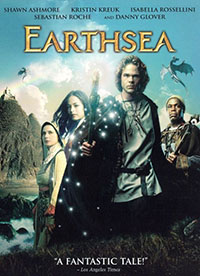
{The Legend of Earthsea's DVD cover, found on Wikipedia.}

Introduction
Plot Summary
The Good
The Bad
Judgment
Closing

Introduction

Normally, I don't do things that aren't movies, but when a request for the Legend of Earthsea (later shortened to Earthsea) came through, I simply could not refuse. Ursula K. Le Guin is a master of the crafts of fantasy and science fiction, and anything based on her work is something that I was sure I could find some good in.

So, let's see what I came out with.


Back to Top
Plot Summary

Ged (Shawn Ashmore) is a typical young man living in a small village. He's skilled with magic and learning from a local wise woman while his father (Dave 'Squatch' Ward) tries to corral him into blacksmithing. Amidst it all though, Ged would rather be spending time with his best friend, Diana (Erin Karpluk). However, beyond the island of Gont, trouble brews. The king of the Kargides, Tygath (Sebastian Roché), is plotting to bring all of the 1,001 islands of Earthsea under his command for the sake of peace.

The king's campaign eventually brings him to Ged's village, where the young wizard uses his wiles to outwit the king's soldiers, but at a terrible cost - the loss of his place as a mere blacksmith and the fulfilment of his greatest desire: to be somebody known and important.

With the promise of his powers pulling him onwards, Ged is thrust into a world of magic and wonder that he cannot begin to comprehend. At the same time, the Kargide king's plan to seize an ultimate, dark power from an order of priestesses is in full swing. Can Ged learn to control his power in time? Will the Kargide king's evil schemes come to fruition? The answers are sure shake all of Earthsea!

Back to Top
The Good

The mini-series begins with some typical fantasy things: the village boy with great hidden power, a mysterious old wise woman, and a call for adventure (some key ingredients in Joseph Campbell's theory of the "Hero's Journey"). Yet these elements are presented in a way that develops them.

We see Ged and Diana (with some of the best chemistry in the series) live out a relationship that's similar to Link and Saria's in The Legend of Zelda: Ocarina of Time.

In fact, the scene where Ged and Diana part ways is just as effective as that in which Link and Saria do the same. We also see Ged and his father's relationship very quickly develop as the two are brought into conflict over the death of Ged's mother and their differing views of what's best for Ged. Plus, the introduction of the great wizard Ogion (Danny Glover) is quite well done.

Earthsea's effects are also quite well done, considering that this was produced in 2004 and on the sort of budget that SyFy (formerly Sci Fi) seems infamous for providing its many mini-series.

In some ways these effects are reminiscent of the animations you'd find in Baldur's Gate on the PC, or of those seen in Hercules: The Legendary Journeys or Xena: Warrior Princess.

The effects aren't breathtakingly realistic (for the most part) but they aren't enough to break the magic and wonder that the mini-series is trying to portray.

On that subject, the world's magic is indeed interesting. Being based on the idea of all things having true names, it doesn't go out of its way to be terribly original (the idea was all the rage among Renaissance thinkers), but it does deliver some intrigue here and there.

The matter of Ged's summoning a shadow - a nameless one - is absolutely fascinating. In fact, this might be the single, best-done part of the movie since his shadow, the Gebbeth (Mark Acheson), is a very effective villain. He's just like Ged, but also always lurking and always threatening until the very end. Unsurprisingly, this is one of the few things brought over from the original novels.

The mini-series' climax definitely delivers, largely because it's the only instance of a real sword fight in the whole thing. This brief duel between Ged and the evil king Tygath is a great fight - possibly because it's the only one we see. Nonetheless, it's definitely a good sign when the series' writers and producers don't go and make their hero an instant swordmaster, and when fight choreography goes fairly smoothly.

Back to Top
The Bad

But the same can't be said for directors and those in charge of casting.

The mini-series' major characters (Ged, Tenar (Kristin Kreuk), Tygath, Thar (Isabella Rossellini), and to some extent Ged's fellow wizard Vetch (Chris Gauthier)) are fairly well-cast, but almost every other actor on screen just doesn't seem to be into it.

One of the essential things that an actor must do in any fantasy movie/mini-series is sell that fantasy; they need to become their character more than ever. This need for an actor to get lost in their role is essential because fantasy stories by their very nature ask their audiences to suspend their disblelief. If the actors aren't entirely into their characters or their lines, that disbelief will be awakened.

It's fair to aim the same sort of double-edged comment at the world's magic system.

The idea of "true names" is a good one to work with, but the reason why it was so popular historically is because it was explained. The original "true language" was thought to be some variation of Hebrew (or, in an eccentric case, Old High Dutch) since that's what the Old Testament was written in, or some sort of celestial or angelic language, since lost to humanity.

Regardless of the varying opinion of whatever the true language is, the point is: People latched onto the idea of an original, Adamic language during the flourishing of humanistic thought in Europe because there were logical speculations about which language is the true language. Not so in Earthsea.

Never are we told who spoke the language of the true names originally, nor how anyone learns true names for things (though there does appear to be a wizarding specialty in true names).

Because we don't get any kind of explanation for this concept it falls flat. Magic can be on the edge of logic (and often is), but it's still within logic. If you don't try to explain it, or even simply have a character say something like "that information is forever lost," then it suggests that you just don't care about keeping your magic system logical.

Moreover, late in the mini-series we learn that faith and magic are somehow opposed to each other. This could make sense if it was explained, but once again no effort is made to explain why there's a rift between two things that are ostensibly forms of extreme concentration.

The other major problem with this mini-series is that it simply tries to do too much. Up until the point where Ged leaves Ogion for the first time, we see enough that we can digest and understand and believe. But once he gets to the magic school the mini-series tries to encapsulate more than it can handle.

Where we could have had a fully realized school with a student body that's as dynamic as that in any of the Harry Potter movies, we get one where we only know the headmaster, Ged's fellow wizard Vetch, the bully Jasper, and a bookish girl who may as well have had a spell of silence on her.

{The redhead on the left communicates almost entirely through looks.}


What's more, the other side of the story, that which is going on with the Kargides and the order of priestesses in charge of protecting the seal on the nameless ones just drags and drags and drags.

Nothing of interest or intrigue is successfully accomplished in this plot-line because it's been done before in its entirey, and, what's more, everywhere it's been done it's been done better. Kossil (Jennifer Calvert) and Tygath's plot to force the high priestess into choosing her as her successor so that she can learn the words to break the seal and she and Tygath can become immortal is played out so predictably that it's almost cringe worthy to watch the transitions from Ged's plot-line to that of the order. Though what Kossil does with one of the women she has to murder along the way is kind of interesting.

Back to Top
Judgment

The TV mini-series Earthsea has its strengths and its weaknesses. It presents some decent actors and some curious characters and wraps them in a fantasy world based on one of the greatest works in the genre, but the essential thing to remember is that it's just that: Based on those books.

What the mini-series fails to capitalize on is the main focus of Le Guin's Earthsea: the conflict between Ged and the Gebbeth that he inadvertently conjures. The otherwise cookie-cutter fantasy story that we get is just filler, essentially. Though why they'd want to do this is beyond understanding.

The cost of making a high-intensity drama where a young wizard faces his inner demons couldn't be that large, and the cast of characters could be unaffected, since that wizard and his demons would have to interact to get across what Le Guin's words did in her writing. Yet this is what we get, this is the Earthsea that was committed to film and publicly aired.

It's an all right mini-series, but it just doesn't bring enough of its potential to bear. Alas, like the wizard that never finds a teacher, this mini-series never found a competent team to bring it together effectively. Watch it for its great beginning, cool climax, and excellent magic, but in between these high points be ready to feel like Ged and Vetch do throughout much of the movie:


So, Freya, grasp this one by the hand if you happen to pass over it, but don't pull, lest its muscled and mighty arm come off of its rotting, leprous corpse.

Back to Top
Closing

Next week, check back here for Part Five of All-Request August: a look for the good in This Means War. Also, check back here every two days for updates on the progress of my blogs' updates.

Back to Top

Friday, August 17, 2012

[Freya-dæg] All-Request August Pt.3: Squirm

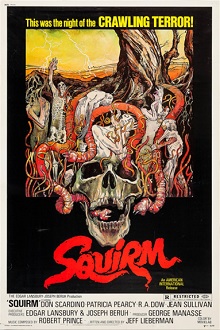
{Squirm's movie poster, found on Wikipedia.}


Introduction
Plot Summary
The Good
The Bad
Judgment
Closing

Introduction

The movie Squirm is one among many in the "nature-strikes-back" sub-genre of horror movies. And perhaps, since the part of nature striking back is none other than the humble worm, the surprise is supposed to horrify as much as the premise itself.

But is this movie really so horrible as to deserve the 30% (from critics) and 28% (from audiences) that it has over at Rotten Tomatoes? Let's find out whether those tomatoes are rotten or just soft because they're worm-eaten.

Back to Top
Plot Summary

Mick, a young man from the city, comes to Fly Creek to meet with a girl he met at an antiques show named Geri. However, the idyllic Southern setting of their romantic rendezvous is ravaged by a storm the night before he sets out and one thing after another goes wrong.

First, he has to wade through a swamp and forest to reach Geri's house when the debris blocks his bus' path, then he's accused of hijacking his egg-cream at the local lunch counter. But things get really weird when Mick and Geri go looking for old man Beardsley, the best antiques dealer in town. Of course, just Mick's presence alone is enough to leave Roger, the hopeful for Geri's heart, seething.

What happened to Mr. Beardsley? Why are worms cropping up where they shouldn't be? And to what lengths will Roger go to to make sure that Mick is taken out of the picture?

Sit back and relax - but, also, be ready to Squirm!

Back to Top
The Good

The acting in this movie is fine, but the accents - the accents are so bad they rebound into the comical.

Everyone except Mick has a Southern drawl of varying intensity. Some of these are light and breathy like those of Geri, her sister and her mother, while others are as heavy as the hillbillies' from Deliverance.

To top off the overdone characters, Mick plays up the role of red-hot lover to a ridiculous extent.


Yet, despite shots like the above, Mick's act is also restrained enough to keep things from going over the top.

The cinematography at times is also fairly well done, considering the movie's genre. Take this excellent dutch angle shot for instance:

{In this shot Geri's mother is saying "Something evil about it."}


For a B-horror flick, Squirm is a good example of the genre. It takes its scares very seriously, and unlike many of the horror films put out today, it relies more on psychological horror than shock horror.

A prime example of this in the film is a scene where Mick and Geri find the Sheriff eating spaghetti with a woman. They tell him about a skeleton they've found, and mention worms a number of times. The woman seems to be there as the audience proxy as she slows herself down and at one point even puts down her utensils - eating spaghetti while talking about worms is never an easy task!

But, the expected scare never happens. None of the spaghetti bits turn out to be the movie's starring monster.

What's more, the movie clearly establishes the potential for the worm-as-spaghetti scare when, earlier in the film, Mick finds a worm in his egg cream (soda) - the next logical step is to have one on a plate of spaghetti, but it never happens. Although it's a relatively small detail, the film is much stronger for leaving this cheap, expected scare out.

Further, even when it doesn't build up the scares, the movie can be down right terrifying. Things get into spoiler territory here, so skip the next paragraph if you're worried about such things.

When Roger gets attacked by the worms we expect them just to kill him. Just to leave him a skeleton as they did the others they've destroyed. Instead, the worms seem to, well, possess him, making him a strange (undead?) worm-man hybrid. This is terrifying visually (thanks to Oscar-winning make-up artist Rick Baker), and also conceptually as we see the worms wriggle up under the skin of Roger's face, leaving welts in their wake.

Back to Top
The Bad

But, why Roger gets possessed while the worms kill everyone else they attack is never explained. This lack of explanation exposes the films' major weakness: its premise is never given any kind of detailed treatment.

Granted, Roger does tell us that when his dad started the worm farm he tried to use electricity to get them out of the ground and that this enraged them (to the point where they bit most of his thumb off), but we don't get any information on how these enraged worms operate.

Case in point, the worms knock down a tree, late in the movie, destroying the dining room in Geri's house while her family and Mick are in it. But this is the first they've knocked down - such a tree's being selected and knocked down suggests some level of consciousness. It seems that they're out to get Mick, and maybe Geri as well.

The other thing that's ill-explained is the worms' being dispersed by "light." This makes little sense because they couldn't have attacked Roger if such was the case, having done so in broad daylight. However, the way that they react to light later in the movie suggests that it's the heat they don't like, not the light. And if this were established as the worm deterrent rather than light when Mick voices his realization, it would help the movie as a whole make more sense.

Now, the same narrow miss at sense is present in the case of Roger.

Because he had his thumb mostly eaten by worms before, it's possible that he has some kind of bond with them. Pair that with his hatred for Mick as competition in the romantic field (though Geri's mother seems to have the hots for him, for some reason), and you have yourself an explanation for his becoming a weird quasi-zombie after the worms' initial attack on him. But this connection is never clearly established. It's strongly implied, but nothing explicit is ever said about it.

Perhaps, though, this is the result of the scientist character being left out of this movie. There's no one in it to say "don't you see...?" or "Of course!" This character could also point out how why, in the world of the movie, this works:

{I've heard of people being oily - but this is pretty ridiculous.}

Photobucket

In fact, a scientist character would be incredibly useful at the movie's end where there are so many loose ends that you could bait all the fishing hooks in a salmon derby with them.

Back to Top
Judgment

Squirm is the kind of movie that drive-in theatres would show back when there were more than a few handfuls of drive-in theatres left within the Western world. It's got it's cheesy moments, it's acceptable acting, and its genuinely terrifying bits (so it's also the kind of movie any real life, mack-daddy Mick would approve of). But there are no drive-in theatres anymore.

Times have changed, and the horror genre has changed.

The modern horror movie genre is divided into two sides: One that relies almost entirely on shock horror, and another that relies on human psychology for its scares. Squirm falls in between these two, and so were it to be released now it would probably fall into complete obscurity.

Yet on it's own it does still do what a horror is supposed to do: frighten, scare, and induce a kind of contained paranoia or fear.

However, a truly good horror movie leaves this fear, this paranoia lingering in your mind so that when you flick off the lights that fear can manifest in the darkness of your own home.

Squirm does not manage to do this because it doesn't explain itself well enough. Is Roger possessed? Can Roger control the worms? Does the whole town wind up dead? After the power's fixed and the electricity is no longer running into the ground do the worms go back to being docile?

It's a horror movie that scares, but at the same time forgets that it also needs to tell a complete and coherent story.

So, Freya, fly low if you like, but leave your hook empty for another of the movies in the Field of Fallen Films - this one seems too comfortable where it is, down there in the dark with its worms for company.

Back to Top
Closing

Next week this blog is going to be left to fallow. I'm going to take some time to recalibrate my writing activities so that I can get some of my larger fiction projects moving again and so that I can tidy some things up with my translation blog (as well as with this one).

For full details of the temporary stoppage, check back here tomorrow.

But, though I'm not going to be updating Monday-Thursday, I still plan on finishing All-Request August with a look at the TV miniseries loosely based on the work by Ursula K. LeGuin: Earthsea. So, watch for that review in one week's time, and for tomorrow's fully detailed temporary blog stoppage guide.

Back to Top

Friday, July 13, 2012

[Freya-dæg] Nicolas Cage Month Pt. 2: Season of the Witch Review

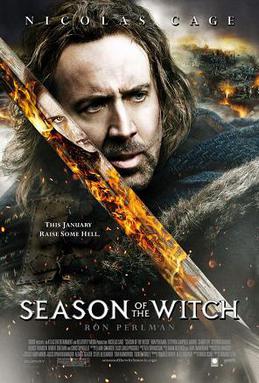
{The Season of the Witch's movie poster, found on Wikipedia.}

Introduction
Plot Summary
The Good
The Bad
Judgment
Closing

Introduction

Part two of Nicolas Cage month is here: A search for the good in the 2011 medieval romp, Season of the Witch.

Generally lambasted and looked down upon among critics (10%) and faring only slightly better among fans (32%), let's see just what's good, what's bad, and how they measure up.

Back to Top
Plot Summary

It's the fourteenth century and the crusades are in full swing in the Middle East, while alleged witches are being persecuted in Europe. Enter our two protagonists, Behman (Cage himself) and Felson (Ron Perlman).

After realizing that a truly good God would not call upon men to slaughter innocents, the two desert and start out across the country only to find that a strange plague has struck the land.

However, while on the lam the two are discovered, imprisoned, and then contracted to take an accused witch that people believe responsible for the plague to a monastery where she can be properly dealt with.

Having no other choice, the two set out with the priest Debelzaq (Stephen Campbell Moore), the swindling guide Hagamar (Stephen Graham), and Kay, a young altar boy seeking knighthood (Robert Sheehan). Their journey to the monastery takes them over some dangerous terrain, but only when they arrive at the monastery will they discover that it's not bear, wolf, or boar season, but it is indeed the Season of the Witch.

Back to Top
The Good

This is not a historical movie by any means - but it is a very medieval movie in the way that it's told, in the way that dialogue is written, and in the way that characters interact.

This isn't to say that it's in iambic pentameter and characters pull elaborate schemes on each other, but instead that were there a medieval bard alive today, this is the sort of story that he would tell. For Season of the Witch is the stuff of medieval romances: magic, adventure, characters who play well off of each other, and intrigue.

Plus, the movie puts the power of language front and center as twice we're shown that saying the proper words (in Latin!) over the bodies of women killed when hung or drowned (tested for being witches, in other words) is the best way to ensure that their bodies are not reanimated.

The fact that these words are in Latin, only weilded by priests, and contained in an ornate book, does a lot to really make the medieval setting accurate. Theatricality is a big part of medieval entertainment, and this movie is definitely theatrical.

This theatricality is further helped by the movie's special effects. They aren't perfectly photo-realistic, but their style helps keep the atmosphere of a medieval story going strong throughout.

The movie also puts forth some really amazing things (especially considering that it's an action movie): The power of psychological warfare on an individual basis, some great suspenseful bits, an excellent cast of characters, and a book that is so obscure it's a triumphant surprise to see it represented on screen.

{The woman Behman slew in a crusade raid, as she appears in his nightmare. This is where over-the-top lives in Season of the Witch.}


Back to Top
The Bad

However, the movie's an hour and a half long and could easily shed 1/3 of that length if a plot hole was removed.

The reason that Behman and co. need to go to the monastery is because that's where there's a book that describes the necessary rituals for dealing with the witch they have captured and believe to be responsible for the plague. So they only need to get there for the book. A thing that they could have brought to them in the city.

Making this minor change would cut out all of the traveling through the dangerous wastes and forest that the Behman's party has to go through, it would mean that there' be no zombie monks, and it would help the movie keep its complications as the movie's final fight would likely happen in an area populated with innocents rather than re-animated, plague-ridden corpses.

But, because the writer, Bragi F. Schut, has them go the monastery the story becomes very thin very fast.

The fact that two key characters, Kay and the witch, are not given any kind of backstory whatsoever certainly doesn't help matters either.

Kay's backstory could explain why he's an altar boy and not already on the way to knighthood. It could answer questions like: Did his father leave his estate to someone else? And, did Kay disgrace himself in the lists?

And we definitely need to know more about the witch because *spoilers* she's possessed, */spoilers* so knowing whether she was devout or not, and just how and why and when she was possessed would fill in so much about her character. Plus more development of her character would set her up to say something more profound than 'this is what really happened with the plague' at the end of the movie.

As per the final battle scene and its zombie monks, the whole thing is disappointing. It's effectively action-packed and all of that, but the entire trip from the city to the monastery could be expanded and lightly edited into a taut full-length psychological thriller, so an action-packed climax is a let down.

Further, although the power of language and of books is definitely rather accurate, there are other details that are not. Specifically, the oath that Behman has Kay recite when he knights him. This oath mentions on the martial duties of a knight, and perhaps this is the sort of oath that knights would give if knighted in the field, but knighthood isn't just about messing up people's sh**.

A quick summary of an actual knightly oath involves things like avoiding trafficking with traitors, protecting women, and observing fasts and abstinences.

After all, knights were guys with swords, but they were also nobility, and therefore had to set something of an example for the rest of society. Moreover, some knights also fulfilled the role of rulers in the medieval three estates system (a social model that broke society down into those who work (the Peasants), those who rule/fight (the Nobles, including knights), and those who pray (the Clergy)). So their code of behaviour goes a bit beyond smiting enemies.

Back to Top
Judgment

The Season of the Witch is a movie that balances itself as well as its lead characters do when they cross a particularly rickety bridge.

The story is thin, the climactic battle is disappointing, and there isn't enough backstory given for some of the main characters. But, those characters still play well off of each other, the setting is stylized but rather accurate, and magic and the demonic are very well portrayed.

In the end though, what tips the scales is the modern medieval romance style of the movie as a whole. That's something of a rarity among medieval action movies, a group of films that are more often too concerned with packing themselves with flashing steel and overflowing flagons of sudsy ale to get into any medieval depth.

So, Freya, as you skim the field of fallen films, reach down your powerful arm and pull this one up with you to movie Valhalla.

For that is as true a judgment today as it was when the judged was written, directed, and produced. Amen.

{A peek into the movie's take on the Key of Solomon.}


Back to Top
Closing

Next week check back here for another creative writing piece, an editorial on a piece of the newest news, and part three of Nicolas Cage month - a search for the good in 2011's Trespass.

Back to Top

Wednesday, June 27, 2012

[Wōdnes-dæg] Ebooks: Easing Working as a Writer

Introduction
The Article Summed Up
Not New, But Great
Publishing's Next Stage and Mainstream Acknowledgement
Closing

{A simple and intriguing image, from a simply intriguing blog: These Are My Days....}


Back To Top
Introduction

On the front page of the Globe and Mail Arts section of Wednesday 27 June 2012, is an article about a 14,000 word ebook and what it means for journalism, as well as for writers more generally.

Back To Top
The Article Summed Up

The article delves into the story behind Paula Todd's ebook about Karla Homolka, Finding Karla. Todd discovered that Homolka has been living in Guadeloupe with three young children, and wanted to get the story out more quickly than the standard months-long magazine publishing schedule permits.

So, she published her story as an ebook with Amazon. It's been in the top 10 list of Kindle Singles since its release on Thursday. Combine that ranking with the price tag of $3, and Todd must be seeing some tidy returns on her three-week, NaNoWriMo-like efforts

Simon Houpt, the article's writer, then goes on to explain and illustrate that this means that writers can take back some of the power - and the profits - that they formerly had to relinquish to publishers. Specifically, he notes that ebooks have helped writers to fight for the electronic rights to their works.

Back To Top
Not New, But Great

This is great news.

Not because it's anything especially new, but because this information's being printed in a high profile newspaper suggests that indie authors can expect to get a little bit more cred in the publishing industry. This is definitely a good thing, since those who take the ebook route are generally painted with a very broad brush previously dipped in a wide, deep pot of scorn by more than a few in the mainstream publishing industry.

Though there are some who might validly argue that along with the market for ebooks, a market for ebook editors needs to be established.

Back To Top
Publishing's Next Stage and Mainstream Acknowledgement

One article is not going to change that entirely, but the acknowledgement of indie authors' successes does suggest that traditional media and those representing it are starting to take ebooks seriously.

Does this mean that indie authors might not be able to add that adjective to their title soon? Likely not.

The printing press made it possible to create multiple copies of a book relatively quickly and cheaply. This meant that more people could put their ideas and stories to paper - hence the propagation of pamphlets and broadsheets and books from the 16th century onwards. But using a press is a process that requires time, special training, and specialized equipment.

E-publishing requires nothing so hard to get and efficiently operate as a printing press. It just requires a computer capable of word processing and connecting to the internet. More and more people are able to say that they have this equipment, and so there are more and more e-books being published on a daily basis.

So many are these e-authors, in fact, that the ebook industry might just be impossible to regulate in the same way as the traditional sort of publishing is with its queries and editors and budget considerations.

So, the "indie" label isn't going anywhere. But just as the case has been with indie musicians going mainstream, the growing recognition of ebooks as a serious alternative source for longer pieces of writing means that it may just get easier for indie authors to go mainstream.

Back To Top
Closing

Check back here on Friday for a hunt for the good in Wrath of the Titans, and tomorrow for another edition of Annotated Links.

Back To Top

Wednesday, March 28, 2012

[Wōdnes-dæg] If the Bard's a Barrister, What's in it for his Audience?

Introduction
Shakespeare's Education
Elizabethan Litigiousness
Playgoers Themselves
Closing
References

{The Sander's Portrait. Image from an article hosted on the University of Guelph website.}


Introduction

A recent article from newswise points to some research being done at the University of Mississippi by one Professor Gregory Heyworth. Professor Heyworth's query: Was Shakespeare an Attorney?

Professor Heyworth bases his question on a comparison of a known signature of the Bard's with one found on the "Archaionomia," a famed Elizabethan collection of Anglo-Saxon laws. Using the newest in digital imaging technology, Professor Heyworth and three graduate students were able to impose the signature in question on one that's certified to be genuine. However, the article never really gives a conclusion to the story since the research appears to be ongoing.

In any case, that's one detailed look at old ink.

But it does raise the intriguing question of whether or not Shakespeare was a lawyer. It's intriguing because so little is known about his life between his time at grammar school and his fame as a playwright. If Shakespeare was a lawyer of whatever stripe it could also nicely relate to the abundance of legal references in Shakespeare's plays.

However, it doesn't have to be that simple. Even Professor Heyworth and his team admit that it might not be the signature of the famous playwright William Shakespeare that they're superimposing over the Bard's authentic mark. "There were multiple people with that name" at the time," Professor Heyworth noted.1

Even if it does, someday, turn out to be the Bard's signature and it comes to light that he indeed was an attorney before he became famous as a playwright, there's the question of his education.

Back To Top
Shakespeare's Education

If the records we have for his birth are accurate, he started life shortly before April 26, 1564.2 However, rather than going onto university at the the age of 14 (as was standard at the time), he was pulled from the system. For his father had gone too far into debt, and had lost his social standing in Stratford,3 due in part to charging too much interest on a loan and, possibly, due to his being a Catholic.

Although Shakespeare becomes hard to track after leaving the school system, it's fair to say that if he had gone to university and studied law there would be some record of (or from) his doing so.

A lack of such a record could be chalked up to a loss of these documents in a fire or a theft, but that's an event that wouldn't have been forgotten or left out of history books.

On the other hand, perhaps Shakespeare's education in grammar school and contemporary London was enough to land him a position as a document reviewer of sorts. Someone who didn't study law to practice it, but who was well enough aware of the way language worked to be a legal copy-editor. That kind of exposure to legal material would definitely brand it into your memory and then you'd be able to pull it out for plays and cocktail parties with ease.

Such a proposition might not be as wild as you think, since, much like modern America, the people of Elizabethan London were often suing each other.

Back To Top
Elizabethan Litigiousness

A lot of their litigiousness had to do with accusations of business malpractice, family relations (usually in-laws and step-children), or with interest and loans. This last one was hotly debated at the time because orthodox Christian belief bans interest, whereas economic theory and practice had no problem with it. Loans with interest helped keep people from being cheated, though charging 'too much' interest was regarded in the same light.

Further, from what's left in documents of the time (diaries, plays, treatises), it seems that the law was not just the exclusive concern of a group of highly trained individuals. These individuals definitely would have an incredible depth of legal knowledge, but the common man or woman might also have a considerable amount of legal know-how when it came to inheritance or the maximum interest rate. Not only were they litigious, but the common people of Elizabethan England did consist of a trading class, and this trading class would've had to have dealt with the law in some way or other.

Back To Top
Playgoers Themselves

Now, if Shakespeare's plays are packed with legal terms and references, why didn't these discourage or disinterest playgoers? If the playgoers of Shakespeare's day just wanted bawdy comedy or gory spectacle, why bother going to see the latest play by the guy who puts all of that the legal jargon on the stage? Either people were interested in such things for some now lost reason, or these references resonated or intrigued because of some level of familiarity.

The fact that Elizabethans weren't shy about bringing each other to court suggests just such a general familiarity.

Back To Top
Closing

So, the question "what were playgoers getting out of these legal references, if anything?" needs to be added to the question of the Bard's being a barrister. Maybe these nods to the law and its terminology was a bit of a thrill because playgoers were familiar with them. Maybe they worked because such references offered special insight into a society that seemed alien and closed off to them (that of a legal specialist, who knew the law's theory as well as practice).

Feel free to add your thoughts in the comments.

And, on Friday, check back here for an attempt to redeem the megaflop Gigli.

Back To Top
References

1. "Was the Bard a Barrister? Signature Analysis May Offer Clues." Newswise, 23 March 2012.

2. "William Shakespeare." Wikipedia. 23 March 2012.

3. "Elizabethan Education." William Shakespeare Biography. 28 March 2012.

Back To Top

Friday, February 24, 2012

[Freya-dæg] A Movie That's Been Unnecessarily Burked

It seems that there's something that I should have considered in last week's review of The Love Guru. Watching such a bad movie will make any movie watched immediately (perhaps up to a week) afterwards seem amazing. At least, that's the feeling that I'm left with after reading reviews of Burke and Hare - which got a 34% from critics and a 37% from audiences on Rotten Tomatoes.

However, I seriously disagree with these numbers.

But what am I disagreeing with? What are so many peoples' beefs with this movie?

The biggest beef, I think, is the movie's being labelled a "dark comedy."

Yes, there are laughs. Yes, there are murders and messy 19th century dissections. But these two elements of "dark comedy" aren't pushed as much as you might expect from a movie labelled as such.

There are some good laughs and witty lines (maybe these seem even more so after watching The Love Guru), and there are some gory and grim scenes too. Yet nothing caused the laughs that Shaun of the Dead brought out, or the sort of atmosphere of fear that a story of 19th century murderers (the movie is based on the real case of Burke and Hare) often does.

Aside from the movie's mis-labelling, the story itself also seems to have been softened. Of Burke and Hare, Hare (Andy Serkis) is the schemer and the plotter, while Burke (Simon Pegg) is played more naively. Hardly do they seem like hard-boiled murderers for money/medical science.

One specific plot point stands out as falling flat.

It happens in the scene where Edinburgh's crime boss, Ferguson, takes Hare aside for the second time. Ferguson asks Hare to be his partner, and says that he has a choice to accept or decline, despite the situation suggesting that to decline would mean death.

My feeling is that Hare wouldn't be killed if he refused (as he and Burke were earlier in the movie), but it isn't that he'd be tossed from the carriage either. Further, if the fact that Hare's hesitation and the lack of a definite answer is supposed to humanize Hare, then the scene seems even more out of place.

Moreover, the movie plays the scene as a major point in the plot - but to me there's no real conflict present in it. Hare is the amoral one of the pair, and so of course he's going to accept, or, if he refuses, be able to slip through the hands of death.

More generally, there's too much going on in the movie plot-wise.

Three plot lines (Burke and Hare trying to make a buck, Ginny (played by Isla Fisher) trying to put on an all female Macbeth, and Drs. Knox and Munroe competing for glory) are definitely not too many, but one of these shouldn't have as much screen time as it does if the movie is supposed to be dark. Yes, alas, I'm looking at you all-ladies-Macbeth, or, rather, the Ginny-Burke romantic subplot.

However, this romantic subplot is engaging and enthralling. It's definitely nothing new in the world of cinema romance, but partly because Simon Pegg is playing the naive sidekick rather than the serious ideas man (as he had in Shaun of the Dead and Hot Fuzz), partly because it involves Shakespeare, and partly because Isla Fisher effectively convinced me that she wanted to put on the Scottish play, it works.

Actually, both Fisher and Jessica Hynes (playing Lucky, Hare's wife) are excellent matches for their male counterparts and show that they've got serious chops on their own, too.

But it is really the relationships between Burke and Ginny and Hare and Lucky that fire up the movie. As with the romantic subplot, these relationships don't break new ground or anything, but they really give an extra punch to the movie.

In particular, Burke and Ginny's relationship is so engaging that when Burke suggests that she goes to London and says that she doesn't need her anymore I found myself preemptively mouthing her reply. Yes, it was that predictable, but their relationship is also so engaging that I found myself mouthing lines.

And bolstering the strength of the main players in the flick, are a number of cameos and other fine stars (Tim Curry, Bill Bailey, and the inimitable Christopher Lee). These might just be little one offs or brief scenes, but the appearance of these actors is amazing. In a similar vein, references to and cameos of famous Romantic Poets are presented as well. I think I know why this movie only made $4,833 ($945 opening weekend) at the US Box Office.

Some solid bits of dialogue are also on offer.

Among these exchanges are incisive and revelatory bits of 19th century Scotland (Hare (on the cost of living in Edinburgh): "I thought life out here was supposed to be cheap" McTavish: "It is.") and those that are at the level of a highbrow Love Guru (Dr Munroe (of Dr. Knox's new students): "Are they enjoying your lectures?" Dr. Knox: "Not as much as they're enjoying your wife"). In either case, Mordecai and Rigby of Regular Show fame aptly capture my reaction to such wit:

{Found on Tumblr, uploaded by cferrr.}


The historical details that are included in the film are excellent as well - from fashion to architecture and design. Most notable of all such references being the offer of "chocolate" to the captain of the militia when he's meeting Lord Harrington. But they don't mean a piece or a chunk - oh no.

They mean hot chocolate, a drink made of cacao mixed with various spices. A drink that was a high style contender in the UK until coffee shops proliferated in the middle of the 18th century. My guess as to why hot chocolate's still around the chambers of power in 1828 Edinburgh: they knew a good thing when they had it and were slow to make the change.

Before I can securely pass judgment on Burke and Hare, I need to address head on one last issue: Ginny's all female Macbeth production.

Critics are perfectly right to ask why it's included. However, I believe that I have an answer.

It's kind of a contrived means of doing so, but I think that the Macbeth rigmarole is included as a reflection of Burke and Hare's consciences. Quite a bit like the play within a play in Hamlet. In answer to the question of "why Ginny?" my theory is that it's the writers' way of showing that she's a strong female character, as well as giving the romantic subplot more detail. Perhaps it's an overly elaborate way of accomplishing these ends, but it's the way the writers went with.

Ultimately, it's safe to say that I disagree entirely with the overall ratings from both the critics and the audience as they appear on Rotten Tomatoes.

Burke and Hare is a film featuring great actors, great characters, awesome literary and historical references, and a few chuckles here and there. In fact, this movie illustrates my general taste in movies: hammy drama and comedy that balance the subtle and the slapstick.

Burke and Hare might not be acted as hammily as some of the old Hammer movies that it refers to, but the comedy is a refreshing blend. The Love Guru may be *ahem* thanked for that, but I am also confident that this movie stands on its own merits as well. After all it's this English major's dream come true to see a 19th century movie that isn't set in London.

And screen-cap Tim Curry also approves.


So, Freya, fly low that you may bear this one up as though it were on eagle's wings.

Check back after the weekend for the waxing moon installment of my musings on teacher's college, and if you've got your own thoughts on Burke and Hare that you want to share, leave me a comment.

Thursday, December 1, 2011

SFContario-Inspired Convention Musings

Conventions. If you have ever lived in a mid-sized city with a fair sized hotel you have probably seen signs for one sort of convention or another over the summer months. Psychic Expo. Philatelists United. Comic Books and Assorted Figurines. Niche markets, specific demographics, a bunch of people gathered together with similar interests that aim to concentrate on a single topic for the span of a few days. But is it worthwhile to go to a convention if you consider yourself a member of such a niche (or someone interested in becoming one)? Even a convention that might not boast the star power of something like the famed San Diego Comicon or a World Fantasy Convention? I have not been to a large convention for a while, but having recently gone to a smaller convention, I have been put into mind of convention going, and what these events can be all about. The smaller convention in question is SFContario 2, hosted in Toronto, Ontario, Canada.

Like most writing conventions, SFContario had plenty of books in its sales area (or dealer's room, in "con speak"). This is something of an aside, but because there are so many of them at writing conventions big and small, small press books need to be talked about. These books are generally fine, though sometimes their editing seems a bit slipshod, but what always bothers me about them is that their cover art is terrible. The somewhat generic, bad cgi effect used to create many of them just screams amateur to me. A lot of the covers also seem crowded, and it is generally the best covers that make the greatest use of empty space. In short, those books that don't show the books' characters standing in a dramatic pose appeal to me the most. After all, if I wanted a shot of main characters gazing out toward the viewer or some kind of middle distance, I would just find a cinema and walk around, admiring the posters. Just as I'm insistent on completing my Song of Ice and Fire collection without buying copies that are marked with "Watch the series on HBO" I prefer to keep the media of film and print separate. They use different methods to tell stories, and they have different strengths and weaknesses, which I may get into in a later entry.

Stepping outside the dealer's room of your standard writing convention, these meetings are basically made up of panels. On this point, I have to say that a smaller convention is likely to give better panels. Larger conventions can draw some very interesting and well-known guests, but something that often happens, especially in my experience, is that the star power of such prominent figures can often cast a glamour over a person who is new to conventions. This can lead to the need for a lot of gutsiness to ask a question during a panel, or to approach a panelist afterwards - both of which being very rewarding experiences. A smaller convention, on the other hand, has a feeling that is more similar to a small group workshop, where everyone is at least visibly familiar to everyone else, and the big stars are big stars within their niche, rather than at large. This difference is important, I think, because it makes the big names at a smaller convention approachable by the dedicated fan and curious newcomer alike. After all, the dedicated fan is already familiar with the niche star and their work, and to the newcomer the star is just another interesting panelist, with little to distinguish them from the average convention-goer except for an extra badge or ribbon on their chest

However, smaller conventions do mean smaller convention spaces. Again, this makes it easier to meet the same people over and over again, and thus build a sense of community, but it also means that things can be claustrophobic at times. Of course, larger conventions often have an opposite problem - plenty of space and also plenty of people which can at times make almost anyone feel a little agoraphobic. However, a common trait of any convention regardless of its size is the consuite, a room in which a convention will offer free food, beverages, and seating to all registered convention-goers. At a big convention where the sheer number of people can be overwhelming these consuites are great spaces in which to relax with a smaller crowd, and at smaller conventions these consuites are usually spacious enough to help restore a person's feeling of personal space.

Considering these aspects of conventions - the dealer's room, panels, and the consuite - I think that SFContario 2 was well worth the price of admission. The dealer's room was big enough for most of the author guests to set up shop in, the panels were particularly well done, and the consuite featured everything from chips to vegetables to cheese to Chinese takeout. Two extra notes about the panels, however. First, one panel in particular was incredibly interesting to me. This panel, called SFContario Idol, involved the anonymous submission of the first page of a novel or short story which would be read aloud judged by a panel of guest editors. The editors did mention that they were going to be more exacting than usual, but the fact that details like writing out sound effects or using individual words (such as "shards") were sometimes enough to discount a submission was really quite shocking to me. Granted, when one of the editors replied to another who expounded on the original disclaimer by saying that he would often receive 1000 submissions a month for approximately 10 spots in a magazine the stringency of the criteria made sense. Nonetheless, that panel alone made me glad that I attended.

The other point about panels that I want to raise is the matter of repetition. At the larger conventions that I went to often 30 of roughly 100 panels would be repeated from year to year. I can't confirm it just yet, having only ever gone to a smaller convention, I fear that this panel repetition would happen on a wider scale at these smaller dos. I can't confirm this, though, having only been to one small convention thus far, but I hope that I'm right only in the sense that university departments offer the same basic group of courses every year and professors give them a personal spin. Essentially, though if a similar proportion of panels are repeated at the very least a smaller convention has the greater benefit of fostering closer conversations between attendees and panelists. And for that, if you are interested in finding out more about your niche or interest rather than running out to pitch an idea/story to an agent (such things happen more often at bigger conventions), a smaller convention is probably a better place to start than a larger one.

And as per SFContario - I will definitely be heading back next year. A dealer's room that doesn't overshadow the rest of the convention, a hospitable consuite, and excellent, informative panels make this a great weekend of meeting other writers and editors and discussing the written word.

Friday, November 11, 2011

The Title Itself

Coming at the tail end of maybe one of the most quoted passages of the bible outside of the words of Jesus himself, the verse from which this blog's title comes has always fascinated me.

"For now we see through a glass, darkly; but then face to face; now I know in part; but then shall I know even as also I am known." (1 Cor 13:12)

Maybe it's the concentration on knowledge, or maybe it's the simple explanation of the world we currently perceive and that which we could - of course with the Christian teleological worldview, will - see. For whatever reason this passage has always arrested my attention, and now I want to try to figure out why. So, following the general process of a close reading (looking at context, and then the passage itself), let's try to find out.

First, it comes after what I think is one of the most overly quoted passages of the bible: the list of what "love" (or, if you're reading the rockin' King James Version, "charity") is. I know that this passage is sweet at weddings and likely gone to by lovers in doubt, but it needs to be put to rest. The spirit of those words still seems true but their flesh is as worn as one who is forced to till by hand a 20 acre field everyday. So, to all of those looking for quotes about love for MC-ing duties or general talking into microphones at big gatherings, I implore you to look elsewhere. It's called "The Bible" because there was a time when it really was "The Book" - the only book in many people's libraries (possession, even). Don't let one worn passage be the scope of your wandering through it.

Anyway, looking at this passage a little more objectively, what can be said about it? At the base it begins as an indirect description of the power of charity, that even if you display all of these other virtues and knowledges but lack charity, your achievements are meaningless. Then it moves into a straight list with an easy lilting rhythm, the kind that can lull. And I think that this rhythm is important, because the opening may grab an audience's attention with its forceful "Though I speak with the tongues of men and of angels, and have not charity, I am become as sounding brass, or a tinkling cymbal" (1 Cor 13:1), But then things grow more soothing after two verses of that indirect definition of charity. Verse 4 states clearly "Charity suffereth long, and is kind; charity envieth not; charity vaunteth not itself, is not puffed up," (1 Cor 13:4) easing into a steady rhythm (here, of 10-7-12 syllabled statements). Then in verse 9, St. Paul breaks to explain knowledge and prophecy, and how they are only partial things. I think that it's significant that St. Paul does this in a markedly shorter statement than those that precede it. What this shortness lacks in a lumbering rhythm it makes up for with its spry repetition. And so we see a kind of return to the original firing up of the audience at hand, though in a much less confrontational way. Effectively then, before getting to what I consider the point of this passage, St. Paul has grabbed his readers' attention, lulled them along, and then reminded them of the seriousness of what he has to say.

Verse 10 gets into his prediction about when wholeness comes all things that are in part "shall be done away." A verse that I read as his vaunting upwards to where his point is. Running with this reading, the next verse, in which he uses an analogy of childhood and adulthood to describe the now and the then, is like his time in the air before landing at his point in verse 12. Transformation is emphasized here in verse 11, I think, because of the emphasis on the fuzzy present (a present that is grammatically the present, but as suggested by the analogy (and what follows) is more of a past) and a vague future as indicated by "when...then." The first indication of any temporal definitiveness comes at the beginning of verse 12 "For now...," when he lands firmly from the air, and has arrived at his point. What follows is a concluding verse which gives a clear indication that though faith, hope, and charity (interestingly the daughters of St. Sophia, which if, for some crackpot reason is translated from Greek would be St. Wisdom) "now abideth," charity is "the greatest of these" (1 Cor 13:13).

But to go back to verse 12. Along with the emphasis on knowledge and perception, this is also where things get stylistically cool.

"For now..." itself is very stylish, since instead of just being a terse "now," "For" gives it an added push; it gives it a kind of ramp by which the audience can climb aboard this "now," or if you like, can scrabble up the rock face on the opposite side of the precipice he just leapt. The statement that follows is sheer elegance, even in modern translations. There's just something really simply beautiful about shuffling an adverb to the end of a clause. "...we see through a glass, darkly." Not "we darkly see through a glass," or "we see darkly through a glass," but "we see through a glass, darkly." Almost like the Roman rhetoricians of Cicero's day, who advocated for the verb to be saved for the end of a sentence for the best effect, the full meaning of the statement isn't disclosed until the very end. I think that this helps to shed light on the whole passage's meaning since it does very little to diminish the knowledge and the prophecy which he has dismissed as being only partial. He isn't saying that it's a cracked glass, or a false one, but that it is simply "see[n] through...darkly." There are clouds in the knowledge, in the prophecies; there are things in there that cannot be clearly discerned. The comma which is used to separate "darkly" from the rest of the clause even imitates this statement's meaning on a prosodic level.

First within the statement "We see through a glass, darkly," the act of seeing through a glass is stated clearly without any punching up. But then, as if suggesting that the clouds are an after thought or something only noticed throught scrutiny, "darkly" is added in after the pause implied by the comma. Read aloud, and if assumed to be an as-it-happens narration, it sounds like the realization of the clouded state of perception dawns just as the glass is focused on.

Beyond its being an articulation of a failing of our current perception on some level there isn't a much grander meaning here, but this passage's delivery of the message is just so striking to me because of the way in which it is delivered. So calmly after the bluster and the listing. So placed that it seems like it is a moment, a statement, from when the glass is clear, but that moment is fleeting and so the author can only fall back on his meditations on charity for his conclusion. After, of course, pausing when realizing that the glass is seen through darkly. A moment of clarity so brief that it is obscured before it can even be exploited.

So in brief, the context in which the passage in question is found is that of a capstone, if you will. A kind of rhetorical high point climbed to first through somewhat violent pushing, and then gentle coaxing, and finally a clarifying climb to where things are sussed out and explained and where they plateau with the passage in question before gently sloping down to the conclusion about those three virtues and charity being their chief.

So what does that matter? Well, it matters because it's the point in the passage where the least effort really need be exerted. Already St. Paul has brought his audience up to where he wanted them, and so he just has to deliver the message. The directness of that message being offset by "For now...," a very direct opener in and of itself. The fact that the glass is seen through darkly should also be read back into the oh-so-precious list about charity/love as well. If we keep in mind that things as we see them are dim, then I think that there are some suggestions that charity or love do not have to be conscious acts or beliefs, but should be read as modes of acting, mindsets in a sense. A deed done from knowledge with or without charity is, on the face of it, the same act. But add charity to the mind of the person doing that act and something changes - a subtle gesture, an extra tone to a word - and that changes the perception of the act. Read as a whole, I would argue that this passage isn't so much about charity being patient, kind, etc, but that charity is a kind of way to get glimpses through a clear glass.

This verse is ecstatic and grammatical. And I love it. But, like a climb up a mountainside to see a sunrise or to drink from a spring, you've got to get dirty to really enjoy it.