I know that I originally planned to re-launch this blog and Tongues in Jars for December, but recently my time has been short. I'll spare you the regular spiel about working three jobs and planning to move out and etc., etc. The shortest possible version is that I just haven't really figured out exactly what I want to do with A Glass Darkly going forward.
Now, I'm still going to blog (as is plain in my resuming regular updates at Tongues in Jars).
However, the big difference between my blogging in the future and my blogging in the past is that I'm only going to dedicate 1/4 of my writing time and energy to blogging. The other 3/4 are going to my novels, short stories, and poetry. Nonetheless, I want to keep updating these blog regularly. The best way to do this, as far as I've been able to figure, is to simply write more fluid entries.
So, rather than sitting down, planning out, strenuously editing and drafting each blog entry, from now on my entries will be shorter. Ultimately, the purpose of these blogs is to publicly indulge my hobbies, and to give you all a way to get to know me and what to expect from my writing. My blog entries will still have the usual polish, though the fiction and poetry I post here will still be drafts and thus a little unpolished. Think of them as the sketches that artists might post on their sites.
The new year's also going to bring some changes to A Glass Darkly's design and, possibly, name. I'll still post creative writing on Mondays, editorials will return on Wednesdays, and reviews will go up on Fridays. These reviews will mostly be of books, but there'll still be some movie reviews sprinkled in for good measure. But, these entries won't necessarily be regular.
Along with these irregular entries, the plan right now is to post thought pieces based on what I'm playing and reading every day. I've got a crazy book/video game backlog, and so there's plenty of fodder for free-writing. The difference between these entries and Wednesday's editorials will be that the former will be free-flowing wanderings with words, while the latter will usually be more concentrated mini-essays that try to make a point.
So, now that all that's out there - what about the rest of December? Well, for now all I can say is that I don't expect to get much up and running here. I might do one final movie review, either of a bad Christmas movie or of the famous flop Ishtar, but doing either seems unlikely. Instead, I can say for sure that Tongues in Jars will keep getting updated on a weekly basis, and I'll be publishing an article over on examiner.com every week as well.
So, watch this space, gentle reader, and something will appear!
Back To Top
Showing posts with label books. Show all posts
Showing posts with label books. Show all posts
Wednesday, December 12, 2012

Monday, October 22, 2012
[Moon-dæg] A West Coast Yawp
Context
West Coast Yawp
Closing
Back To Top
Context
Today's poem is one of several "yawps" I wrote while living over in Victoria, BC. Like this majority of these pieces, this one combines two of the larger hurdles of that experience: the weather and the burden of grad school.
In true yawp-like fashion, it might not make perfect logical sense, but logic isn't so much the point as is putting out words that stir emotions and produce strong images.
As always, you can leave your own thoughts of the poem below in the comments.
Back To Top
West Coast Yawp
My eyes hoard the written word
And pass out its meaning like a
Miserly king
On the verge of becoming a dragon -
Ready to flaunt his draconitas
In the trick of his new found tail.
All the bone-houses and heart-thought
Of dead poets and buried heroes:
Now no help to me.
Scholar voices bound the crenellations
Of my cranium
And pipe up treble loud
when I place my nose into a book;
Something has gone out
Some spark or other has snuffed it.
More light,
More light,
Lest the West Coast wind
Topple my last lit tapers.
Back To Top
Closing
Check back here Friday for a search through the sins of The Convent for part Four of Shocktober.
In the meantime, check out tomorrow's Latin ("Dum Diane vitrea") entry and Thursday's Old English (Beowulf) entry over at Tongues in Jars!
Back To Top
West Coast Yawp
Closing
 |
Back To Top
Context
Today's poem is one of several "yawps" I wrote while living over in Victoria, BC. Like this majority of these pieces, this one combines two of the larger hurdles of that experience: the weather and the burden of grad school.
In true yawp-like fashion, it might not make perfect logical sense, but logic isn't so much the point as is putting out words that stir emotions and produce strong images.
As always, you can leave your own thoughts of the poem below in the comments.
Back To Top
West Coast Yawp
My eyes hoard the written word
And pass out its meaning like a
Miserly king
On the verge of becoming a dragon -
Ready to flaunt his draconitas
In the trick of his new found tail.
All the bone-houses and heart-thought
Of dead poets and buried heroes:
Now no help to me.
Scholar voices bound the crenellations
Of my cranium
And pipe up treble loud
when I place my nose into a book;
Something has gone out
Some spark or other has snuffed it.
More light,
More light,
Lest the West Coast wind
Topple my last lit tapers.
Back To Top
Closing
Check back here Friday for a search through the sins of The Convent for part Four of Shocktober.
In the meantime, check out tomorrow's Latin ("Dum Diane vitrea") entry and Thursday's Old English (Beowulf) entry over at Tongues in Jars!
Back To Top
Thursday, August 9, 2012
Annotated Links #15: Refreshing Language, Renewing Knowledge
1. Doll, Jen. "A Dictionary of Despicable Words." The Atlantic Wire 7 August 2012. Web. 10 August 2012.
This is a list of despised words that readers of The Atlantic Wire have contributed. Each word's entry includes a brief description of why it is so reviled. The list and its introduction are written in a conversational, lightly humourous style.
This article is included because it offers a cross-section of the English words that many would like to see left behind.
2. Carswell, Beth. "Singularity & Co: Saving Out-of-Print Science Fiction." Abe Books 8 August 2012. Web. 10 August 2012.
Details how a group called Singularity & Co. is going to start a bookstore online and in Brooklyn, New York that will feature one new, formerly out-of-print science fiction book every month. Each month the group is accepting votes and suggestions on titles to bring back and has pledged to bring back whichever book has the greatest support. The article is written in a straightforward style and includes a lengthy excerpt from Singularity & Co. themselves.
The article is included in this Annotated Links because this project is incredible and deserves as much support as possible. It's also in keeping with today's theme of refreshing old knowledge. If they expand into fantasy, it could make Eve Forward's Villains By Necessity much easier to find.
3. "Cataclysmic volcano wreaked havoc on medieval Britain." Medieval News 6 August 2012. Web. 10 August 2012.
A volcano that erupted somewhere in the tropics during the 13th century is believed to have affected distant London. This eruption may be the reason for the heavy rains, crop failure, and famine noted in thirteenth century records, or so archaeologists who have been baffled by medieval London burial pits believe. This article is written in a crisp, English style of reportage.
Although it's not about language, this article is all about new discoveries altering existing knowledge.
Back To Top
Closing
Tomorrow, be sure to come by the blog and join me for a look for the good in the Sci Fi Channel's Alien Apocalypse.
Back To Top
Wednesday, August 8, 2012
[Wōdnes-dæg] Book Covers or Ebook Reviews?
Introduction
The Article Summed Up
Covers, Reviews, Impressions
Undercutting and Supporting
Closing
Back To Top
Introduction
Although hardcopy books might seem to be disappearing from the lives of many as more and more people get ereaders, the old saying "don't judge a book by its cover" still has some currency. Yet, as books make the transition from paper to screen, their covers could become a thing of the past.
Back To Top
The Article Summed Up
An article from NPR Books came to my attention through a Google Alert of mine.
The article posits that, in the past, books could sell based on their covers alone, while now ebooks aren't bought because of covers, but because word of them gets around or people read reviews.
However, Chip Kidd, an associate art director with Alfred A. Knopf, has no fear for the future of book covers. Kidd's theory is that hardcover books, the focus of his work, have always been luxury items, and that they will endure as such in spite of publishing's ongoing transition into the digital world.
Included with the article is a short recording that summarizes and expands upon it.
Back To Top
Covers, Reviews, Impressions
As much as reviews or mentions by friends might help to make books attractive to online readers, covers can really make or break a book.
Even if you've seen a book a few times, a really powerful cover can grab your attention with every pass. And as much as a review can help you to make an informed decision about a book, a book that's bought because of a review is a book bought based on reason rather than instinct. A book's cover can evoke a more visceral response, which can lead to stronger feelings both during and after reading it.
In fact, buying a book based on it's cover (along with a quick peek inside, perhaps) can make the experience of reading that book more enjoyable.
Instead of knowing what to expect from a writer's style, a book's story, or it's characters as you might after reading a review, peeking at a book's cover and blurb gives you a more nebulous impression of a book. The difference is like that between the impression a person whom you're meeting for the first time but have heard about before and the impression that someone completely new to you leaves.
Maybe you don't remember the book's title after an initial encounter, just as you might not remember a person's name, but if a cover and a peek at the text leave any impression at all you've just formed something that reading that book (once you get around to that) can cause to grow and change with more fluidity than a first impression from a review or word of mouth.
Now, the same could be argued about word of mouth or a review. These things also leave you with a first impression of a book comparable to that which you're left with after meeting someone for the first time. But the major difference is that in this situation your first impression isn't really your own. Instead, it's pre-formed based on what you've been told or read.
Back To Top
Undercutting and Supporting
Of course, it could be argued that this talk of varying extents of first impressions (first and second hand) and the effects that they have on your perceptions of a book is just splitting hairs. This is a valid argument, though, and now my English degrees might be showing through, having first impressions that are entirely your own - and therefore based on a cover rather than a review or word of mouth - will lead to a richer personal experience of the book.
But perhaps the extra personal element that covers bring to books, just as their durability, is something that makes hard-copy, hard-cover books luxury items.
In a world that's constantly socializing the individualized experience of seeing an entrancing cover and knowing you must buy that book might just become another selling point for books that are read off of paper rather than a screen.
Back To Top
Closing
Tomorrow's Annotated Links will carry today's literary focus forward, while Friday's search for the salvageable in Alien Apocalypse may take a different turn. Be sure to check back here to find out!
Back To Top
The Article Summed Up
Covers, Reviews, Impressions
Undercutting and Supporting
Closing
 |
Back To Top
Introduction
Although hardcopy books might seem to be disappearing from the lives of many as more and more people get ereaders, the old saying "don't judge a book by its cover" still has some currency. Yet, as books make the transition from paper to screen, their covers could become a thing of the past.
Back To Top
The Article Summed Up
An article from NPR Books came to my attention through a Google Alert of mine.
The article posits that, in the past, books could sell based on their covers alone, while now ebooks aren't bought because of covers, but because word of them gets around or people read reviews.
However, Chip Kidd, an associate art director with Alfred A. Knopf, has no fear for the future of book covers. Kidd's theory is that hardcover books, the focus of his work, have always been luxury items, and that they will endure as such in spite of publishing's ongoing transition into the digital world.
Included with the article is a short recording that summarizes and expands upon it.
Back To Top
Covers, Reviews, Impressions
As much as reviews or mentions by friends might help to make books attractive to online readers, covers can really make or break a book.
Even if you've seen a book a few times, a really powerful cover can grab your attention with every pass. And as much as a review can help you to make an informed decision about a book, a book that's bought because of a review is a book bought based on reason rather than instinct. A book's cover can evoke a more visceral response, which can lead to stronger feelings both during and after reading it.
In fact, buying a book based on it's cover (along with a quick peek inside, perhaps) can make the experience of reading that book more enjoyable.
Instead of knowing what to expect from a writer's style, a book's story, or it's characters as you might after reading a review, peeking at a book's cover and blurb gives you a more nebulous impression of a book. The difference is like that between the impression a person whom you're meeting for the first time but have heard about before and the impression that someone completely new to you leaves.
Maybe you don't remember the book's title after an initial encounter, just as you might not remember a person's name, but if a cover and a peek at the text leave any impression at all you've just formed something that reading that book (once you get around to that) can cause to grow and change with more fluidity than a first impression from a review or word of mouth.
Now, the same could be argued about word of mouth or a review. These things also leave you with a first impression of a book comparable to that which you're left with after meeting someone for the first time. But the major difference is that in this situation your first impression isn't really your own. Instead, it's pre-formed based on what you've been told or read.
Back To Top
Undercutting and Supporting
Of course, it could be argued that this talk of varying extents of first impressions (first and second hand) and the effects that they have on your perceptions of a book is just splitting hairs. This is a valid argument, though, and now my English degrees might be showing through, having first impressions that are entirely your own - and therefore based on a cover rather than a review or word of mouth - will lead to a richer personal experience of the book.
But perhaps the extra personal element that covers bring to books, just as their durability, is something that makes hard-copy, hard-cover books luxury items.
In a world that's constantly socializing the individualized experience of seeing an entrancing cover and knowing you must buy that book might just become another selling point for books that are read off of paper rather than a screen.
Back To Top
Closing
Tomorrow's Annotated Links will carry today's literary focus forward, while Friday's search for the salvageable in Alien Apocalypse may take a different turn. Be sure to check back here to find out!
Back To Top
Wednesday, August 1, 2012
[Wōdnes-dæg] Fantastic Fantasy and the Grit of Popularity
Introduction
The Article Summed Up
Fantasy and Cynicism...Hand in Hand?
The More Names, the More Things
Closing
Back To Top
Introduction
The subject of today's editorial comes from the website Fantasy Faction - a site that hosts articles, interviews, reviews, forums, and a podcast that are all about the fantasy genre.
This article by Douglas Smith caught my eye because it attempts to explain the current trend away from "classic" tales of black-and-white good versus evil in modern popular fantasy. The article also grabbed my attention because it speaks to the variety that can be found in the fantasy genre.
These elements aren't just interesting, but are also quite relevant to me since I'm in the midst of writing my own fantasy universe into existence.
Back To Top
The Article Summed Up
In his article Douglas Smith notes the growing popularity and presence of gritty, realistic fantasy and tries to explain it.
Quite deftly Smith looks at the trends in entertainment more generally, and concludes that what we watch and read to relax as a whole has become grittier as the world around us has changed into something a bit grittier, too.
Gone are the days of massively popular soap operas and police procedurals, and now things are more about characters so real we might bump into them on the street and involve plots so intricate that it's as easy to become entangled as it is to become immersed.
Smith concludes with the statements that writers of gritty fantasy are reinvigorating the genre, that it's cool to read fantasy again, and that this might just be "a second 'Golden Age' for fantasy."
Back To Top
Fantasy and Cynicism...Hand in Hand?
As far as its explanation of why gritty fantasy is now popular goes, this is a great article.
The world certainly has changed, and, as those of older generations have said from time immemorial, it may actually be worse off (in some ways). Technological advances aside, events like "9/11" have made people more readily dubious of others and paranoid enough that fear could now be considered a small animal living in most people's heads as much as a human emotion.
Older stories that follow a straightforward plot and shimmering, clean-cut characters are definitely no longer enough to put this animal to sleep for a time so that the human host can truly enjoy an escape.
Instead, worlds and characters need more depth. In fact, this might be an analogue to the extra cynicism in a lot of people's worldviews. Just as more scrutiny and attention is paid to the real world and goings-on therein, so too in entertainment are characters and plots under more and more scrutiny.
The best way to meet that scrutiny, so far, has been to present things that are more layered and more like the world that can be seen all around. Instead of escaping into worlds that contrast the real one, the increasing popularity of gritty fantasy suggests that people are more willing to escape into worlds that are like their own.
Back To Top
The More Names, the More Things
Another factor to consider when looking the rise in gritty fantasy is the ever-increasing drive to categorize literature and entertainment. Particularly, the urge to separate the "adult" literature from the "children's" literature.
Both fantasy and science fiction have always been perceived as children's literature.
They aren't set in the real, contemporary world.
They aren't written by those who aspire to write capital-L literature.
But at the same time, there have always been adults who enjoy fantasy and science fiction more than other forms of not-true stories. These adults would read Frank L. Baum, they would flip through Asimov, they would delve into the world of the Harry Potter series.
At times these stories, labelled as being for "children," would be adapted into re-tellings or versions that were more "grown-up," and at other times they would be distributed with darker, more "adult" covers. Anything to appeal more directly to those who were outside of the original key age demographic but nonetheless liked what they read for whatever reason.
Enter gritty, realistic fantasy.
Just like that, there's now a fantasy sub-genre for adults, those who'd been generally perceived as "too old" for stories about magic, heroes and villains, Good and Evil. And where there is a supply to fill a hitherto unfulfilled demand that supply will soon prove insufficient.
After all, give something a new, more specific name, and those previously too shy to admit to liking that something under it's old, general name (let's say fantasy) will come out and help push demand even further.
Back To Top
Closing
Don't miss tomorrow's Annotated Links (#13), and keep an eye out on Friday for the first part of All-Request August, featuring a search for the superb in Plan 9 From Outer Space!
Back To Top
The Article Summed Up
Fantasy and Cynicism...Hand in Hand?
The More Names, the More Things
Closing
 |
Back To Top
Introduction
The subject of today's editorial comes from the website Fantasy Faction - a site that hosts articles, interviews, reviews, forums, and a podcast that are all about the fantasy genre.
This article by Douglas Smith caught my eye because it attempts to explain the current trend away from "classic" tales of black-and-white good versus evil in modern popular fantasy. The article also grabbed my attention because it speaks to the variety that can be found in the fantasy genre.
These elements aren't just interesting, but are also quite relevant to me since I'm in the midst of writing my own fantasy universe into existence.
Back To Top
The Article Summed Up
In his article Douglas Smith notes the growing popularity and presence of gritty, realistic fantasy and tries to explain it.
Quite deftly Smith looks at the trends in entertainment more generally, and concludes that what we watch and read to relax as a whole has become grittier as the world around us has changed into something a bit grittier, too.
Gone are the days of massively popular soap operas and police procedurals, and now things are more about characters so real we might bump into them on the street and involve plots so intricate that it's as easy to become entangled as it is to become immersed.
Smith concludes with the statements that writers of gritty fantasy are reinvigorating the genre, that it's cool to read fantasy again, and that this might just be "a second 'Golden Age' for fantasy."
Back To Top
Fantasy and Cynicism...Hand in Hand?
As far as its explanation of why gritty fantasy is now popular goes, this is a great article.
The world certainly has changed, and, as those of older generations have said from time immemorial, it may actually be worse off (in some ways). Technological advances aside, events like "9/11" have made people more readily dubious of others and paranoid enough that fear could now be considered a small animal living in most people's heads as much as a human emotion.
Older stories that follow a straightforward plot and shimmering, clean-cut characters are definitely no longer enough to put this animal to sleep for a time so that the human host can truly enjoy an escape.
Instead, worlds and characters need more depth. In fact, this might be an analogue to the extra cynicism in a lot of people's worldviews. Just as more scrutiny and attention is paid to the real world and goings-on therein, so too in entertainment are characters and plots under more and more scrutiny.
The best way to meet that scrutiny, so far, has been to present things that are more layered and more like the world that can be seen all around. Instead of escaping into worlds that contrast the real one, the increasing popularity of gritty fantasy suggests that people are more willing to escape into worlds that are like their own.
Back To Top
The More Names, the More Things
Another factor to consider when looking the rise in gritty fantasy is the ever-increasing drive to categorize literature and entertainment. Particularly, the urge to separate the "adult" literature from the "children's" literature.
Both fantasy and science fiction have always been perceived as children's literature.
They aren't set in the real, contemporary world.
They aren't written by those who aspire to write capital-L literature.
But at the same time, there have always been adults who enjoy fantasy and science fiction more than other forms of not-true stories. These adults would read Frank L. Baum, they would flip through Asimov, they would delve into the world of the Harry Potter series.
At times these stories, labelled as being for "children," would be adapted into re-tellings or versions that were more "grown-up," and at other times they would be distributed with darker, more "adult" covers. Anything to appeal more directly to those who were outside of the original key age demographic but nonetheless liked what they read for whatever reason.
Enter gritty, realistic fantasy.
Just like that, there's now a fantasy sub-genre for adults, those who'd been generally perceived as "too old" for stories about magic, heroes and villains, Good and Evil. And where there is a supply to fill a hitherto unfulfilled demand that supply will soon prove insufficient.
After all, give something a new, more specific name, and those previously too shy to admit to liking that something under it's old, general name (let's say fantasy) will come out and help push demand even further.
Back To Top
Closing
Don't miss tomorrow's Annotated Links (#13), and keep an eye out on Friday for the first part of All-Request August, featuring a search for the superb in Plan 9 From Outer Space!
Back To Top
Friday, July 13, 2012
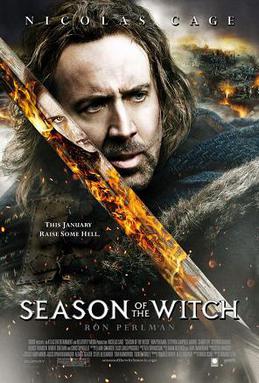
[Freya-dæg] Nicolas Cage Month Pt. 2: Season of the Witch Review
 |
Plot Summary
The Good
The Bad
Judgment
Closing
Introduction
Part two of Nicolas Cage month is here: A search for the good in the 2011 medieval romp, Season of the Witch.
Generally lambasted and looked down upon among critics (10%) and faring only slightly better among fans (32%), let's see just what's good, what's bad, and how they measure up.
Back to Top
Plot Summary
It's the fourteenth century and the crusades are in full swing in the Middle East, while alleged witches are being persecuted in Europe. Enter our two protagonists, Behman (Cage himself) and Felson (Ron Perlman).
After realizing that a truly good God would not call upon men to slaughter innocents, the two desert and start out across the country only to find that a strange plague has struck the land.
However, while on the lam the two are discovered, imprisoned, and then contracted to take an accused witch that people believe responsible for the plague to a monastery where she can be properly dealt with.
Having no other choice, the two set out with the priest Debelzaq (Stephen Campbell Moore), the swindling guide Hagamar (Stephen Graham), and Kay, a young altar boy seeking knighthood (Robert Sheehan). Their journey to the monastery takes them over some dangerous terrain, but only when they arrive at the monastery will they discover that it's not bear, wolf, or boar season, but it is indeed the Season of the Witch.
Back to Top
The Good
This is not a historical movie by any means - but it is a very medieval movie in the way that it's told, in the way that dialogue is written, and in the way that characters interact.
This isn't to say that it's in iambic pentameter and characters pull elaborate schemes on each other, but instead that were there a medieval bard alive today, this is the sort of story that he would tell. For Season of the Witch is the stuff of medieval romances: magic, adventure, characters who play well off of each other, and intrigue.
Plus, the movie puts the power of language front and center as twice we're shown that saying the proper words (in Latin!) over the bodies of women killed when hung or drowned (tested for being witches, in other words) is the best way to ensure that their bodies are not reanimated.
The fact that these words are in Latin, only weilded by priests, and contained in an ornate book, does a lot to really make the medieval setting accurate. Theatricality is a big part of medieval entertainment, and this movie is definitely theatrical.
This theatricality is further helped by the movie's special effects. They aren't perfectly photo-realistic, but their style helps keep the atmosphere of a medieval story going strong throughout.
The movie also puts forth some really amazing things (especially considering that it's an action movie): The power of psychological warfare on an individual basis, some great suspenseful bits, an excellent cast of characters, and a book that is so obscure it's a triumphant surprise to see it represented on screen.
 |
Back to Top
The Bad
However, the movie's an hour and a half long and could easily shed 1/3 of that length if a plot hole was removed.
The reason that Behman and co. need to go to the monastery is because that's where there's a book that describes the necessary rituals for dealing with the witch they have captured and believe to be responsible for the plague. So they only need to get there for the book. A thing that they could have brought to them in the city.
Making this minor change would cut out all of the traveling through the dangerous wastes and forest that the Behman's party has to go through, it would mean that there' be no zombie monks, and it would help the movie keep its complications as the movie's final fight would likely happen in an area populated with innocents rather than re-animated, plague-ridden corpses.
But, because the writer, Bragi F. Schut, has them go the monastery the story becomes very thin very fast.
The fact that two key characters, Kay and the witch, are not given any kind of backstory whatsoever certainly doesn't help matters either.
Kay's backstory could explain why he's an altar boy and not already on the way to knighthood. It could answer questions like: Did his father leave his estate to someone else? And, did Kay disgrace himself in the lists?
And we definitely need to know more about the witch because *spoilers* she's possessed, */spoilers* so knowing whether she was devout or not, and just how and why and when she was possessed would fill in so much about her character. Plus more development of her character would set her up to say something more profound than 'this is what really happened with the plague' at the end of the movie.
As per the final battle scene and its zombie monks, the whole thing is disappointing. It's effectively action-packed and all of that, but the entire trip from the city to the monastery could be expanded and lightly edited into a taut full-length psychological thriller, so an action-packed climax is a let down.
Further, although the power of language and of books is definitely rather accurate, there are other details that are not. Specifically, the oath that Behman has Kay recite when he knights him. This oath mentions on the martial duties of a knight, and perhaps this is the sort of oath that knights would give if knighted in the field, but knighthood isn't just about messing up people's sh**.
A quick summary of an actual knightly oath involves things like avoiding trafficking with traitors, protecting women, and observing fasts and abstinences.
After all, knights were guys with swords, but they were also nobility, and therefore had to set something of an example for the rest of society. Moreover, some knights also fulfilled the role of rulers in the medieval three estates system (a social model that broke society down into those who work (the Peasants), those who rule/fight (the Nobles, including knights), and those who pray (the Clergy)). So their code of behaviour goes a bit beyond smiting enemies.
Back to Top
Judgment
The Season of the Witch is a movie that balances itself as well as its lead characters do when they cross a particularly rickety bridge.
The story is thin, the climactic battle is disappointing, and there isn't enough backstory given for some of the main characters. But, those characters still play well off of each other, the setting is stylized but rather accurate, and magic and the demonic are very well portrayed.
In the end though, what tips the scales is the modern medieval romance style of the movie as a whole. That's something of a rarity among medieval action movies, a group of films that are more often too concerned with packing themselves with flashing steel and overflowing flagons of sudsy ale to get into any medieval depth.
So, Freya, as you skim the field of fallen films, reach down your powerful arm and pull this one up with you to movie Valhalla.
For that is as true a judgment today as it was when the judged was written, directed, and produced. Amen.
 |
Back to Top
Closing
Next week check back here for another creative writing piece, an editorial on a piece of the newest news, and part three of Nicolas Cage month - a search for the good in 2011's Trespass.
Back to Top
Wednesday, July 4, 2012
[Wōdnes-dæg] Books with Amazing Argentinian Fading Ink
Introduction
The Article Summed Up
The Power of Mystical Emptiness
New Bounds for an old Medium
Closing
Back To Top
Introduction
Last week's editorial was all about the mainstream acknowledgement of ebooks and indie authors.
This week, we take two steps back from the fore of technology and then one toward it.
Back To Top
The Article Summed Up
According to Tecca over at Y! Tech (a division of Yahoo News), an Argentine publishing house called Eterna Cadencia is creating books that will not outlast their authors or readers.
It’s not that these books are poorly constructed - quite the opposite in fact.
Using a new ink technology, developed by the ad agency Draftfcb, the Argentine publisher is going to be printing books with short-lived ink. Apparently, these books will fade into illegibility two months after they’ve been opened and exposed to light and air.
However, the publisher isn’t going to be doing this with all of their books, only with collections of new authors’ work. A move that might just help to give them the captive audience that all new writers need.
Back To Top
The Power of Mystical Emptiness
Although the article closes with a point about the fading ink gimmick only working if people can be convinced to buy “books that'll end up as fancy bound paper within just a couple of months[,]” this might also be the gimmick’s greatest strength.
Many people are reluctant to write in books that they cherish or thoroughly enjoy reading. And rightly so, there’s something special about a book - an inanimate object populated with ink splotches shaped into an old alphabet - that can make you feel or think things that you might otherwise not feel or think.
But what if that book went blank?
Would the book still hold the significance that it did for you while the story was still within? And, if it did, mightn’t that inspire some people to try their hand at writing using their since faded book?
The cost of these fading books, assuming that they’ll be priced at just a little bit more than a standard paperback or hardcover, might be a barrier to their success. But, if Moleskine notebooks can be sold for an exorbitant price based on a link to Ernest Hemmingway, Oscar Wilde, and Vincent Van Gogh, then why wouldn’t these eventually blank books have the same level of mystique?
In a way, they might even have more because they will have actually held what a revered and enjoyed author wrote rather than just having been used by him or her when he or she was alive.
Printing books with fading ink might not be a practice that will catch on for the classics, but it definitely could lead to some interesting stuff down the line for new authors.
Back To Top
New Bounds for an old Medium
Perhaps this gimmick will become something more than a response to ebooks and will lead to a cross between the two, possibly leading to something like the journey book from Terry Goodkind’s Sword of Truth series.
Or, getting more specific, maybe the idea of disappearing ink will seep into the digital world and lead to some kind of technology that lets fans write directly to the author via their faded out tomes.
That gimmicks are needed, or at least believed to be needed, to sell paper and ink books might be one of the death knells sounded over the coffin of traditional publishing, but bringing the book into the digital age like this, without any computerization to speak of, is quite a feat, and points to better things ahead for traditional paper and ink publishing.
The question shouldn’t be will people buy books that will essentially become fancy notebooks in two months time, but rather: What will the use of this disappearing ink lead to?
Back To Top
Closing
Be sure to check back here on Friday for the search for the good in Deadfall, part one of Nicolas Cage month. Plus, don't miss tomorrow's annotated links!
Back To Top
The Article Summed Up
The Power of Mystical Emptiness
New Bounds for an old Medium
Closing
 |
Back To Top
Introduction
Last week's editorial was all about the mainstream acknowledgement of ebooks and indie authors.
This week, we take two steps back from the fore of technology and then one toward it.
Back To Top
The Article Summed Up
According to Tecca over at Y! Tech (a division of Yahoo News), an Argentine publishing house called Eterna Cadencia is creating books that will not outlast their authors or readers.
It’s not that these books are poorly constructed - quite the opposite in fact.
Using a new ink technology, developed by the ad agency Draftfcb, the Argentine publisher is going to be printing books with short-lived ink. Apparently, these books will fade into illegibility two months after they’ve been opened and exposed to light and air.
However, the publisher isn’t going to be doing this with all of their books, only with collections of new authors’ work. A move that might just help to give them the captive audience that all new writers need.
Back To Top
The Power of Mystical Emptiness
Although the article closes with a point about the fading ink gimmick only working if people can be convinced to buy “books that'll end up as fancy bound paper within just a couple of months[,]” this might also be the gimmick’s greatest strength.
Many people are reluctant to write in books that they cherish or thoroughly enjoy reading. And rightly so, there’s something special about a book - an inanimate object populated with ink splotches shaped into an old alphabet - that can make you feel or think things that you might otherwise not feel or think.
But what if that book went blank?
Would the book still hold the significance that it did for you while the story was still within? And, if it did, mightn’t that inspire some people to try their hand at writing using their since faded book?
The cost of these fading books, assuming that they’ll be priced at just a little bit more than a standard paperback or hardcover, might be a barrier to their success. But, if Moleskine notebooks can be sold for an exorbitant price based on a link to Ernest Hemmingway, Oscar Wilde, and Vincent Van Gogh, then why wouldn’t these eventually blank books have the same level of mystique?
In a way, they might even have more because they will have actually held what a revered and enjoyed author wrote rather than just having been used by him or her when he or she was alive.
Printing books with fading ink might not be a practice that will catch on for the classics, but it definitely could lead to some interesting stuff down the line for new authors.
Back To Top
New Bounds for an old Medium
Perhaps this gimmick will become something more than a response to ebooks and will lead to a cross between the two, possibly leading to something like the journey book from Terry Goodkind’s Sword of Truth series.
Or, getting more specific, maybe the idea of disappearing ink will seep into the digital world and lead to some kind of technology that lets fans write directly to the author via their faded out tomes.
That gimmicks are needed, or at least believed to be needed, to sell paper and ink books might be one of the death knells sounded over the coffin of traditional publishing, but bringing the book into the digital age like this, without any computerization to speak of, is quite a feat, and points to better things ahead for traditional paper and ink publishing.
The question shouldn’t be will people buy books that will essentially become fancy notebooks in two months time, but rather: What will the use of this disappearing ink lead to?
Back To Top
Closing
Be sure to check back here on Friday for the search for the good in Deadfall, part one of Nicolas Cage month. Plus, don't miss tomorrow's annotated links!
Back To Top
Subscribe to:
Posts (Atom)