1. Ramstad, Evan. "Are Koreans the Irish of Asia? Here’s a Case." Korea Realtime (Wall Street Journal) 16 October 2012. Web. 20 October 2012.
Ramstad recounts the recent visit to Seoul of Eammon McKee, Ireland's ambassador to the Koreas, and a speech he made there wherein he fleshed out the Korea-is-Ireland cliché. He quotes McKee's speech selectively, compiling a brief list of the ways in which the two nations are similar. This article is written in a pure journalistic style, this article reports on the idea of the two nations having shared traits.
An article about how two disparate nations actually have quite a bit in common is a great way to start of an Annotated Links about different things that, upon further analysis, can easily be considered similar. Thus, this article was an easy pick for this week's batch.
2. Lorditch, Emilie. "Using Science Fiction to Educate." Inside Science 17 October 2012. Web. 20 October 2012.
This one is a brief article that provides an overview of the basic argument for using science fiction in science education: to show the relevance of science to young people so that more of them will take an active interest in pursuing the sciences at college or university. It makes specific reference to science fiction and super hero films while leaving out anything about science fiction literature. Lorditch writes in a direct style of reportage, with an effective use of quotes.
Science fiction and science fact are definitely different, but the limits of human technology are always making gains on the limits of human imagination. This article doesn't make a direct comparison between science fiction and science in the classroom, but mining science fiction for examples to show how science does and doesn't work bridges the two nicely.
3. Houpt, Simon. "IBM hones Watson the supercomputer’s skills." The Globe and Mail 19 October 2012. Web. 20 October 2012.
In this interview with the IBM T.J. Watson Research Center's Eric Brown, Houpt explores the different uses for IBM's Question Answering supercomputer Watson. Specifically, Houpt asks about IBM's work with the US healthcare insurance provider WellPoint and how Watson will figure in with that. It's written as any interview is bound to be written - in a conversational tone.
Though comparisons between Watson and human personalities don't come up until near the end of the interview, this piece is included in this week's Annotated Links because it underscores how a stripped down version of human thinking (parsing sentences, taking certain elements and understanding the relationships between them) is being emulated by computers.
4. Taylor, Kate. "Picnicface: Why are we laughing? I don’t know, but it sure beats crying." The Globe and Mail 20 October 2012. Web. 20 October 2012.
Taylor's article offers some quick background information on the Picnicface story, along with a very quick rundown of where the three-person comedy trio is today. Her article also offers some thoughts on the matter of internet fame vs. old school fame, and how being popular on YouTube does not necessarily translate being popular on the boob tube. This one is written in a straightforward style, with quotes from players in the Picnicface story sprinkled throughout.
Including this one in the Links for this week was necessarily partly because it fit and partly because of personal prejudices. Picnicface is an hilarious troupe, and the ways in which culture on the internet is different from culture on TV or radio or in print is something that needs more mainstream attention.
5. Strickland, Eddie. "Red Potion (The Legend of Zelda cocktail)." The Drunken Moogle 14 October 2012. Web. 20 October 2012.
Simply a recipe for a cocktail inspired by the Legend of Zelda (clicking on that tag at the bottom of the recipe shows another 4 pages worth of Zelda-inspired booze bombs). This recipe is written in a direct style without any extra notes.
This one's included for the obvious reason that video games ('The Legend of Zelda,' perhaps especially) are not the same as real life. However, it must definitely be noted that medieval medicine (and therefore medicine in a high fantasy setting such as the one in 'Zelda') would invariably involve alcohol in some way - so the two different worlds of the real and the virtual are bridged by the cause of and solution to all of life's problems: alcohol.
Back To Top
Closing
Next week, watch for a poem post for Monday, and Part Four of Shocktober, when I'll make the call for the conversion of the campy horror flic The Convent.
Plus, over at Tongues in Jars, watch for the fifth stanza of "Dum Diane vitrea" in Tuesday's Latin entry, and Wiglaf's tongue lashing of the cowardly thanes in Thursday's Beowulf entry.
Back To Top
Showing posts with label culture. Show all posts
Showing posts with label culture. Show all posts
Saturday, October 20, 2012

Sunday, October 14, 2012
[Sæternes-dæg] Annotated Links #21: Simple Solutions
1. "Scholars finish dictionary of ancient Egyptian language." ScienceBlog 19 September 2012. Web. 13 October 2012.
The Chicago Demotic Dictionary, developed at the University of Chicago's Oriental Institute, has finally been completed. The article details how the Ancient Egyptian common language has contributed to Modern English, as well as how it sheds light on how the common people of Ancient Egypt lived. It is written in a fairly conversational style.
Language news is always fascinating news, and so this one had to be included.
2. Knight, Chris. "From Doctor Who to Looper to Robot & Frank: The best sci-fi is made on a shoestring." National Post 7 October 2012. Web. 13 October 2012.
Knight uses Doctor Who (the Daleks, specifically), Looper, and Robot & Frank as examples of effective science fiction that's financially successful because of its small budget. These are contrasted with blockbuster movies of the past summer, and the take away is that good science fiction needs to be more substantial and referential to our own present to be successful.
This article is included because it shows that substance is more often appreciated than flash.
3. McGinn, Dave. "The $55K, 2,900-square foot, eco-friendly home – with no electricity bills." The Globe and Mail 10 October 2012. Web. 13 October 2012.
This article explains just what an "earthship" home is (one built from recycled materials, and that uses natural heating and water) and how they're more economically and environmentally feasible than your standard home. Its focus on a couple from Tilsonburg, Ontario lends this story a human interest element, and it's written in a simple style that makes broad use of quotations.
Wild designs and neat aesthetics combine with practicality in this subject, and so it's something I've got to share.
4. Baumann, Chris, and Shu Setogawa. "Korean teachers preferred." The Korea Herald 10 October 2012. Web. 13 October 2012.
This one is a report on a study of teacher preferences among Koreans. It shows that Koreans do prefer Korean teachers, even when it comes to English language instruction, because they are believed to be the most apt to demonstrate the proper etiquette and cultural values. Baumann and Setogawa's report is written in a formal, academic style and includes a handful of charts.
Although this report addresses the issue of ESL teachers, I included this one to help spread these findings and because it very quickly details how the Korean approach to ESL teaching is changing.
5. Everett-Green, Robert. "1K Wave: Can a great film be made for $1,000? Ingrid Veninger thinks so." The Globe and Mail 10 October 2012. Web. 13 October 2012.
Ingrid Veninger, Toronto filmmaker, believes that local filming and at-home editing mean that anyone who wants to make a movie can - and for only $1000 up front. Veninger has already run the 1K Wave contest, and five films were created as a direct result. This article is written in a conversational style with quotes from a variety of local filmmakers.
Creative contests that stand out like this one deserve to get attention. So, since this one also works with this Annotated Links' theme, it had to be included.
Back To Top
Closing
Next week check the blog for a new polished draft of fiction (Monday), a look for the lurking in Silent House (Friday), and the next Annotated Links (Saturday).
And to keep your reading going throughout the week, check out Tongues in Jars for translations and commentary of the Latin poem "Dum Diane vitrea" and the Old English Beowulf.
Back To Top
The Chicago Demotic Dictionary, developed at the University of Chicago's Oriental Institute, has finally been completed. The article details how the Ancient Egyptian common language has contributed to Modern English, as well as how it sheds light on how the common people of Ancient Egypt lived. It is written in a fairly conversational style.
Language news is always fascinating news, and so this one had to be included.
2. Knight, Chris. "From Doctor Who to Looper to Robot & Frank: The best sci-fi is made on a shoestring." National Post 7 October 2012. Web. 13 October 2012.
Knight uses Doctor Who (the Daleks, specifically), Looper, and Robot & Frank as examples of effective science fiction that's financially successful because of its small budget. These are contrasted with blockbuster movies of the past summer, and the take away is that good science fiction needs to be more substantial and referential to our own present to be successful.
This article is included because it shows that substance is more often appreciated than flash.
3. McGinn, Dave. "The $55K, 2,900-square foot, eco-friendly home – with no electricity bills." The Globe and Mail 10 October 2012. Web. 13 October 2012.
This article explains just what an "earthship" home is (one built from recycled materials, and that uses natural heating and water) and how they're more economically and environmentally feasible than your standard home. Its focus on a couple from Tilsonburg, Ontario lends this story a human interest element, and it's written in a simple style that makes broad use of quotations.
Wild designs and neat aesthetics combine with practicality in this subject, and so it's something I've got to share.
4. Baumann, Chris, and Shu Setogawa. "Korean teachers preferred." The Korea Herald 10 October 2012. Web. 13 October 2012.
This one is a report on a study of teacher preferences among Koreans. It shows that Koreans do prefer Korean teachers, even when it comes to English language instruction, because they are believed to be the most apt to demonstrate the proper etiquette and cultural values. Baumann and Setogawa's report is written in a formal, academic style and includes a handful of charts.
Although this report addresses the issue of ESL teachers, I included this one to help spread these findings and because it very quickly details how the Korean approach to ESL teaching is changing.
5. Everett-Green, Robert. "1K Wave: Can a great film be made for $1,000? Ingrid Veninger thinks so." The Globe and Mail 10 October 2012. Web. 13 October 2012.
Ingrid Veninger, Toronto filmmaker, believes that local filming and at-home editing mean that anyone who wants to make a movie can - and for only $1000 up front. Veninger has already run the 1K Wave contest, and five films were created as a direct result. This article is written in a conversational style with quotes from a variety of local filmmakers.
Creative contests that stand out like this one deserve to get attention. So, since this one also works with this Annotated Links' theme, it had to be included.
Back To Top
Closing
Next week check the blog for a new polished draft of fiction (Monday), a look for the lurking in Silent House (Friday), and the next Annotated Links (Saturday).
And to keep your reading going throughout the week, check out Tongues in Jars for translations and commentary of the Latin poem "Dum Diane vitrea" and the Old English Beowulf.
Back To Top
Saturday, October 6, 2012
[Sæternes-dæg] Annotated Links #20: Bending Borders
1. Koh, Yoree. "Novelist Murakami Weighs In on Japan Territorial Rows." Japan Real Time (The Wall Street Journal) 28 September 2012. Web. 06 October 2012.
Koh recaps Haruki Murakami's stance on Japan's current territorial disputes as they appeared in an essay that made the front page of the Asahi Shimbun. Murakami argues that these territorial disputes are threatening the cultural ties that the three Asian countries have established over recent decades, and that they're "like getting drunk on cheap sake." This article is written in a plain, direct style.
Haruki Murakami is an amazing writer, and the matter of Japanese-South Korean-Chinese territorial disputes is one of interest since I recall how passionate many South Koreans were about their owning Dokdo (Takeshima, in Japan), so inlcuding this article was a must.
2. Stusinski, Melissa. "‘Looper’-Like Time Travel Possible, Scientists Say." The Inquisitr 28 September 2012. Web. 06 October 2012.
A misleadingly titled article that suggests that time travel to the future is possible, while time travel to the past is much more problematic. This one is written in a very conversational style that makes it seem like a token blog entry.
Despite its brevity, this article is included because it is a solid summary of time travel mechanics.
3. Tozer, Jessica L.. "Sensors on Scan." Armed With Science 2 October 2012. Web. 06 October 2012.
Dr. Chris Field at the Naval Research Laboratory is currently working on technology that does just what Star Trek's tricorder does - scan an area for any and all vapours it contains. Various applications for this quarter-sized technology are discussed, ranging from carbon monoxide detection to airport security applications. Tozer writes in an informal style.
Anything about such amazing science simply has to be included. It's practically the law.
4. Oh, Young-Jin. "Coming out on Psy." The Korea Times 2 October 2012. Web. 06 October 2012.
This one offers a thought-provoking look at the Psy phenomenon from the perspective of someone who thinks that Psy represents nothing Korean. In it Oh relates his thoughts on Psy and how they've evolved to his current stance that Psy represents more of global pop culture than Korean pop culture. It is written in a prim, yet conversational style.
Because of the wild popularity of Psy, this one had to be included to offer a counter-argument to his apparent bolstering of the Korean cultural wave that's supposedly swept over the world in recent weeks.
5.Clayton, Nick. "Scientists Look to Use Bee’s Brains to Control Flying Robots." Tech Europe (The Wall Street Journal) 4 October 2012. Web. 6 October 2012.
Researchers at the universities of Sheffield and Sussex are looking into using bee brains to power flying recon robots. Among the uses for these robots, the article focuses on their being used to gather information to help rescue teams figure out what the next best option is. It is a short article, written in a plain style.
This one's included because it's some exciting news from the world of robotics, and it's not often that social insects are thought of as being as useful to science as social mammals.
Back To Top
Closing
Next week, watch for another (much more recent) poem on Monday, and a prowl for the palatable in Leprechaun In The Hood on Friday!
Back To Top
Koh recaps Haruki Murakami's stance on Japan's current territorial disputes as they appeared in an essay that made the front page of the Asahi Shimbun. Murakami argues that these territorial disputes are threatening the cultural ties that the three Asian countries have established over recent decades, and that they're "like getting drunk on cheap sake." This article is written in a plain, direct style.
Haruki Murakami is an amazing writer, and the matter of Japanese-South Korean-Chinese territorial disputes is one of interest since I recall how passionate many South Koreans were about their owning Dokdo (Takeshima, in Japan), so inlcuding this article was a must.
2. Stusinski, Melissa. "‘Looper’-Like Time Travel Possible, Scientists Say." The Inquisitr 28 September 2012. Web. 06 October 2012.
A misleadingly titled article that suggests that time travel to the future is possible, while time travel to the past is much more problematic. This one is written in a very conversational style that makes it seem like a token blog entry.
Despite its brevity, this article is included because it is a solid summary of time travel mechanics.
3. Tozer, Jessica L.. "Sensors on Scan." Armed With Science 2 October 2012. Web. 06 October 2012.
Dr. Chris Field at the Naval Research Laboratory is currently working on technology that does just what Star Trek's tricorder does - scan an area for any and all vapours it contains. Various applications for this quarter-sized technology are discussed, ranging from carbon monoxide detection to airport security applications. Tozer writes in an informal style.
Anything about such amazing science simply has to be included. It's practically the law.
4. Oh, Young-Jin. "Coming out on Psy." The Korea Times 2 October 2012. Web. 06 October 2012.
This one offers a thought-provoking look at the Psy phenomenon from the perspective of someone who thinks that Psy represents nothing Korean. In it Oh relates his thoughts on Psy and how they've evolved to his current stance that Psy represents more of global pop culture than Korean pop culture. It is written in a prim, yet conversational style.
Because of the wild popularity of Psy, this one had to be included to offer a counter-argument to his apparent bolstering of the Korean cultural wave that's supposedly swept over the world in recent weeks.
5.Clayton, Nick. "Scientists Look to Use Bee’s Brains to Control Flying Robots." Tech Europe (The Wall Street Journal) 4 October 2012. Web. 6 October 2012.
Researchers at the universities of Sheffield and Sussex are looking into using bee brains to power flying recon robots. Among the uses for these robots, the article focuses on their being used to gather information to help rescue teams figure out what the next best option is. It is a short article, written in a plain style.
This one's included because it's some exciting news from the world of robotics, and it's not often that social insects are thought of as being as useful to science as social mammals.
Back To Top
Closing
Next week, watch for another (much more recent) poem on Monday, and a prowl for the palatable in Leprechaun In The Hood on Friday!
Back To Top
Monday, September 24, 2012
[Moon-dæg] Poem #997b
Context
Sun and Moon
Closing
Back To Top
Context
Tonight's piece is a sample of my poetry from 2010. This was when I wrote poetry that stuck to a fairly regular form. This specific poem is also an example of my stuff on love that's written in an Elizabethan style; in fact, it's similar to Christopher Marlowe's "The Passionate Shepherd to His Love" (a.k.a. "Poem #997").
Check it out, and let me know what you think in the comments!
Back To Top
Sun and Moon
A kiss and a peck and a see you tonight
Said the sun to the moon
at the coming of first light
Go my love and hide away
Scarce your face - scarce!
I’ll hide it behind window-blurred bars
And raise around you robes of cloud
As I shed light, generation, elation to those below.
Then, when those look up nightly
through eyes and disembodied words
To the glow of light from my cumulus chase,
We can join behind a dark-wooled herd
To stoke our lights before parting.
Before returning to our days.
Back To Top
Closing
Check back at this blog on Friday for a look for the likeable in The Samaritan (a.k.a. Fury). Then on Saturday, you'll be able to find the newest Annotated Links here, and a look back/look ahead on Sunday.
Back To Top
Sun and Moon
Closing
 |
Back To Top
Context
Tonight's piece is a sample of my poetry from 2010. This was when I wrote poetry that stuck to a fairly regular form. This specific poem is also an example of my stuff on love that's written in an Elizabethan style; in fact, it's similar to Christopher Marlowe's "The Passionate Shepherd to His Love" (a.k.a. "Poem #997").
Check it out, and let me know what you think in the comments!
Back To Top
Sun and Moon
A kiss and a peck and a see you tonight
Said the sun to the moon
at the coming of first light
Go my love and hide away
Scarce your face - scarce!
I’ll hide it behind window-blurred bars
And raise around you robes of cloud
As I shed light, generation, elation to those below.
Then, when those look up nightly
through eyes and disembodied words
To the glow of light from my cumulus chase,
We can join behind a dark-wooled herd
To stoke our lights before parting.
Before returning to our days.
Back To Top
Closing
Check back at this blog on Friday for a look for the likeable in The Samaritan (a.k.a. Fury). Then on Saturday, you'll be able to find the newest Annotated Links here, and a look back/look ahead on Sunday.
Back To Top
Thursday, August 2, 2012
Annotated Links #13: Japan in Art and Quirk
1. Bennett, Lennie. "Art deco exhibit at Ringling Museum illuminates Japan's lost decades." Tampa Bay Times 22 July 2012. Web. 2 August 2012.
Bennett describes the contents of the "Deco Japan: Shaping Art and Culture, 1920-45" exhibition and gives a brief history, explanation, and context of the movement in Japan. However, Bennett doesn't include what the remaining two stops of the exhibition are or for how much longer the exhibition will be staying at the John and Mable Ringling Museum of Art. Bennett writes in the style of an informative account of visiting the exhibition.
This article is included because of the obscurity of its subject matter - I had no idea that there was a significant and culture-changing art movement in Japan after World War I and during World War II.
2. Elwood, Kate. "CULTURAL CONUNDRUMS/Cultural facets of Cupid's arrow." Daily Yomiuri Online 30 July 2012. Web. 2 August 2012.
Elwood gives a history of Japanese romance novels, including how they "blossomed out of Western seeds" in the 70s and 80s, and how Sanrio started its "New Romance" line for domestically written romances in 1982. She also summarizes a comparative study of Western harlequin and Japanese romance stories written during the 70s and 80s. According to the study, the most marked differences found in Japanese romance novels are that female leads are generally stronger, and that the hardships involve social restrictions that keep love from being widely accepted rather than love itself.
This article is included here because because it gives a good look at the differences in the romance genre, and thus in two cultures romantic ideals.
3. Liebl, Lance. "Giant dancing Japanese robot women in bras will be the end of us." GameZone 27 July 2012. Web. 2 August 2012.
Liebl reports on a restaurant in Tokyo that features robotic female torsos on giant mech-legs, operated by women in bikinis. His article includes a live link to the original picture album on The Chive. It also Includes a short youtube video of a man tinkering with one of the robots.
This article is included here because it's an example of Japan's well-known quirkiness, something that I find utterly fascinating.
Back To Top
Closing
Tomorrow, join me for Pt. 1 of All-Request August, featuring a search for the superb in Plan 9 From Outer Space!
Back To Top
Bennett describes the contents of the "Deco Japan: Shaping Art and Culture, 1920-45" exhibition and gives a brief history, explanation, and context of the movement in Japan. However, Bennett doesn't include what the remaining two stops of the exhibition are or for how much longer the exhibition will be staying at the John and Mable Ringling Museum of Art. Bennett writes in the style of an informative account of visiting the exhibition.
This article is included because of the obscurity of its subject matter - I had no idea that there was a significant and culture-changing art movement in Japan after World War I and during World War II.
2. Elwood, Kate. "CULTURAL CONUNDRUMS/Cultural facets of Cupid's arrow." Daily Yomiuri Online 30 July 2012. Web. 2 August 2012.
Elwood gives a history of Japanese romance novels, including how they "blossomed out of Western seeds" in the 70s and 80s, and how Sanrio started its "New Romance" line for domestically written romances in 1982. She also summarizes a comparative study of Western harlequin and Japanese romance stories written during the 70s and 80s. According to the study, the most marked differences found in Japanese romance novels are that female leads are generally stronger, and that the hardships involve social restrictions that keep love from being widely accepted rather than love itself.
This article is included here because because it gives a good look at the differences in the romance genre, and thus in two cultures romantic ideals.
3. Liebl, Lance. "Giant dancing Japanese robot women in bras will be the end of us." GameZone 27 July 2012. Web. 2 August 2012.
Liebl reports on a restaurant in Tokyo that features robotic female torsos on giant mech-legs, operated by women in bikinis. His article includes a live link to the original picture album on The Chive. It also Includes a short youtube video of a man tinkering with one of the robots.
This article is included here because it's an example of Japan's well-known quirkiness, something that I find utterly fascinating.
Back To Top
Closing
Tomorrow, join me for Pt. 1 of All-Request August, featuring a search for the superb in Plan 9 From Outer Space!
Back To Top
Wednesday, August 1, 2012
[Wōdnes-dæg] Fantastic Fantasy and the Grit of Popularity
Introduction
The Article Summed Up
Fantasy and Cynicism...Hand in Hand?
The More Names, the More Things
Closing
Back To Top
Introduction
The subject of today's editorial comes from the website Fantasy Faction - a site that hosts articles, interviews, reviews, forums, and a podcast that are all about the fantasy genre.
This article by Douglas Smith caught my eye because it attempts to explain the current trend away from "classic" tales of black-and-white good versus evil in modern popular fantasy. The article also grabbed my attention because it speaks to the variety that can be found in the fantasy genre.
These elements aren't just interesting, but are also quite relevant to me since I'm in the midst of writing my own fantasy universe into existence.
Back To Top
The Article Summed Up
In his article Douglas Smith notes the growing popularity and presence of gritty, realistic fantasy and tries to explain it.
Quite deftly Smith looks at the trends in entertainment more generally, and concludes that what we watch and read to relax as a whole has become grittier as the world around us has changed into something a bit grittier, too.
Gone are the days of massively popular soap operas and police procedurals, and now things are more about characters so real we might bump into them on the street and involve plots so intricate that it's as easy to become entangled as it is to become immersed.
Smith concludes with the statements that writers of gritty fantasy are reinvigorating the genre, that it's cool to read fantasy again, and that this might just be "a second 'Golden Age' for fantasy."
Back To Top
Fantasy and Cynicism...Hand in Hand?
As far as its explanation of why gritty fantasy is now popular goes, this is a great article.
The world certainly has changed, and, as those of older generations have said from time immemorial, it may actually be worse off (in some ways). Technological advances aside, events like "9/11" have made people more readily dubious of others and paranoid enough that fear could now be considered a small animal living in most people's heads as much as a human emotion.
Older stories that follow a straightforward plot and shimmering, clean-cut characters are definitely no longer enough to put this animal to sleep for a time so that the human host can truly enjoy an escape.
Instead, worlds and characters need more depth. In fact, this might be an analogue to the extra cynicism in a lot of people's worldviews. Just as more scrutiny and attention is paid to the real world and goings-on therein, so too in entertainment are characters and plots under more and more scrutiny.
The best way to meet that scrutiny, so far, has been to present things that are more layered and more like the world that can be seen all around. Instead of escaping into worlds that contrast the real one, the increasing popularity of gritty fantasy suggests that people are more willing to escape into worlds that are like their own.
Back To Top
The More Names, the More Things
Another factor to consider when looking the rise in gritty fantasy is the ever-increasing drive to categorize literature and entertainment. Particularly, the urge to separate the "adult" literature from the "children's" literature.
Both fantasy and science fiction have always been perceived as children's literature.
They aren't set in the real, contemporary world.
They aren't written by those who aspire to write capital-L literature.
But at the same time, there have always been adults who enjoy fantasy and science fiction more than other forms of not-true stories. These adults would read Frank L. Baum, they would flip through Asimov, they would delve into the world of the Harry Potter series.
At times these stories, labelled as being for "children," would be adapted into re-tellings or versions that were more "grown-up," and at other times they would be distributed with darker, more "adult" covers. Anything to appeal more directly to those who were outside of the original key age demographic but nonetheless liked what they read for whatever reason.
Enter gritty, realistic fantasy.
Just like that, there's now a fantasy sub-genre for adults, those who'd been generally perceived as "too old" for stories about magic, heroes and villains, Good and Evil. And where there is a supply to fill a hitherto unfulfilled demand that supply will soon prove insufficient.
After all, give something a new, more specific name, and those previously too shy to admit to liking that something under it's old, general name (let's say fantasy) will come out and help push demand even further.
Back To Top
Closing
Don't miss tomorrow's Annotated Links (#13), and keep an eye out on Friday for the first part of All-Request August, featuring a search for the superb in Plan 9 From Outer Space!
Back To Top
The Article Summed Up
Fantasy and Cynicism...Hand in Hand?
The More Names, the More Things
Closing
 |
Back To Top
Introduction
The subject of today's editorial comes from the website Fantasy Faction - a site that hosts articles, interviews, reviews, forums, and a podcast that are all about the fantasy genre.
This article by Douglas Smith caught my eye because it attempts to explain the current trend away from "classic" tales of black-and-white good versus evil in modern popular fantasy. The article also grabbed my attention because it speaks to the variety that can be found in the fantasy genre.
These elements aren't just interesting, but are also quite relevant to me since I'm in the midst of writing my own fantasy universe into existence.
Back To Top
The Article Summed Up
In his article Douglas Smith notes the growing popularity and presence of gritty, realistic fantasy and tries to explain it.
Quite deftly Smith looks at the trends in entertainment more generally, and concludes that what we watch and read to relax as a whole has become grittier as the world around us has changed into something a bit grittier, too.
Gone are the days of massively popular soap operas and police procedurals, and now things are more about characters so real we might bump into them on the street and involve plots so intricate that it's as easy to become entangled as it is to become immersed.
Smith concludes with the statements that writers of gritty fantasy are reinvigorating the genre, that it's cool to read fantasy again, and that this might just be "a second 'Golden Age' for fantasy."
Back To Top
Fantasy and Cynicism...Hand in Hand?
As far as its explanation of why gritty fantasy is now popular goes, this is a great article.
The world certainly has changed, and, as those of older generations have said from time immemorial, it may actually be worse off (in some ways). Technological advances aside, events like "9/11" have made people more readily dubious of others and paranoid enough that fear could now be considered a small animal living in most people's heads as much as a human emotion.
Older stories that follow a straightforward plot and shimmering, clean-cut characters are definitely no longer enough to put this animal to sleep for a time so that the human host can truly enjoy an escape.
Instead, worlds and characters need more depth. In fact, this might be an analogue to the extra cynicism in a lot of people's worldviews. Just as more scrutiny and attention is paid to the real world and goings-on therein, so too in entertainment are characters and plots under more and more scrutiny.
The best way to meet that scrutiny, so far, has been to present things that are more layered and more like the world that can be seen all around. Instead of escaping into worlds that contrast the real one, the increasing popularity of gritty fantasy suggests that people are more willing to escape into worlds that are like their own.
Back To Top
The More Names, the More Things
Another factor to consider when looking the rise in gritty fantasy is the ever-increasing drive to categorize literature and entertainment. Particularly, the urge to separate the "adult" literature from the "children's" literature.
Both fantasy and science fiction have always been perceived as children's literature.
They aren't set in the real, contemporary world.
They aren't written by those who aspire to write capital-L literature.
But at the same time, there have always been adults who enjoy fantasy and science fiction more than other forms of not-true stories. These adults would read Frank L. Baum, they would flip through Asimov, they would delve into the world of the Harry Potter series.
At times these stories, labelled as being for "children," would be adapted into re-tellings or versions that were more "grown-up," and at other times they would be distributed with darker, more "adult" covers. Anything to appeal more directly to those who were outside of the original key age demographic but nonetheless liked what they read for whatever reason.
Enter gritty, realistic fantasy.
Just like that, there's now a fantasy sub-genre for adults, those who'd been generally perceived as "too old" for stories about magic, heroes and villains, Good and Evil. And where there is a supply to fill a hitherto unfulfilled demand that supply will soon prove insufficient.
After all, give something a new, more specific name, and those previously too shy to admit to liking that something under it's old, general name (let's say fantasy) will come out and help push demand even further.
Back To Top
Closing
Don't miss tomorrow's Annotated Links (#13), and keep an eye out on Friday for the first part of All-Request August, featuring a search for the superb in Plan 9 From Outer Space!
Back To Top
Tuesday, July 31, 2012
Annotated Links #12: Bully for Japan
1. Ruble, Cynthia. "Parent-child relationship key to solving bullying problem in Japan." The Japan Daily Press 30 July 2012. Web. 31 July 2012.
This is a first person, opinion-based piece written as part anecdote and part observation. It identifies two major issues in Japanese culture that may make bullying ubiquitous: a willingness to accept hardships as part of life rather than try to improve them (related to the Japanese concept of "gaman"); and the unwillingness amongst adults to stand up against bullying for social reasons.
This article is of interest because it offers a cross-cultural look at bullying, and at some of the universals (unwillingness to defend oneself, fatalism) that may perpetuate bullying.
2. Gale, Bruce. "Tackling the bullying culture in Japan's schools." The Straits Times [found on Asia News Network] 18 July 2012. Web. 31 July 2012.
Gale analyzes bullying in Japan based on Herman Smith's The Myth of Japanese Homogeneity. Specifically, Gale notes and includes analysis based on the three characteristics Smith writes of: "intense competition for scarce educational advantages;" "that girls are rarely victims;" and "that the victims are usually transfer students who do not yet have friends to protect them." Gale also makes an interesting connection between bullying, gang violence, and heterogenous/multicultural societies, and another between bullying and the art style found in many manga. The article is written in a straightforward, easy to read style.
This article is of interest because of its analyses and because it offers a good sociological overview of the problem of bullying in Japan.
3. Nelson, Christopher. "To cut down on bullying, transform school culture." MPR News 23 July 2012. Web. 31 July 2012.
A first person opinion piece based on Nelson's experiences as a student and educator. Nelson writes that it's important to tell bullies that bullying isn't what's done, and to get them to feel included after being reprimanded, not ostracised. He states that the best solution is to have a strong, school-wide sense of where the school is going and what's important to it, yet he notes that there is no one formula for this sense and its enactment that can be universally applied. The article includes a brief summary of Nelson's experience and credentials.
Though it isn't about bullying in Japan, this article is included because it offers an interesting counterpoint to the otherwise ignored sense of school spirit found in Japanese schools that may also underlie bullying new/transfer students.
Back To Top
Closing
Tomorrow's editorial will be about the increasing grittiness of popular fantasy, and this Friday check the blog for a search for the good in the infamous Plan 9 From Outer Space. Plan 9 currently sits at a 66% among critics on Rotten Tomatoes, but because of a special request, and the movie's reputation, I'm going to relax my usual 50% cut off point.
And, of course, don't forget to check out "Annotated Links #13" on Thursday!
Back To Top
This is a first person, opinion-based piece written as part anecdote and part observation. It identifies two major issues in Japanese culture that may make bullying ubiquitous: a willingness to accept hardships as part of life rather than try to improve them (related to the Japanese concept of "gaman"); and the unwillingness amongst adults to stand up against bullying for social reasons.
This article is of interest because it offers a cross-cultural look at bullying, and at some of the universals (unwillingness to defend oneself, fatalism) that may perpetuate bullying.
2. Gale, Bruce. "Tackling the bullying culture in Japan's schools." The Straits Times [found on Asia News Network] 18 July 2012. Web. 31 July 2012.
Gale analyzes bullying in Japan based on Herman Smith's The Myth of Japanese Homogeneity. Specifically, Gale notes and includes analysis based on the three characteristics Smith writes of: "intense competition for scarce educational advantages;" "that girls are rarely victims;" and "that the victims are usually transfer students who do not yet have friends to protect them." Gale also makes an interesting connection between bullying, gang violence, and heterogenous/multicultural societies, and another between bullying and the art style found in many manga. The article is written in a straightforward, easy to read style.
This article is of interest because of its analyses and because it offers a good sociological overview of the problem of bullying in Japan.
3. Nelson, Christopher. "To cut down on bullying, transform school culture." MPR News 23 July 2012. Web. 31 July 2012.
A first person opinion piece based on Nelson's experiences as a student and educator. Nelson writes that it's important to tell bullies that bullying isn't what's done, and to get them to feel included after being reprimanded, not ostracised. He states that the best solution is to have a strong, school-wide sense of where the school is going and what's important to it, yet he notes that there is no one formula for this sense and its enactment that can be universally applied. The article includes a brief summary of Nelson's experience and credentials.
Though it isn't about bullying in Japan, this article is included because it offers an interesting counterpoint to the otherwise ignored sense of school spirit found in Japanese schools that may also underlie bullying new/transfer students.
Back To Top
Closing
Tomorrow's editorial will be about the increasing grittiness of popular fantasy, and this Friday check the blog for a search for the good in the infamous Plan 9 From Outer Space. Plan 9 currently sits at a 66% among critics on Rotten Tomatoes, but because of a special request, and the movie's reputation, I'm going to relax my usual 50% cut off point.
And, of course, don't forget to check out "Annotated Links #13" on Thursday!
Back To Top
Thursday, July 26, 2012
Annotated Links #11: Getting Technical And/Or Long
1. Bird, Winifred. "Fish-loving Japan begins to embrace sustainable seafood." The Christian Science Monitor 24 July 2012. Web. 26 July 2012.
A lengthy article that details much of the action being taken both inside and outside Japan to move the country into using sustainable fisheries since they consume 6% of the world's fish harvest. The article is flush with consumption and fishing industry statistics. It is written in the style of a report, and includes very little to no human interest element.
2. Julian, Hana Levi. "Sci-Fi Comes Alive in New 'Temporal Focusing' Microscope." Arutz Sheva 25 July 2012. Web. 26 July 2012.
Professor Yaron Silberberg and Dr. Dan Oron of the Physics of Complex Systems Department at the Weizmann Institute have created a microscope that views cells in both time and space. The microscope works by controlling the focus of a laser light beam in time rather than in space. It has been used primarily for brain tissue analysis so far. The article is written in a revelatory fashion, and dwells on explaining just how the microscope works.
3.Johnson, Carolyn Y. "Boston scientists use light to control behavior in monkeys." White Coat Notes 26 July 2012. Web. 26 July 2012.
Using a technique called "optogenetics," (a process by which algae genes are inserted into brain tissue) a team of scientists in Boston have successfully used light to control monkey behaviour. The team is optimistic that their work will help scientists to breakdown and figure out complex human behaviours and diseases in the future. The article is lengthy, but gives a significant amount of background information on the experiment and where it may lead in a straightforward fashion.
Back To Top
Closing
Don't miss tomorrow's conclusion to Nicolas Cage Month - a search for the salvageable in Seeking Justice!
Back To Top
A lengthy article that details much of the action being taken both inside and outside Japan to move the country into using sustainable fisheries since they consume 6% of the world's fish harvest. The article is flush with consumption and fishing industry statistics. It is written in the style of a report, and includes very little to no human interest element.
2. Julian, Hana Levi. "Sci-Fi Comes Alive in New 'Temporal Focusing' Microscope." Arutz Sheva 25 July 2012. Web. 26 July 2012.
Professor Yaron Silberberg and Dr. Dan Oron of the Physics of Complex Systems Department at the Weizmann Institute have created a microscope that views cells in both time and space. The microscope works by controlling the focus of a laser light beam in time rather than in space. It has been used primarily for brain tissue analysis so far. The article is written in a revelatory fashion, and dwells on explaining just how the microscope works.
3.Johnson, Carolyn Y. "Boston scientists use light to control behavior in monkeys." White Coat Notes 26 July 2012. Web. 26 July 2012.
Using a technique called "optogenetics," (a process by which algae genes are inserted into brain tissue) a team of scientists in Boston have successfully used light to control monkey behaviour. The team is optimistic that their work will help scientists to breakdown and figure out complex human behaviours and diseases in the future. The article is lengthy, but gives a significant amount of background information on the experiment and where it may lead in a straightforward fashion.
Back To Top
Closing
Don't miss tomorrow's conclusion to Nicolas Cage Month - a search for the salvageable in Seeking Justice!
Back To Top
Tuesday, July 24, 2012
Annotated Links #10: Massaging Media
1. Chung-Un, Cho. "‘Focus on human nature, not unique cultural aspects’." The Korea Herald 18 July 2012. Web. 24 July 2012.
Robert McKee explains why he finds Korean film so intriguing. He also highlights the importance of speaking to human nature rather than cultural elements in stories intended for an international audience. This article is part reportage, part interview between McKee and the Korea Herald. It is written in a straightforward style with only some minor typos.
2. Dvorsky, George. "How An Alien Invasion Inspired Kevin J. Anderson to Start Writing Science Fiction." io9 16 July 2012. Web. 24 July 2012.
Kevin J. Anderson's accomplishments are listed, and it's noted that his novelization of Rush's Clockwork Angels is due out in September. Included is a long quote about Anderson's seeing the War of the Worlds movie lead him to writing science fiction. The article is written in a light, direct style.
3. MSumm. "Dear Nintendo, Please Give Me a Zelda Game Tougher Than Majora’s Mask." Kotaku 17 July 2012. Web. 24 July 2012.
A rant/letter directed at the major players at Nintendo, asking for a new Zelda game that is as difficult as Majora's Mask. MSumm considers Majora's Mask difficult because of its utter lack of hand-holding and un-skippable tutorials. Difficulty is sought because beating such a game grants the player a great feeling of satisfaction. This article is posted from Kotaku's "Speak Up" forum, so there are some typos and grammatical errors. The article's style is quite casual.
Back To Top
Closing
Tomorrow, watch this space for an editorial entry, and don't miss Annotated Links #11 on Thursday! Then, come Friday, the final part of Nicolas Cage month, a quest to find the good in Seeking Justice, will be posted.
Back To Top
Robert McKee explains why he finds Korean film so intriguing. He also highlights the importance of speaking to human nature rather than cultural elements in stories intended for an international audience. This article is part reportage, part interview between McKee and the Korea Herald. It is written in a straightforward style with only some minor typos.
2. Dvorsky, George. "How An Alien Invasion Inspired Kevin J. Anderson to Start Writing Science Fiction." io9 16 July 2012. Web. 24 July 2012.
Kevin J. Anderson's accomplishments are listed, and it's noted that his novelization of Rush's Clockwork Angels is due out in September. Included is a long quote about Anderson's seeing the War of the Worlds movie lead him to writing science fiction. The article is written in a light, direct style.
3. MSumm. "Dear Nintendo, Please Give Me a Zelda Game Tougher Than Majora’s Mask." Kotaku 17 July 2012. Web. 24 July 2012.
A rant/letter directed at the major players at Nintendo, asking for a new Zelda game that is as difficult as Majora's Mask. MSumm considers Majora's Mask difficult because of its utter lack of hand-holding and un-skippable tutorials. Difficulty is sought because beating such a game grants the player a great feeling of satisfaction. This article is posted from Kotaku's "Speak Up" forum, so there are some typos and grammatical errors. The article's style is quite casual.
Back To Top
Closing
Tomorrow, watch this space for an editorial entry, and don't miss Annotated Links #11 on Thursday! Then, come Friday, the final part of Nicolas Cage month, a quest to find the good in Seeking Justice, will be posted.
Back To Top
Thursday, July 19, 2012
Annotated Links #9: Changing Our Minds
1. Kesterton, Michael. "Keeping an open mind about vacationing aliens." Globe and Mail 12 July 2012. Web. 19 July 2012.
This is a collection of small news briefs about quirky events and findings. The most interesting of these is one entitled "Seat of self-awareness disputed," which summarizes an article from London's Sunday Times about Dr. Donald Pfaff, a neuroscientist who believes that the center of the brain responsible for creativity and self-awareness evolved in primitive fish to help them escape from predators. These news briefs are written around quotes from the original articles.
2. Feit, Daniel. "Hands-On: Nintendo’s Demon Training Purports to Build Your Brain’s RAM." Wired 18 July 2012. Web. 18 July 2012.
As a 3DS follow-up to the popular Brain Age memory training game, Nintendo is releasing Five-Minute Demon Training on July 28 in Japan. According to Ryuta Kawashima, the neuroscientist who works on Nintendo's brain training games, Five-Minute Demon Training helps to build your memory's speed and capacity. The article is written using the first person, and includes a video of the Nintendo Direct video featuring a demo of the game.
3. Crowell, Todd. "Could Fukushima Cause A Change In Japan's Groupthink?" Asia Sentinel 17 July 2012. Web. 18 July 2012.
Two commissions, a parliamentary commission headed by Kiyoshi Kurokawa (the Kurokawa commission for short) and "The Verification Committee for the Accident at Tepco’s Fukushima Nuclear Power Station" headed by Yotaro Hatamura (the "Hatamura Committee" for short) are on the verge of publishing investigative reports on the Fukushima disaster. These reports will help to answer whether the disaster was an act of God or the result of Japanese risk-aversion and group-think, though the article takes no sides. This article is written in a clear, concise style and includes some quotes.
Back To Top
Closing
Don't miss part three of Nicolas Cage month, going up tomorrow, as we get into 2011's Trespass.
Back To Top
This is a collection of small news briefs about quirky events and findings. The most interesting of these is one entitled "Seat of self-awareness disputed," which summarizes an article from London's Sunday Times about Dr. Donald Pfaff, a neuroscientist who believes that the center of the brain responsible for creativity and self-awareness evolved in primitive fish to help them escape from predators. These news briefs are written around quotes from the original articles.
2. Feit, Daniel. "Hands-On: Nintendo’s Demon Training Purports to Build Your Brain’s RAM." Wired 18 July 2012. Web. 18 July 2012.
As a 3DS follow-up to the popular Brain Age memory training game, Nintendo is releasing Five-Minute Demon Training on July 28 in Japan. According to Ryuta Kawashima, the neuroscientist who works on Nintendo's brain training games, Five-Minute Demon Training helps to build your memory's speed and capacity. The article is written using the first person, and includes a video of the Nintendo Direct video featuring a demo of the game.
3. Crowell, Todd. "Could Fukushima Cause A Change In Japan's Groupthink?" Asia Sentinel 17 July 2012. Web. 18 July 2012.
Two commissions, a parliamentary commission headed by Kiyoshi Kurokawa (the Kurokawa commission for short) and "The Verification Committee for the Accident at Tepco’s Fukushima Nuclear Power Station" headed by Yotaro Hatamura (the "Hatamura Committee" for short) are on the verge of publishing investigative reports on the Fukushima disaster. These reports will help to answer whether the disaster was an act of God or the result of Japanese risk-aversion and group-think, though the article takes no sides. This article is written in a clear, concise style and includes some quotes.
Back To Top
Closing
Don't miss part three of Nicolas Cage month, going up tomorrow, as we get into 2011's Trespass.
Back To Top
Wednesday, July 18, 2012
[Wōdnes-dæg] A Well Placed Documentary Makes Science Fiction Science Fact
Introduction
The Article Summed Up
Not New, But Great
Publishing's Next Stage and Mainstream Acknowledgement
Closing
Back To Top
Introduction
This past Sunday, the Discovery Channel aired a documentary that has stirred up controversy. The program in question is called "Mermaids: The Body Found," a work of science fiction in the form of a documentary.
Back To Top
The Article Summed Up
The article (from The Christian Post) gives an overview of the controversy and sums it up by stating that the documentary's description and creators said that it is "based on some real life events." Whether or not this is a case of misdirection is not made clear.
Making things even more provocative, the article ends with some statements from the Discovery Channel that present logical arguments for the possibility of mermaids existing.
Back To Top
Not New, But Great
The controversy here isn't so much about whether or not mermaids are real, but about media literacy. And, much more specifically, about the power of the claim that things are "based on some real life events" (or "based on a true story" or "based on real events," whichever variation you might encounter).
This intertitle has become so overused that it's almost meaningless. Anything can be "based on a true story." In fact, any story that is in any way metaphorical (such as science fiction and fantasy stories) is "based on" reality, otherwise its metaphor is useless. The same can be said for comic book stories like Batman - society is faltering because good people do nothing, and then those good people stand up (only in an extreme way that goes beyond what most people would do).
Moreover, it's human nature to relate things to what we know, and most of us know some sort of "real life."
This connection might not seem like a strong argument against specifying that certain things are 'based on reality,' but just as people are apt to read things into various stories, so too are stories apt to feed these readings. Stories that don't have some relation to "real life" often don't make sense and often don't become very popular.
To take a risk and go out on a limb, stories that are successful speak to people's basic desires. Many stories that are coming out now are complicating these desires and the road to their fulfilment.
Christopher Nolan's Batman trilogy, or Geroge R.R. Martin's A Song of Ice and Fire series are good examples of these desires being complicated. Yet, even they still come down to basic desires like wanting to be the hero, personal growth, or safety.
Back To Top
Publishing's Next Stage and Mainstream Acknowledgement
In terms of the documentary form itself, especially regarding the "Mermaids: The Body Found" documentary featured in today's article, it is an especially powerful tool for science fiction and fantasy.
These genres are so continuously popular because people are always looking for more than what they have.
As humans we're always trying to reach beyond our grasp. Putting this desire for more into a form that purports to give straight facts says to people, "hey, you know that thing that you really want to be real? Well, it is, and here are the facts."
That we're so willing to believe is also a great sign of our open-mindedness. Some might say that this willingness to believe is something that people need to guard against when it comes to the stuff of fantasy like mermaids and supernatural cures, but open minds are as necessary for advancement as they are for distraction.
Back To Top
Closing
Don't miss my look at 2011's Trespass for part three of Nicolas Cage month, and be sure to catch tomorrow's Annotated Links!
Back To Top
The Article Summed Up
Not New, But Great
Publishing's Next Stage and Mainstream Acknowledgement
Closing
 |
Back To Top
Introduction
This past Sunday, the Discovery Channel aired a documentary that has stirred up controversy. The program in question is called "Mermaids: The Body Found," a work of science fiction in the form of a documentary.
Back To Top
The Article Summed Up
The article (from The Christian Post) gives an overview of the controversy and sums it up by stating that the documentary's description and creators said that it is "based on some real life events." Whether or not this is a case of misdirection is not made clear.
Making things even more provocative, the article ends with some statements from the Discovery Channel that present logical arguments for the possibility of mermaids existing.
Back To Top
Not New, But Great
The controversy here isn't so much about whether or not mermaids are real, but about media literacy. And, much more specifically, about the power of the claim that things are "based on some real life events" (or "based on a true story" or "based on real events," whichever variation you might encounter).
This intertitle has become so overused that it's almost meaningless. Anything can be "based on a true story." In fact, any story that is in any way metaphorical (such as science fiction and fantasy stories) is "based on" reality, otherwise its metaphor is useless. The same can be said for comic book stories like Batman - society is faltering because good people do nothing, and then those good people stand up (only in an extreme way that goes beyond what most people would do).
Moreover, it's human nature to relate things to what we know, and most of us know some sort of "real life."
This connection might not seem like a strong argument against specifying that certain things are 'based on reality,' but just as people are apt to read things into various stories, so too are stories apt to feed these readings. Stories that don't have some relation to "real life" often don't make sense and often don't become very popular.
To take a risk and go out on a limb, stories that are successful speak to people's basic desires. Many stories that are coming out now are complicating these desires and the road to their fulfilment.
Christopher Nolan's Batman trilogy, or Geroge R.R. Martin's A Song of Ice and Fire series are good examples of these desires being complicated. Yet, even they still come down to basic desires like wanting to be the hero, personal growth, or safety.
Back To Top
Publishing's Next Stage and Mainstream Acknowledgement
In terms of the documentary form itself, especially regarding the "Mermaids: The Body Found" documentary featured in today's article, it is an especially powerful tool for science fiction and fantasy.
These genres are so continuously popular because people are always looking for more than what they have.
As humans we're always trying to reach beyond our grasp. Putting this desire for more into a form that purports to give straight facts says to people, "hey, you know that thing that you really want to be real? Well, it is, and here are the facts."
That we're so willing to believe is also a great sign of our open-mindedness. Some might say that this willingness to believe is something that people need to guard against when it comes to the stuff of fantasy like mermaids and supernatural cures, but open minds are as necessary for advancement as they are for distraction.
Back To Top
Closing
Don't miss my look at 2011's Trespass for part three of Nicolas Cage month, and be sure to catch tomorrow's Annotated Links!
Back To Top
Tuesday, July 17, 2012
Annotated Links #8: Wearing in and Wearing Out
1. Turchin, Peter. "Cultural Evolution of Pants." Social Evolution Forum 7 July 2012. Web. 18 July 2012.
Peter Turchin posits that pants are worn not because of any sort of comfort, but because of social norms - and that these norms evolved over time. His central argument is that in the Classical West everyone wore tunics or chitons, and they believed that only barbarians wore pants (and laughed at them for it, just as non-Scottish Westerners might laugh at men wearing kilts today). This is a blog entry, strewn with illustrative pictures and written in a casual professional style. The entry includes a link to part two of his argument, wherein he explains why horses led to the prevalance and social power of pants in Western society.
2. "Wearable Hummingbird Feeder." Heatstick.com 2010. Web. 18 July 2012.
The product known as eYe2eye is a hummingbird feeding helmet. This site contains videos and pictures of people using the helmet, and a detailed explanation of what the helmet is and what it's made from, all of which implies that the asking price is a fair one. All of the information is presented in a bright and stylized format, with text written in a simple and direct style.
3. Oremus, Will. "Hacker Uses 3-D Printed Keys to Crack Police Handcuffs." Slate 16 July 2012. Web. 18 July 2012.
A German security consultant known only as "Ray" demonstrated how 3-D printing can be used to make effective handcuff keys at a New York conference on Friday 13 July 2012. Police departments use one set of keys for all of their handcuffs from the same manufacturer, meaning that anyone with the right digital blueprint and a 3-D printer could create a key to all of a police department's handcuffs. "Ray" plans to make the digital blueprints for the key he used in his demonstration public to show police how new technology is changing the rules of the security game and to help them to keep vigilant. The article is written in a quick and light style.
Back To Top
Closing
Don't miss tomorrow's editorial entry, or part three of Nicolas Cage month on Friday with a search for the decent in 2011's Trespass. And, of course, come Thursday be sure to watch for Annotated Links #9!
Back To Top
Peter Turchin posits that pants are worn not because of any sort of comfort, but because of social norms - and that these norms evolved over time. His central argument is that in the Classical West everyone wore tunics or chitons, and they believed that only barbarians wore pants (and laughed at them for it, just as non-Scottish Westerners might laugh at men wearing kilts today). This is a blog entry, strewn with illustrative pictures and written in a casual professional style. The entry includes a link to part two of his argument, wherein he explains why horses led to the prevalance and social power of pants in Western society.
2. "Wearable Hummingbird Feeder." Heatstick.com 2010. Web. 18 July 2012.
The product known as eYe2eye is a hummingbird feeding helmet. This site contains videos and pictures of people using the helmet, and a detailed explanation of what the helmet is and what it's made from, all of which implies that the asking price is a fair one. All of the information is presented in a bright and stylized format, with text written in a simple and direct style.
3. Oremus, Will. "Hacker Uses 3-D Printed Keys to Crack Police Handcuffs." Slate 16 July 2012. Web. 18 July 2012.
A German security consultant known only as "Ray" demonstrated how 3-D printing can be used to make effective handcuff keys at a New York conference on Friday 13 July 2012. Police departments use one set of keys for all of their handcuffs from the same manufacturer, meaning that anyone with the right digital blueprint and a 3-D printer could create a key to all of a police department's handcuffs. "Ray" plans to make the digital blueprints for the key he used in his demonstration public to show police how new technology is changing the rules of the security game and to help them to keep vigilant. The article is written in a quick and light style.
Back To Top
Closing
Don't miss tomorrow's editorial entry, or part three of Nicolas Cage month on Friday with a search for the decent in 2011's Trespass. And, of course, come Thursday be sure to watch for Annotated Links #9!
Back To Top
Thursday, July 12, 2012
Annotated Links #7: Old Things Found New
1. "Climate in Northern Europe Reconstructed for the Past 2,000 Years: Cooling Trend Calculated Precisely for the First Time." Science Daily 9 July 2012. Web. 13 July 2012.
Professor Dr. Jan Esper and his team from the Institute of Geography at Johannes Gutenburg University Mainz have used tree-ring density measurements to reconstruct Northern Europe's climate as far back as 138 BC. This research has shown that the coolness of Roman and medieval periods were previously over-estimated, and that there has been a cooling trend of -0.3 °C each millenia over the past two (global warming is credited with causing a rise of less than 1 °C). The article is written in dense paragraphs that summarize and skim the full journal article, a link to which is provided at the end of the article
2. Moore, Karl. "Transcript: Tapping the potential of bi-cultural employees." Globe and Mail 11 July 2012. Web. 13 July 2012.
Karl Moore of the Desautels Faculty of Management at McGill University talks with Mary Yoko Brannen, a professor at one of the world's top business schools, INSEAD. They talk about the value of bi-cultural people to businesses and the workplace. The article is a transcription of the conversation between these two academicians.
3.Mulrine, Anna. "Army uses 'Xena: Warrior Princess' as inspiration for new body armor for women." Christian Science Monitor 9 July 2012. Web. 13 July 2012.
Men's body armor is not optimized for women's use, and now female-specific armor is being developed by the US Military. The armor worn by Lucy Lawless in Xena:Warrior Princess is being used as an example of female armor that is comfortable and maximally effective. This article is written in a narrative style that delivers the Five Ws while relating how the story has developed.
Back To Top
Closing
Don't miss the search for the good in Season of the Witch (Part Two of Nicolas Cage month) - it'll be posted here tomorrow!
Back To Top
Professor Dr. Jan Esper and his team from the Institute of Geography at Johannes Gutenburg University Mainz have used tree-ring density measurements to reconstruct Northern Europe's climate as far back as 138 BC. This research has shown that the coolness of Roman and medieval periods were previously over-estimated, and that there has been a cooling trend of -0.3 °C each millenia over the past two (global warming is credited with causing a rise of less than 1 °C). The article is written in dense paragraphs that summarize and skim the full journal article, a link to which is provided at the end of the article
2. Moore, Karl. "Transcript: Tapping the potential of bi-cultural employees." Globe and Mail 11 July 2012. Web. 13 July 2012.
Karl Moore of the Desautels Faculty of Management at McGill University talks with Mary Yoko Brannen, a professor at one of the world's top business schools, INSEAD. They talk about the value of bi-cultural people to businesses and the workplace. The article is a transcription of the conversation between these two academicians.
3.Mulrine, Anna. "Army uses 'Xena: Warrior Princess' as inspiration for new body armor for women." Christian Science Monitor 9 July 2012. Web. 13 July 2012.
Men's body armor is not optimized for women's use, and now female-specific armor is being developed by the US Military. The armor worn by Lucy Lawless in Xena:Warrior Princess is being used as an example of female armor that is comfortable and maximally effective. This article is written in a narrative style that delivers the Five Ws while relating how the story has developed.
Back To Top
Closing
Don't miss the search for the good in Season of the Witch (Part Two of Nicolas Cage month) - it'll be posted here tomorrow!
Back To Top
Thursday, July 5, 2012
Annotated Links #5: Technological Culture, Cultural Technology
1. Totilo, Stephen. "A New, $99 Console Called Ouya Is Real and Radically Different From Xbox, PlayStation and Wii." Kotaku 3 July 2012. Web. 5 July 2012.
This article confirms the existence of a new console called the "Ouya." Apparently the console will sell for $99, run on the Android platform, and come with a developer's kit - inviting people to create their own games and hacks. The article is written in a sparse style that just covers the basics, but promises more information once it becomes available.
2. Mckenzie, Hamish. "The Curse of Culture." PandoDaily 4 July 2012. Web. 5 July 2012.
Mckenzie writes about the limitations that a country's culture imposes on its youth, especially those of an entrepreneurial bent. His analysis focuses on the way in which cultural emphasis on hierarchies, the status quo, and risk evasion found in Asian nations leads to less innovation. This analysis is briefly contrasted with the individualistic culture of America, though with the caveat that Americans often don't know how to handle entrepreneurial hardship since their dreams often face too little criticism. Mckenzie writes in a conversational, yet professional style, and includes some quoted expert opinions.
3. Shin, Ji-Hye. "Culture Technology – a Paradigm Shift from Technology Oriented to Human-Centered." Korea IT Times 3 July 2012. Web. 5 July 2012.
Shin provides two definitions of 'culture technology': technology used to emphasize pre-existing cultural forms, and technology that has stories embedded in its design. Shin also mentions the theory of convergence, and the fact that technology and culture are converging more and more in the realm of the individual as society as a whole puts more and more emphasis on the individual. The article is written in a simple style, but with a few misspellings and grammatical errors that may initially cloud understanding.
Back To Top
Closing
Be sure to come back to this blog tomorrow for a search for the good in the first film of Nicolas Cage month: Deadfall!
Back To Top
This article confirms the existence of a new console called the "Ouya." Apparently the console will sell for $99, run on the Android platform, and come with a developer's kit - inviting people to create their own games and hacks. The article is written in a sparse style that just covers the basics, but promises more information once it becomes available.
2. Mckenzie, Hamish. "The Curse of Culture." PandoDaily 4 July 2012. Web. 5 July 2012.
Mckenzie writes about the limitations that a country's culture imposes on its youth, especially those of an entrepreneurial bent. His analysis focuses on the way in which cultural emphasis on hierarchies, the status quo, and risk evasion found in Asian nations leads to less innovation. This analysis is briefly contrasted with the individualistic culture of America, though with the caveat that Americans often don't know how to handle entrepreneurial hardship since their dreams often face too little criticism. Mckenzie writes in a conversational, yet professional style, and includes some quoted expert opinions.
3. Shin, Ji-Hye. "Culture Technology – a Paradigm Shift from Technology Oriented to Human-Centered." Korea IT Times 3 July 2012. Web. 5 July 2012.
Shin provides two definitions of 'culture technology': technology used to emphasize pre-existing cultural forms, and technology that has stories embedded in its design. Shin also mentions the theory of convergence, and the fact that technology and culture are converging more and more in the realm of the individual as society as a whole puts more and more emphasis on the individual. The article is written in a simple style, but with a few misspellings and grammatical errors that may initially cloud understanding.
Back To Top
Closing
Be sure to come back to this blog tomorrow for a search for the good in the first film of Nicolas Cage month: Deadfall!
Back To Top
Wednesday, July 4, 2012
[Wōdnes-dæg] Books with Amazing Argentinian Fading Ink
Introduction
The Article Summed Up
The Power of Mystical Emptiness
New Bounds for an old Medium
Closing
Back To Top
Introduction
Last week's editorial was all about the mainstream acknowledgement of ebooks and indie authors.
This week, we take two steps back from the fore of technology and then one toward it.
Back To Top
The Article Summed Up
According to Tecca over at Y! Tech (a division of Yahoo News), an Argentine publishing house called Eterna Cadencia is creating books that will not outlast their authors or readers.
It’s not that these books are poorly constructed - quite the opposite in fact.
Using a new ink technology, developed by the ad agency Draftfcb, the Argentine publisher is going to be printing books with short-lived ink. Apparently, these books will fade into illegibility two months after they’ve been opened and exposed to light and air.
However, the publisher isn’t going to be doing this with all of their books, only with collections of new authors’ work. A move that might just help to give them the captive audience that all new writers need.
Back To Top
The Power of Mystical Emptiness
Although the article closes with a point about the fading ink gimmick only working if people can be convinced to buy “books that'll end up as fancy bound paper within just a couple of months[,]” this might also be the gimmick’s greatest strength.
Many people are reluctant to write in books that they cherish or thoroughly enjoy reading. And rightly so, there’s something special about a book - an inanimate object populated with ink splotches shaped into an old alphabet - that can make you feel or think things that you might otherwise not feel or think.
But what if that book went blank?
Would the book still hold the significance that it did for you while the story was still within? And, if it did, mightn’t that inspire some people to try their hand at writing using their since faded book?
The cost of these fading books, assuming that they’ll be priced at just a little bit more than a standard paperback or hardcover, might be a barrier to their success. But, if Moleskine notebooks can be sold for an exorbitant price based on a link to Ernest Hemmingway, Oscar Wilde, and Vincent Van Gogh, then why wouldn’t these eventually blank books have the same level of mystique?
In a way, they might even have more because they will have actually held what a revered and enjoyed author wrote rather than just having been used by him or her when he or she was alive.
Printing books with fading ink might not be a practice that will catch on for the classics, but it definitely could lead to some interesting stuff down the line for new authors.
Back To Top
New Bounds for an old Medium
Perhaps this gimmick will become something more than a response to ebooks and will lead to a cross between the two, possibly leading to something like the journey book from Terry Goodkind’s Sword of Truth series.
Or, getting more specific, maybe the idea of disappearing ink will seep into the digital world and lead to some kind of technology that lets fans write directly to the author via their faded out tomes.
That gimmicks are needed, or at least believed to be needed, to sell paper and ink books might be one of the death knells sounded over the coffin of traditional publishing, but bringing the book into the digital age like this, without any computerization to speak of, is quite a feat, and points to better things ahead for traditional paper and ink publishing.
The question shouldn’t be will people buy books that will essentially become fancy notebooks in two months time, but rather: What will the use of this disappearing ink lead to?
Back To Top
Closing
Be sure to check back here on Friday for the search for the good in Deadfall, part one of Nicolas Cage month. Plus, don't miss tomorrow's annotated links!
Back To Top
The Article Summed Up
The Power of Mystical Emptiness
New Bounds for an old Medium
Closing
 |
Back To Top
Introduction
Last week's editorial was all about the mainstream acknowledgement of ebooks and indie authors.
This week, we take two steps back from the fore of technology and then one toward it.
Back To Top
The Article Summed Up
According to Tecca over at Y! Tech (a division of Yahoo News), an Argentine publishing house called Eterna Cadencia is creating books that will not outlast their authors or readers.
It’s not that these books are poorly constructed - quite the opposite in fact.
Using a new ink technology, developed by the ad agency Draftfcb, the Argentine publisher is going to be printing books with short-lived ink. Apparently, these books will fade into illegibility two months after they’ve been opened and exposed to light and air.
However, the publisher isn’t going to be doing this with all of their books, only with collections of new authors’ work. A move that might just help to give them the captive audience that all new writers need.
Back To Top
The Power of Mystical Emptiness
Although the article closes with a point about the fading ink gimmick only working if people can be convinced to buy “books that'll end up as fancy bound paper within just a couple of months[,]” this might also be the gimmick’s greatest strength.
Many people are reluctant to write in books that they cherish or thoroughly enjoy reading. And rightly so, there’s something special about a book - an inanimate object populated with ink splotches shaped into an old alphabet - that can make you feel or think things that you might otherwise not feel or think.
But what if that book went blank?
Would the book still hold the significance that it did for you while the story was still within? And, if it did, mightn’t that inspire some people to try their hand at writing using their since faded book?
The cost of these fading books, assuming that they’ll be priced at just a little bit more than a standard paperback or hardcover, might be a barrier to their success. But, if Moleskine notebooks can be sold for an exorbitant price based on a link to Ernest Hemmingway, Oscar Wilde, and Vincent Van Gogh, then why wouldn’t these eventually blank books have the same level of mystique?
In a way, they might even have more because they will have actually held what a revered and enjoyed author wrote rather than just having been used by him or her when he or she was alive.
Printing books with fading ink might not be a practice that will catch on for the classics, but it definitely could lead to some interesting stuff down the line for new authors.
Back To Top
New Bounds for an old Medium
Perhaps this gimmick will become something more than a response to ebooks and will lead to a cross between the two, possibly leading to something like the journey book from Terry Goodkind’s Sword of Truth series.
Or, getting more specific, maybe the idea of disappearing ink will seep into the digital world and lead to some kind of technology that lets fans write directly to the author via their faded out tomes.
That gimmicks are needed, or at least believed to be needed, to sell paper and ink books might be one of the death knells sounded over the coffin of traditional publishing, but bringing the book into the digital age like this, without any computerization to speak of, is quite a feat, and points to better things ahead for traditional paper and ink publishing.
The question shouldn’t be will people buy books that will essentially become fancy notebooks in two months time, but rather: What will the use of this disappearing ink lead to?
Back To Top
Closing
Be sure to check back here on Friday for the search for the good in Deadfall, part one of Nicolas Cage month. Plus, don't miss tomorrow's annotated links!
Back To Top
Wednesday, June 13, 2012
[Wōdnes-dæg] Music Online: Product for Sale or Product of Passion?
 |
Introduction
The Article Summed Up
Pay vs. Passion
The Mass May Emphasize The Few
Closing
Back To Top
Introduction
The internet is an amazing place. A place where people can find everything that they’re looking for or would care to look for. It’s a great place for business, and it lets musicians and artists and writers reach out to audiences well beyond the population of their immediate surroundings.
And getting things out to more eyes - especially when you pursue something in the arts - is essential. Having someone with the right connections see and enjoy what you create could lead to your being discovered, or at least to your picking up an important gig or job.
But an article in the Globe and Mail from Tuesday 12 June 2012 raises a counterpoint to this sort of optimism about the arts on the internet.
Back To Top
The Article Summed Up
The article, ("A leg up for artists or a step back for the biz?" by Guy Dixon), is about the digital music provider TuneCore. It’s a service that hosts musicians' works for a flat fee and lets them sell these works without any commission being taken from sales.
So, instead of losing 30% of every sale as is the case with iTunes, musicians pay the $9.99 or $49.99 annual fee to host their song or album and then bank whatever profit comes their way.
Admittedly this sounds like a sweet system. Make more than your fee and production costs and you can see actual profit from your music. The site also provides a songwriting copyright registration service that can help artists see international royalties come in if their works are used in the right contexts for $49.99.
Plus, according to TuneCore’s Jeff Price, about 1000 artists made over $1000 in one month around February. As far as income from art goes, that’s nothing to sneeze at.
Back To Top
Pay vs. Passion
Yet, the point that the article’s author raises, alongside Pete Townshend, is that services like TuneCore may get musicians paid, but they don’t guarantee that they’re “heard.” That is, it turns music from an artistic pursuit into something more monetarily driven, it takes out the creative feedback that bands might receive from a record label’s Artists and Repertoire (A&R) department or from listeners themselves.
And, Townshend notes, it’s this feedback that artistic people want. They want to know that what they’re doing is appreciated, and not just picked up on a whim and never really given a thorough listen.
That music becomes more commercial when it’s easier for people to get their music out there and sold without all of the barriers presented by record labels. After all, their taking their percentages and ownership of copyrights (neither of which TuneCore takes) is problematic.
If people are making music to make money rather than making music to make music, turning it into a way to live rather than a way of life, then there’s a risk run that the experience will be cheapened.
Back To Top
The Mass May Emphasize The Few
However, the mass number of artists that services like TuneCorp enable won’t really affect music as an art form.
There will always be a mass of popular bands and musicians that appeal to a wide audience, but then there will always be those acts or artists that are iconic. The David Bowies, the They Might Be Giants, the Björks that really only sound better for all of their mediocre competitors.
After all, the more noise there is, the more harmonious and wonderful true music becomes. And the more musicians there are promoting and creating music, the more points of reference there will be to show just how great great musicians can be, making the medium much more accessible and more appealing to more people.
In fact, as more and more people successfully make music in capitalist terms, more and more people will be able to appreciate it since more people will be able to “get into it.”
The result of this nigh-on-utopic spread of musical appreciation is that more and more people will be able to find something that really appeals to them as individuals and as communities, strengthening the identities and confidence of all.
Back To Top
Closing
Check back here on Friday for a search for the good in the Ralph Bakshi flop, Cool World.
Back To Top
Wednesday, May 16, 2012
[Wōdnes-dæg] Classic Korean Films for Free on YouTube
 |
This isn't as new as many of the things that have been posted here on Wednesdays in the past, but it's too big to keep quiet on. Thanks to WebProNews for getting this story in front of me.
The Korean Film Archive (KOFA) did something truly amazing on 10 May 2012. Taking full advantage of the internet’s communication and distribution capabilities, and in partnership with YouTube, KOFA released 70 classic Korean films on YouTube. These movies are available in their full versions with subtitles provided by Google and are an varied display of the world of Korean film. And, they're available for free.
Along with Japan, Korea is among those nations that are the most eager to promote their culture abroad, a trend among most financially strong Asian countries that might just be interested in the soft power approach to international relationships.
Putting this large piece of their film history out on the internet for all the world to enjoy is definitely a master stroke in Korea’s cultural export game. All 70 films are available on KoreanFilmArchive's channel.
Back To Top
Monday, May 14, 2012
[Moon-dæg] Thoughts on Screens (A Break for Re-Alignment)
Introduction
Screens
Privacy
Closing
Back To Top
Introduction
Great comedy should make you think as much as laugh. Greg Proops’ The Smartest Man in The World is a good example of this kind of comedy - even if much of the thought provoking stuff that Greg speaks of is done during the “boring, preachy part” of (nearly) each episode. Nonetheless, something from episode 149B is strangely thought-provoking.
While answering a question (starting around the 47:15 mark), Greg paraphrases a part of Ray Bradbury’s Fahrenheit 451: Guy Montag’s wife Mildred asking him “when can we get more screens?”
Back To Top
Screens
As a person born in the mid 80s, I can still remember what life was like when the only screen that time was spent in front of was the TV screen. Whether it was a broadcast, or a video game, or something off the VCR. Computer screens were around, but they were generally just used for homework.
This isn’t about tooting my horn and saying that those days were better, but rather about wondering if something was lost as screens have became more and more ubiquitous. To speak in Marxist terms, things that are now done on screens but that could be done without it - like the writing of this blog article for instance - are being separated from their creator by these viewing machines.
Yes, it’s my hand typing these words, but they’re being put into my word processor in the same Times New Roman typeface that anyone else with a word processor uses. If I were to hand-write this entry, I might not be able to transcribe it, but it would have a different and unique feel, written in a font that is very much my own.
Back To Top
Privacy
Perhaps it’s a matter of privacy. If you write something on a piece of paper, then you have almost complete control over that paper. There’s really very little that can happen to that paper that’s outside of your control, either directly or indirectly.
Typing something up in a word processor, though. There’s less privacy there, the threat of viruses, or of remote operators manipulating your system through a hack of some kind make this definite. Plus, anything that only exists digitally is much more difficult to entirely secure, since its existence is much more ethereal.
After all, what you’re reading right now are words, but really these words are made up of pixels, and those pixels are made up of signals that tell them to be one color or another.
So not only is there a lack of privacy on the modern computer, or at leas the threat of it, there’s also a certain lack of concrete-ness - it all looks solid, but at it’s base its all very abstract.
Yet, strangely enough, there’s more trust inherent in the lack of privacy and concreteness related to digital content. Although, maybe trust and the belief that other people will be decent enough to not destroy your online, wired, connected world are the substances that will be used for the new walls that will go up between people, the walls that will come to replace the wood and the drywall that have all been circumscribed by invisible connections traveling through wires or airwaves.
"'Fences make good neighbors,'" as Robert Frost noted, and hopefully fences made of trust and discretion will be more effective than those of wood and steel.
Back To Top
Closing
Check back here on Wednesday for an entry on the newest news, and on Friday for a hunt for the good in Manos: The Hands of Fate!
Back To Top
Screens
Privacy
Closing
 |

Back To Top
Introduction
Great comedy should make you think as much as laugh. Greg Proops’ The Smartest Man in The World is a good example of this kind of comedy - even if much of the thought provoking stuff that Greg speaks of is done during the “boring, preachy part” of (nearly) each episode. Nonetheless, something from episode 149B is strangely thought-provoking.
While answering a question (starting around the 47:15 mark), Greg paraphrases a part of Ray Bradbury’s Fahrenheit 451: Guy Montag’s wife Mildred asking him “when can we get more screens?”
Back To Top
Screens
As a person born in the mid 80s, I can still remember what life was like when the only screen that time was spent in front of was the TV screen. Whether it was a broadcast, or a video game, or something off the VCR. Computer screens were around, but they were generally just used for homework.
This isn’t about tooting my horn and saying that those days were better, but rather about wondering if something was lost as screens have became more and more ubiquitous. To speak in Marxist terms, things that are now done on screens but that could be done without it - like the writing of this blog article for instance - are being separated from their creator by these viewing machines.
Yes, it’s my hand typing these words, but they’re being put into my word processor in the same Times New Roman typeface that anyone else with a word processor uses. If I were to hand-write this entry, I might not be able to transcribe it, but it would have a different and unique feel, written in a font that is very much my own.
Back To Top
Privacy
Perhaps it’s a matter of privacy. If you write something on a piece of paper, then you have almost complete control over that paper. There’s really very little that can happen to that paper that’s outside of your control, either directly or indirectly.
Typing something up in a word processor, though. There’s less privacy there, the threat of viruses, or of remote operators manipulating your system through a hack of some kind make this definite. Plus, anything that only exists digitally is much more difficult to entirely secure, since its existence is much more ethereal.
After all, what you’re reading right now are words, but really these words are made up of pixels, and those pixels are made up of signals that tell them to be one color or another.
So not only is there a lack of privacy on the modern computer, or at leas the threat of it, there’s also a certain lack of concrete-ness - it all looks solid, but at it’s base its all very abstract.
Yet, strangely enough, there’s more trust inherent in the lack of privacy and concreteness related to digital content. Although, maybe trust and the belief that other people will be decent enough to not destroy your online, wired, connected world are the substances that will be used for the new walls that will go up between people, the walls that will come to replace the wood and the drywall that have all been circumscribed by invisible connections traveling through wires or airwaves.
"'Fences make good neighbors,'" as Robert Frost noted, and hopefully fences made of trust and discretion will be more effective than those of wood and steel.
Back To Top
Closing
Check back here on Wednesday for an entry on the newest news, and on Friday for a hunt for the good in Manos: The Hands of Fate!
Back To Top
Wednesday, April 25, 2012
[Wōdnes-dæg] (Korean) Robots on the Rise
 |
Introduction
Robots in the Workforce
Robots in South Korea
Closing
References
Introduction
According to an article in the Korea IT Times South Korea is really pushing to become a major player in the field of robotics.
And why not? More and more robots are entering the workforce in various ways: "lights-out" factories that can operate for up to thirty days without any human intervention (and so the lights and air conditioning are turned off); surgeons operating on patients hundreds or thousands of miles away via robotic arms; teacher and health care robots; as cleaners and cooks.1
Back To Top
Robots in the Workforce
The transition into a much more robotic society seems inevitable. Granted, the article is from April 2011, but Rodney Brooks - a professor emeritus at MIT - robots will make the American economy more efficient and competitive.2 He bases these point on the facts that robot labor can be quicker, and a robotic manufacturing base on American soil will cut out the cost of bringing in goods from China and elsewhere.2
Plus, increasing the presence of robots in manufacturing might make the overseas production of Apple, and Sony products much more ethically palatable to those who care about such things. A fact that Foxconn seems well aware of, since they plan to employ 1 million robots by 2014.3
However, though Brooks and Bill Gates have said that the robot revolution is happening in a way similar to the computer revolution (slow and specialized, marching towards quick and ubiquitous), Brooks said in 2011 that the robots of the near future will have an eight year old's social skills, a six year old's dexterity, a four year old's language skills and a two year old's object recognition2 - not exactly as dexterous or quick witted as a T-1000 or a Bending Unit 22.
Back To Top
Robots in South Korea
Still, the ambition and drive of countries like South Korea when it comes to robotics makes it seem like advanced robots are not so far off.
After all, Korean society's "pali-pali" mentality is indeed evident in plans to spend 322 million US dollars between 2012 and 2016 to turn the city of Daegu into a "robot city and hub to the nation’s robot industry."1 Perhaps, in some way, this push for robotics is meant to complement the global spread of its culture.
As wind turbines crop up in more and more places, and with robots apparently well on the way to becoming everyday fixtures, one question that comes to mind: Does this mean we're going to be getting flying cars soon?
Back To Top
Closing
Check back here on Friday for the hunt for the good in The Darkest Hour
Back To Top
References
1. Ji-Hye, Shin. "KIRIA Robotics - The Future is Here." Korea IT Times 24 April 2012.
2. Young, Grace. "Are Workforce Robots the Next Big Thing? Rodney Brooks Gives a Definite Yes." MIT Entrepreneurship Review 12 April 2011.
3. Schroeder, Stan. "Foxconn To Replace Some of Its Workforce With 1 Million Robots." Mashable Business 1 August 2011.
Back To Top
Wednesday, April 11, 2012
[Wōdnes-dæg] The Korean Wave: Soft-Power-ful K-Pop Culture
Introduction
Soft Power
Soft Power too Soft?
Closing
Back To Top
Introduction
Something that's been in the news here and there over the past few years is the presence of a cultural Korean Wave.
This Korean Wave, or Hallyu, refers to the slow spread of Korean pop culture throughout Asia, Europe, and North America.1 When the National Post reports on something, you know it's got to be good, right? Plus, there's even a North York couple that moved to Korea, started out as teachers, but that now blog full time about Korean culture and music.1
In some sense, this trend could be compared to the rise in the popularity of Japanese culture abroad in the 80s and 90s in the form of increasingly easily accessed anime and the console wars between Nintendo, Sega, and Sony. Perhaps Korea has less that's unique to offer in the realms of animated TV shows and video games, but both cultural spreads are definitely prime examples of "soft-power"
Back To Top
Soft Power
Soft-power "is the ability to obtain what one wants through co-option and attraction."2 This definitely describes the kind of cultural influence that foreign lands have had on Western culture and aesthetics for quite some time. Rather than trying to do what the West itself did in many colonial instances and force their culture back on the West, places like Korea and Japan are merely creating things that appeal to Western consumers.
In some cases, this means creating a hybrid culture. As Kim Seong-Kon points out, the Korean Wave is just such a hybrid form since K-Pop and K-Drama tend to be combinations of traditional Korean and Western cultures.3
Kim argues that this sort of hybrid culture is not a true representation of traditional Korean culture (the "high brow"), but he also cedes that the hybrid culture that's set off the Korean Wave is something like "John the Baptist, preparing the path for Jesus’ arrival."3
Back To Top
Soft Power too Soft?
Yet, with soft-power, and the appeal of hybrid cultures, is introducing someone to a 'lite' version of a culture really going to entice them into a full-blown interest in more traditional forms? Not everyone who watches anime is going to try to learn about the Sengoku period or try to find out just who Bashō is.
Likewise, the current rise of Korean pop culture isn't going to necessarily lead people to delve deeper into traditional Korean culture. At least not in the numbers that people who say that "hallyu will conquer the world" or that compare the current Korean Wave to John the Baptist imply. Watching My Girlfriend is a Gumiho or listening to the latest by Super Junior, won't necessarily bring people to look into Dangun or research the poetry of the Goryeo period.
That's the thing with soft power, it can be the hand that brings a horse to water, but the horse is ultimately the one who will either dip its tongue in the water, slurp a few waves, or just stare at its own reflection.
Back To Top
Closing
Check back here Friday for a search for the good in the series stalling I Am Number Four.
And for some insight into what the big news stories are in South Korea itself (the dark side of hallyu, some may say), check out KoreaBANG
Back To Top
References
1. Donnelly, Aileen. "Riding the Korean Wave: Latest cultural trend driving Kanadians krazy for music, dance moves." National Post 8 April 2012.
2. "Soft Power." Wikipedia.
3. Kim Seong-Kon. "Future of hallyu: Pop to highbrow." The Korea Herald 4 April 2012.
Back To Top
Soft Power
Soft Power too Soft?
Closing
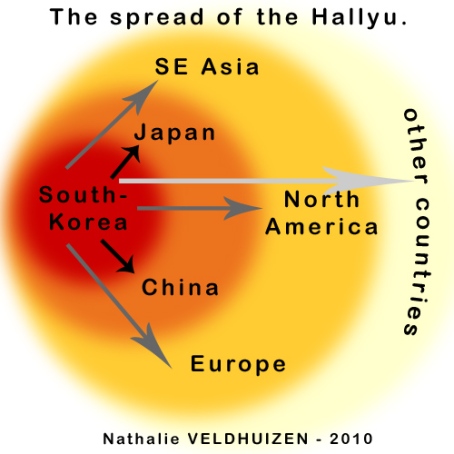 |
Back To Top
Introduction
Something that's been in the news here and there over the past few years is the presence of a cultural Korean Wave.
This Korean Wave, or Hallyu, refers to the slow spread of Korean pop culture throughout Asia, Europe, and North America.1 When the National Post reports on something, you know it's got to be good, right? Plus, there's even a North York couple that moved to Korea, started out as teachers, but that now blog full time about Korean culture and music.1
In some sense, this trend could be compared to the rise in the popularity of Japanese culture abroad in the 80s and 90s in the form of increasingly easily accessed anime and the console wars between Nintendo, Sega, and Sony. Perhaps Korea has less that's unique to offer in the realms of animated TV shows and video games, but both cultural spreads are definitely prime examples of "soft-power"
Back To Top
Soft Power
Soft-power "is the ability to obtain what one wants through co-option and attraction."2 This definitely describes the kind of cultural influence that foreign lands have had on Western culture and aesthetics for quite some time. Rather than trying to do what the West itself did in many colonial instances and force their culture back on the West, places like Korea and Japan are merely creating things that appeal to Western consumers.
In some cases, this means creating a hybrid culture. As Kim Seong-Kon points out, the Korean Wave is just such a hybrid form since K-Pop and K-Drama tend to be combinations of traditional Korean and Western cultures.3
Kim argues that this sort of hybrid culture is not a true representation of traditional Korean culture (the "high brow"), but he also cedes that the hybrid culture that's set off the Korean Wave is something like "John the Baptist, preparing the path for Jesus’ arrival."3
Back To Top
Soft Power too Soft?
Yet, with soft-power, and the appeal of hybrid cultures, is introducing someone to a 'lite' version of a culture really going to entice them into a full-blown interest in more traditional forms? Not everyone who watches anime is going to try to learn about the Sengoku period or try to find out just who Bashō is.
Likewise, the current rise of Korean pop culture isn't going to necessarily lead people to delve deeper into traditional Korean culture. At least not in the numbers that people who say that "hallyu will conquer the world" or that compare the current Korean Wave to John the Baptist imply. Watching My Girlfriend is a Gumiho or listening to the latest by Super Junior, won't necessarily bring people to look into Dangun or research the poetry of the Goryeo period.
That's the thing with soft power, it can be the hand that brings a horse to water, but the horse is ultimately the one who will either dip its tongue in the water, slurp a few waves, or just stare at its own reflection.
Back To Top
Closing
Check back here Friday for a search for the good in the series stalling I Am Number Four.
And for some insight into what the big news stories are in South Korea itself (the dark side of hallyu, some may say), check out KoreaBANG
Back To Top
References
1. Donnelly, Aileen. "Riding the Korean Wave: Latest cultural trend driving Kanadians krazy for music, dance moves." National Post 8 April 2012.
2. "Soft Power." Wikipedia.
3. Kim Seong-Kon. "Future of hallyu: Pop to highbrow." The Korea Herald 4 April 2012.
Back To Top
Subscribe to:
Posts (Atom)