I know that I originally planned to re-launch this blog and Tongues in Jars for December, but recently my time has been short. I'll spare you the regular spiel about working three jobs and planning to move out and etc., etc. The shortest possible version is that I just haven't really figured out exactly what I want to do with A Glass Darkly going forward.
Now, I'm still going to blog (as is plain in my resuming regular updates at Tongues in Jars).
However, the big difference between my blogging in the future and my blogging in the past is that I'm only going to dedicate 1/4 of my writing time and energy to blogging. The other 3/4 are going to my novels, short stories, and poetry. Nonetheless, I want to keep updating these blog regularly. The best way to do this, as far as I've been able to figure, is to simply write more fluid entries.
So, rather than sitting down, planning out, strenuously editing and drafting each blog entry, from now on my entries will be shorter. Ultimately, the purpose of these blogs is to publicly indulge my hobbies, and to give you all a way to get to know me and what to expect from my writing. My blog entries will still have the usual polish, though the fiction and poetry I post here will still be drafts and thus a little unpolished. Think of them as the sketches that artists might post on their sites.
The new year's also going to bring some changes to A Glass Darkly's design and, possibly, name. I'll still post creative writing on Mondays, editorials will return on Wednesdays, and reviews will go up on Fridays. These reviews will mostly be of books, but there'll still be some movie reviews sprinkled in for good measure. But, these entries won't necessarily be regular.
Along with these irregular entries, the plan right now is to post thought pieces based on what I'm playing and reading every day. I've got a crazy book/video game backlog, and so there's plenty of fodder for free-writing. The difference between these entries and Wednesday's editorials will be that the former will be free-flowing wanderings with words, while the latter will usually be more concentrated mini-essays that try to make a point.
So, now that all that's out there - what about the rest of December? Well, for now all I can say is that I don't expect to get much up and running here. I might do one final movie review, either of a bad Christmas movie or of the famous flop Ishtar, but doing either seems unlikely. Instead, I can say for sure that Tongues in Jars will keep getting updated on a weekly basis, and I'll be publishing an article over on examiner.com every week as well.
So, watch this space, gentle reader, and something will appear!
Back To Top
Showing posts with label fiction. Show all posts
Showing posts with label fiction. Show all posts
Wednesday, December 12, 2012

Monday, October 29, 2012
[Moon-dæg] The Box and the Monk
Context
The Monk and the Box
Closing
Back To Top
Context
Tonight's story is a bit of a long one, and, as was the case two weeks ago, it is an early version of a short story related to the larger world that I'm building for my novel series. It's something that could maybe be a prologue or first chapter to a novel in the future, but more than likely it will be the first part of a short story told in three parts.
Check it out, and let me know what you think in the comments.
Back To Top
The Monk and the Box
"Come on, Let’s go.”
The light outside stung his eyes. He still remembered his writing desk - filled with notes that he had been copying and illuminating. But that was before the burning, the beating, and the bag.
He had no idea where he was now. only that the sun beat down so heavily as to make his formerly cool robes feel like a bear pelt.
"Hey! No lagging.” The speaker’s foot found his thigh without problem. After all, there was enough of it to strike, but he was glad of the boot's missing his backside. Spending so much of his life sitting seemed to have tenderized more than harden it.
At the least, he reflected, it was good to be able to stretch out once more. Hunching over the illumination desk for all of those winters had never crumpled his back and he continued to enjoy a height that intimidated most other men. Let alone women.
Though that had never been much of an issue. He remembered what his mother had said of him the night before she sent him to the monastery as the men in hauberks and greaves shouted at him and each other.
“All that fine skin. But no grace. And all that great height and no strength. You’re a misshaped one Hugh, but you’re my misshaped one. Maybe that mind a' yours is at least put right.” He remembered her gnarled cane raising to tap his forehead, “Least it never seems to have pointed you wrong. And it gave you the sponsorship of that roving Friar.
Least ways we can send you off to where the misshaped don’t matter long as the mind is sound. You’ll make me proud yet, you will.”
He brushed a lock of hair out of his eyes as best he could. His hands, tied together as they were, looked oddly over-large to him, as if he hadn’t seen them for days or even weeks. Of course, they were all he'd seen - he never was admitted to the Abbot's order, though he had read and heard about the herbs they used.
“Kneel here.” The man leading Hugh pulled on the rope tied to his bound hands and he fell forward. Unable to catch himself his face broke his fall. He thought he could smell blood, but when he opened his eyes he saw that the flagstone he knelt on was only splotched with dried red patches.
All he had wanted was to be as his elder sister was. Kind and shapely, admired by all - even if, as the brother Olaf had told him in confession, that admiration was only with the eyes. “Eyes make better company than mites.” Hugh had mused to himself then, though he never uttered the words aloud. Only when he was in his cell, struggling to sleep on a bed lengthened with uneven stones. A place whence he knew himself to be entirely alone.
That was still all he wanted, admiration of any sort. But the other brothers only gave congratulations and the Abbot only a wry smile whenever he saw Hugh’s illuminations. Hugh could appreciate their thankfulness for his gifts, but still felt unfulfilled by it. He wondered if any of is work would have survived the fire. He wondered if hoping to find out would help him to do so.
“Say these words.” The rope was yanked again and a piece of parchment was thrust into Hugh's face. Hugh reocgnized the characters but stared at the shapes before they registered.
Something cold reached under his chin. “You can read, can’t you?” The man’s dagger point pricked the excess skin about Hugh’s throat.
“A monk who can’t read? Maybe one of us might as well try to open the damned box. It’s all ended already.” The voice was new and faceless.
“Shut up, Reg. This needs to be seen with fresh eyes. The wise woman said so.”
Reg muttered something as the sound of steel sliding back into a sheath came from his direction.
“You can read, right?”
Hugh looked up into the eyes of his captor.
They were small beady things that looked like the chapel tower windows as the fire licked through the yard. They may even have belonged to the man that burst into the library chamber and threw him from his chair.
“Yes I can read. The brothers taught me.”
“Good. That saves us from cleaning our damn swords later.” The man frowned deeply. “Maybe. Read it.” He pressed the parchment closer into Hugh’s face.
The words had finally settled and they gave Hugh no challenge though he had never seen many before. The parchment was not written in the common tongue, but in the same dialect as some of the older folios and sheaves that he had worked through. Living most of his life with regular prayers in the language made reading the parchment especially easy.
As he began to intone the words, he felt the kiss of steel at his throat.
"Read it to yourself! None of us want to get caught in this, otherwise we wouldn't need an other!" Hugh dared not look up, but a pause suggested a look passed between Reg and Grenn. When he spoke again, Reg's voice carried with it a low grumble, "just move your lips if you have to. Read it t'your self!"
After Hugh had finished reading and looked up, Grenn looked stymied for a moment before pulling his sword from its sheath and raising it over his head.
Hugh threw his hands over his own as he saw and heard the sword swooshing down upon him. He had seen many falcons and owls strike their prey from above but never before suspected that he’d find himself in the role of the rat.
After the sword flashed in its arc one of Hugh's thumbs throbbed, but his wrists felt freer.
“Grenn. Is that a good idea? Letting him loose like that after all his reading?”
“Relax Reg. He’s not about to go anywhere. Not just yet.” Grenn turned to Hugh. Sorry about the thumb, mate. I’m not so used to being precise with this thing.” His sword was swallowed by its sheath.
Hugh lowered his hands and said “It’s alright. What’s this about a box?” He popped his thumb into his mouth. The blood quenched a thirst he hadn’t even been aware of. The flap of his thumb was still well enough attached to keep, he felt. It’s just the end anyway. He pulled his thumb from his mouth, “what, then, about the box?” He still knelt.
“It’s right there. A thing that only the right person can open, at least so Slovan says. But you’re the closest they ever got.” Grenn threw his thumb over his shoulder. “The rest couldn’t read it. Or plain couldn’t read.”
“So what do you expect me to do?” Hugh rubbed his wrists.
“Open the box”
“Why should I do that?” Hugh tried to stand, but a hand from behind him fell onto his shoulder and pushed him back down.
“Hey now. We can end this well for everyone, if you just open the box. No need to get up so fast.”
Hugh heard steel ring against steel all around him. He noticed Grenn reading the parchment as his lips fell into a solid line.
“Now get up. But take it slow. Slow. Just to the box.”
Hugh made his way to where the box sat step by step. The place was completely walled in, yet but there was no echo. He swore he saw water dropping from the ceiling, but he never heard the sound of dripping. His steps were short and shallow, and he realized that his feet were still bound together.
He stopped at the box and looked at it. A large stone contaier of one sort or another. He reached for its edge but Grenn shouted him out of it.
“Wait. Wait. Here” He handed Hugh the parchment. “Hold it while you open it.”
Hugh searched the man but found no answer in his face. He held the paper in oe hand and dedicated the other to the box’s lid. It looked and felt as heavy as the bell rope in the chapel tower. But it moved so quickly that Hugh wondered if it was fleeing his hand rather than being pushed by it.
As the lid slid away, the box’s interior was revealed. A hollow dull space, occupied only by a bundled folio.
Back To Top
Closing
That's it for this blog until my review of The Room and Annotated Links #24 are posted on Friday and Saturday respectively, but don't miss out my Latin and Old English translations and commentaries on Tuesday and Thursday over at Tongues in Jars.
Back To Top
The Monk and the Box
Closing
 |
Back To Top
Context
Tonight's story is a bit of a long one, and, as was the case two weeks ago, it is an early version of a short story related to the larger world that I'm building for my novel series. It's something that could maybe be a prologue or first chapter to a novel in the future, but more than likely it will be the first part of a short story told in three parts.
Check it out, and let me know what you think in the comments.
Back To Top
The Monk and the Box
"Come on, Let’s go.”
The light outside stung his eyes. He still remembered his writing desk - filled with notes that he had been copying and illuminating. But that was before the burning, the beating, and the bag.
He had no idea where he was now. only that the sun beat down so heavily as to make his formerly cool robes feel like a bear pelt.
"Hey! No lagging.” The speaker’s foot found his thigh without problem. After all, there was enough of it to strike, but he was glad of the boot's missing his backside. Spending so much of his life sitting seemed to have tenderized more than harden it.
At the least, he reflected, it was good to be able to stretch out once more. Hunching over the illumination desk for all of those winters had never crumpled his back and he continued to enjoy a height that intimidated most other men. Let alone women.
Though that had never been much of an issue. He remembered what his mother had said of him the night before she sent him to the monastery as the men in hauberks and greaves shouted at him and each other.
“All that fine skin. But no grace. And all that great height and no strength. You’re a misshaped one Hugh, but you’re my misshaped one. Maybe that mind a' yours is at least put right.” He remembered her gnarled cane raising to tap his forehead, “Least it never seems to have pointed you wrong. And it gave you the sponsorship of that roving Friar.
Least ways we can send you off to where the misshaped don’t matter long as the mind is sound. You’ll make me proud yet, you will.”
He brushed a lock of hair out of his eyes as best he could. His hands, tied together as they were, looked oddly over-large to him, as if he hadn’t seen them for days or even weeks. Of course, they were all he'd seen - he never was admitted to the Abbot's order, though he had read and heard about the herbs they used.
“Kneel here.” The man leading Hugh pulled on the rope tied to his bound hands and he fell forward. Unable to catch himself his face broke his fall. He thought he could smell blood, but when he opened his eyes he saw that the flagstone he knelt on was only splotched with dried red patches.
All he had wanted was to be as his elder sister was. Kind and shapely, admired by all - even if, as the brother Olaf had told him in confession, that admiration was only with the eyes. “Eyes make better company than mites.” Hugh had mused to himself then, though he never uttered the words aloud. Only when he was in his cell, struggling to sleep on a bed lengthened with uneven stones. A place whence he knew himself to be entirely alone.
That was still all he wanted, admiration of any sort. But the other brothers only gave congratulations and the Abbot only a wry smile whenever he saw Hugh’s illuminations. Hugh could appreciate their thankfulness for his gifts, but still felt unfulfilled by it. He wondered if any of is work would have survived the fire. He wondered if hoping to find out would help him to do so.
“Say these words.” The rope was yanked again and a piece of parchment was thrust into Hugh's face. Hugh reocgnized the characters but stared at the shapes before they registered.
Something cold reached under his chin. “You can read, can’t you?” The man’s dagger point pricked the excess skin about Hugh’s throat.
“A monk who can’t read? Maybe one of us might as well try to open the damned box. It’s all ended already.” The voice was new and faceless.
“Shut up, Reg. This needs to be seen with fresh eyes. The wise woman said so.”
Reg muttered something as the sound of steel sliding back into a sheath came from his direction.
“You can read, right?”
Hugh looked up into the eyes of his captor.
They were small beady things that looked like the chapel tower windows as the fire licked through the yard. They may even have belonged to the man that burst into the library chamber and threw him from his chair.
“Yes I can read. The brothers taught me.”
“Good. That saves us from cleaning our damn swords later.” The man frowned deeply. “Maybe. Read it.” He pressed the parchment closer into Hugh’s face.
The words had finally settled and they gave Hugh no challenge though he had never seen many before. The parchment was not written in the common tongue, but in the same dialect as some of the older folios and sheaves that he had worked through. Living most of his life with regular prayers in the language made reading the parchment especially easy.
As he began to intone the words, he felt the kiss of steel at his throat.
"Read it to yourself! None of us want to get caught in this, otherwise we wouldn't need an other!" Hugh dared not look up, but a pause suggested a look passed between Reg and Grenn. When he spoke again, Reg's voice carried with it a low grumble, "just move your lips if you have to. Read it t'your self!"
After Hugh had finished reading and looked up, Grenn looked stymied for a moment before pulling his sword from its sheath and raising it over his head.
Hugh threw his hands over his own as he saw and heard the sword swooshing down upon him. He had seen many falcons and owls strike their prey from above but never before suspected that he’d find himself in the role of the rat.
After the sword flashed in its arc one of Hugh's thumbs throbbed, but his wrists felt freer.
“Grenn. Is that a good idea? Letting him loose like that after all his reading?”
“Relax Reg. He’s not about to go anywhere. Not just yet.” Grenn turned to Hugh. Sorry about the thumb, mate. I’m not so used to being precise with this thing.” His sword was swallowed by its sheath.
Hugh lowered his hands and said “It’s alright. What’s this about a box?” He popped his thumb into his mouth. The blood quenched a thirst he hadn’t even been aware of. The flap of his thumb was still well enough attached to keep, he felt. It’s just the end anyway. He pulled his thumb from his mouth, “what, then, about the box?” He still knelt.
“It’s right there. A thing that only the right person can open, at least so Slovan says. But you’re the closest they ever got.” Grenn threw his thumb over his shoulder. “The rest couldn’t read it. Or plain couldn’t read.”
“So what do you expect me to do?” Hugh rubbed his wrists.
“Open the box”
“Why should I do that?” Hugh tried to stand, but a hand from behind him fell onto his shoulder and pushed him back down.
“Hey now. We can end this well for everyone, if you just open the box. No need to get up so fast.”
Hugh heard steel ring against steel all around him. He noticed Grenn reading the parchment as his lips fell into a solid line.
“Now get up. But take it slow. Slow. Just to the box.”
Hugh made his way to where the box sat step by step. The place was completely walled in, yet but there was no echo. He swore he saw water dropping from the ceiling, but he never heard the sound of dripping. His steps were short and shallow, and he realized that his feet were still bound together.
He stopped at the box and looked at it. A large stone contaier of one sort or another. He reached for its edge but Grenn shouted him out of it.
“Wait. Wait. Here” He handed Hugh the parchment. “Hold it while you open it.”
Hugh searched the man but found no answer in his face. He held the paper in oe hand and dedicated the other to the box’s lid. It looked and felt as heavy as the bell rope in the chapel tower. But it moved so quickly that Hugh wondered if it was fleeing his hand rather than being pushed by it.
As the lid slid away, the box’s interior was revealed. A hollow dull space, occupied only by a bundled folio.
Back To Top
Closing
That's it for this blog until my review of The Room and Annotated Links #24 are posted on Friday and Saturday respectively, but don't miss out my Latin and Old English translations and commentaries on Tuesday and Thursday over at Tongues in Jars.
Back To Top
Monday, October 1, 2012
[Moon-dæg] Watching the Detective
Context
All an Act
Closing
Back To Top
Context
This is another draft from my time spent at the local creative writing group. It's a story that carries on with the mystery element from the previous fiction entry, but that is completely unrelated to that piece.
Since it appeared incomplete in my notes, it still has the feel of being the opening for something bigger. Though, of course, I have given it a bit of a polish.
Back To Top
All an Act
The page was still sticky with the yellow paste that held the letters to it. Bland letters and frazzled letters. All cut out by the same hand, but each written in its own.
"Where did you say you found this, again?"
"On the tuba case."
"And the tuba was still inside it?"
Ren rolled her eyes as Jason said the instrument was still in its place when he claimed to have found the note. It was unfortunate, but that was something her younger brother hadn't lost. Another thing. She put the letter down and then walked over to the case. Maybe there's a print or something, she mused.
The case was elephantine amidst the rest of Jason's room - strewn with miniatures. All of them were upright as if guarding every square inch of surface space not occupied by lamps. The music stand crowded close to the tuba's case for comfort.
"Look at this." Ren bent over the case.
Jason took his time to respond. When he did it was mostly just a grunt.
"Come on, now." She waited until his attention swung around to her. "There's a line along the case - in the dust, I mean."
"I don't see it." Jason looked over Ren's shoulder.
She stepped aside and pulled him into place in front of the case by his arm. "Here." Ren put her hand behind Jason's shoulder and nudged him to the exact spot where she judged she had been standing when she noticed the line. "You can only really see it in the light right here." She pointed. "It's just the way it falls."
Jason shrugged and turned to her. "So there's a line. What's that even mean?"
"Somebody must've dragged something across the case. Maybe it's a drawing or something." She craned her neck until she could see the path in the dust clearly again. "Are you sure you don't notice anything missing? Anything out of the ordinary? Out of place?"
"No. It's all here." Jason made a quick spot check over each shoulder. "Yeah. All there."
"And your room's locked?"
He eyed the door and then lowered his voice. "Yeah, you know that sis. It would need to be in a house like this. The rent's so cheap, after all - something's got to be wrong somewhere."
Ren straightened and turned to him, picking up the note along the way. "This better not be another job, Jason. I can't be playing the detective here, too."
Jason shrugged as if the motion was necessary to squeeze the words out of himself, "Why not?" He paused long enough to grin, "Acting practice never hurt anyone."
Ren eyed Jason as she turned, the note in hand. Watch that grin, brother - the last I checked, you were the only one in the house with liquid glue.
Back To Top
Closing
Check back here on Friday for the first part of Shocktober, a four week look at some of the reportedly worst horror films ever made. First up: The Screaming Skull!
Back To Top
All an Act
Closing
 |
Back To Top
Context
This is another draft from my time spent at the local creative writing group. It's a story that carries on with the mystery element from the previous fiction entry, but that is completely unrelated to that piece.
Since it appeared incomplete in my notes, it still has the feel of being the opening for something bigger. Though, of course, I have given it a bit of a polish.
Back To Top
All an Act
The page was still sticky with the yellow paste that held the letters to it. Bland letters and frazzled letters. All cut out by the same hand, but each written in its own.
"Where did you say you found this, again?"
"On the tuba case."
"And the tuba was still inside it?"
Ren rolled her eyes as Jason said the instrument was still in its place when he claimed to have found the note. It was unfortunate, but that was something her younger brother hadn't lost. Another thing. She put the letter down and then walked over to the case. Maybe there's a print or something, she mused.
The case was elephantine amidst the rest of Jason's room - strewn with miniatures. All of them were upright as if guarding every square inch of surface space not occupied by lamps. The music stand crowded close to the tuba's case for comfort.
"Look at this." Ren bent over the case.
Jason took his time to respond. When he did it was mostly just a grunt.
"Come on, now." She waited until his attention swung around to her. "There's a line along the case - in the dust, I mean."
"I don't see it." Jason looked over Ren's shoulder.
She stepped aside and pulled him into place in front of the case by his arm. "Here." Ren put her hand behind Jason's shoulder and nudged him to the exact spot where she judged she had been standing when she noticed the line. "You can only really see it in the light right here." She pointed. "It's just the way it falls."
Jason shrugged and turned to her. "So there's a line. What's that even mean?"
"Somebody must've dragged something across the case. Maybe it's a drawing or something." She craned her neck until she could see the path in the dust clearly again. "Are you sure you don't notice anything missing? Anything out of the ordinary? Out of place?"
"No. It's all here." Jason made a quick spot check over each shoulder. "Yeah. All there."
"And your room's locked?"
He eyed the door and then lowered his voice. "Yeah, you know that sis. It would need to be in a house like this. The rent's so cheap, after all - something's got to be wrong somewhere."
Ren straightened and turned to him, picking up the note along the way. "This better not be another job, Jason. I can't be playing the detective here, too."
Jason shrugged as if the motion was necessary to squeeze the words out of himself, "Why not?" He paused long enough to grin, "Acting practice never hurt anyone."
Ren eyed Jason as she turned, the note in hand. Watch that grin, brother - the last I checked, you were the only one in the house with liquid glue.
Back To Top
Closing
Check back here on Friday for the first part of Shocktober, a four week look at some of the reportedly worst horror films ever made. First up: The Screaming Skull!
Back To Top
Saturday, September 22, 2012
[Sæternes-dæg] Annotated Links # 18: Cultural and Career Vehicles
1. Skelding, Conor. "K is for Kapital, and Not in a Marxist Way." BWOG 22 September 2012. Web. 23 September 2012.
Professor John Lie gave a talk at Center for Korean Research’s Colloquium Series on Korean Cultural Studies in which he didn't speak about K-Pop. Instead, Lie spoke about how Korean pop music is an entirely market and capitalist driven endeavour that is hollow culturally. His evidence is all of the financial backing that the industry receives and its stark contrast to Korea's straightforward and simple traditional music.
This piece is written in a casual style befitting a blog, but with authority. It's included because I find the different perspective on K-Pop's importance refreshing.
2. Cho, Chung-un. "Hallyu can help spread Korean: Minister." AsiaOne 18 September 2012. Web. 23 September 2012.
Choe Kwang-shik, Korean Culture Minister, claims that the world's initial interest in K-Pop is spreading to other cultures. Yet, he posits that even more important than the spread of K-culture in general is the spread of the interest in the Korean language, what he calls the "most important cultural product."
Written in a direct, journalistic style, this article is included because it celebrates the Korean language, a thing truly worth studying.
3. Sofge, Erik. "What Would a Starship Actually Look Like?" Popular Mechanics 20 September 2012. Web. 23 September 2012.
Real physics and space dangers are considered in what an interstellar ship might just look like. The fact that there is no air in space, and so aeordynamics aren't relevant, as well as the problem of space dust perforating sails and hulls because of ships' high speeds are among the things considered.
Sofge wrote this piece in a technical style, but in a tone that is readable - even if some of its paragraphs tend toward lumpiness. Its included because the realities of space-travelling vehicles are excellent things to know for writing science fiction.
4. Hanna, Jeff. "Fantastic Poetry: W&L's Wheeler Uses Terza Rime to Spin a Sci-Fi Story." Washington and Lee Universities: News and Media 20 September 2012. Web. 23 September 2012.
Leslie Wheeler, the Henry S. Fox Professor of English at Washington and Lee University, has just published a collection of speculative fiction poetry. The title poem ("The Receptionist") is set in a fantastical academia, where fantasy creatures and figures stand in for the usual group found in universities.
This article doubles as a light overview/review of the collection and an informative piece. It's included because I find it encouraging that something close to one of my own projects has been carried out and published.
5. Hagy, Jessica. "20 Ways to Find Your Calling." Forbes.com 26 June 2012. Web. 23 September 2012.
This article gives readers a list of 20 questions to ask and things to think about to figure out what you want to do with their lives. The things on this list aren't earth shattering but they're the sort of things that can help to shake loose what might be rattling around in your head.
Written in a casual, easy-going style, this article is included because it offers a way to potentially figure out where your natural skills lay.
Back To Top
Closing
Check back here tomorrow for the week-in-review/week-ahead entry!
Back To Top
Monday, September 17, 2012
[Moon-dæg] Writing of Pale Horses
Context
Horse Play
Closing
Back To Top
Context
One of the early stories from my time with the writing group here in town, tonight's bit is a little noir. The exercise that lead to its being committed to paper simply asked for a first person piece.
It might be partially inspired by Sarah Palmer's vision of a white horse in the middle of the second season of Twin Peaks. In fact, in keeping with that show, the bizarre-ness might or might not be real.
Back To Top
Horse Play
Suddenly I saw a white horse pacing behind the curtains. They were drawn but the iridescent fur drew on the sun's fading strength (and the moon's gaining power) just as the snow did, and shone through the window's thin veil. Its silhouette gave me pause and I stood in the middle of the side walk, gawking over side walk snow banks and into the house.
If anyone else had been out walking that night they might have stopped as well. Or slowed down to gather details before calling the police to report a suspicious character staring into windows.
The animal faded from my sight and I took a step closer to the house. Blinked. It was gone. The window was empty.
In my delirium of curiousity I walked over the snow covered yard to close the distance between myself and the pane. Foot prints didn't matter. There was a horse in there. At least there might have been. I had to find out.
With my feet firmly rooted in the snow in front of the covered flower bed beneath the window sill I leaned forward and set my hands onto the rough stone sill. I could feel my gloves stick to the cold of it. My face nearly grazed the glass. My eyes were filled with the curtains' dull floral pattern and the shapes and shadows of things beyond. On my left I also saw the sun, reflected. Tucked behind houses as it was I knew that I needed to act quickly. Where was that horse?
A snort and a stamp caused me to whirl around so quickly that I nearly fell head first into the sill. Thinking of that possibility and trying to grasp what I saw before me set my heart pounding.
The man sitting astride the horse addressed me in an accent that would have wooed queens.
"Terribly sorry sir - but I do fear that my polo ball has fallen into those bushes."
I tried to keep my eyes off the mallet he held in one of his hands. The horse stamped. I felt my palms dampen.
"Oh. In the bushes. What's it look like?" I knelt and pretended to look.
"Small. Red. Ball-like."
I didn't need to turn around to see the look of growing suspicion that I knew was on his face. That would have been a rookie mistake. And I knew I was no rookie. Horse or no he sure was lucky that these were my old jeans. The trip to Missoula hadn't just been about business.
He said something in that accent of his and I could hear him getting closer. I noticed the horseman's shadow riding up and over my own. As much as I tried to convince myself that this was all just about a red ball I knew the truth. I knew I was trapped.
"Oh, do hurry on there." His horse whinnied to show its support for its rider.
I brushed against the side of the house now. Crawling among the shadows that hid the ball - I was delusional, ball, what ball? - as well as any first rate hacker could hide a data file.
Before the man and his horse could close off my escape entirely I closed both fists around the snow and slush. This would take speed, precision. Quick thinking after it was done. I hoped my week away hadn't dulled my senses too much. I rose, whirled, and threw.
Both fistfuls hit with a piff more satisfying tha any deli pastrami on rye and I dashed past - though that bastard horse almost pulled me down with its tail. I knew that I was scot-free when the man's curses were gentler than the breeze and just as incoherent.
At the next block I slowed and patted my pockets, unsure that nothing was lost. I reached into the one on the inside of my coat and pulled out the book concealed within. The image on its cover of a man in a round brim hat and full-on suit sitting behind a cluttered desk while a woman with bare shoulders wearing beads and short hair spoke to him reassured me that all was still there. That all was still all right. That my time off hadn't dulled any senses. There had to be a horse.
Back To Top
Closing
On Friday, definitely be sure to check in for my looking for the likeable (aside from Samuel L. Jackson and Luke Wilson) in Meeting Evil. Then on Saturday, watch for an Annotated Links, followed by the week-in-review/week-ahead entry on Sunday.
Back To Top
Horse Play
Closing
 |
Back To Top
Context
One of the early stories from my time with the writing group here in town, tonight's bit is a little noir. The exercise that lead to its being committed to paper simply asked for a first person piece.
It might be partially inspired by Sarah Palmer's vision of a white horse in the middle of the second season of Twin Peaks. In fact, in keeping with that show, the bizarre-ness might or might not be real.
Back To Top
Horse Play
Suddenly I saw a white horse pacing behind the curtains. They were drawn but the iridescent fur drew on the sun's fading strength (and the moon's gaining power) just as the snow did, and shone through the window's thin veil. Its silhouette gave me pause and I stood in the middle of the side walk, gawking over side walk snow banks and into the house.
If anyone else had been out walking that night they might have stopped as well. Or slowed down to gather details before calling the police to report a suspicious character staring into windows.
The animal faded from my sight and I took a step closer to the house. Blinked. It was gone. The window was empty.
In my delirium of curiousity I walked over the snow covered yard to close the distance between myself and the pane. Foot prints didn't matter. There was a horse in there. At least there might have been. I had to find out.
With my feet firmly rooted in the snow in front of the covered flower bed beneath the window sill I leaned forward and set my hands onto the rough stone sill. I could feel my gloves stick to the cold of it. My face nearly grazed the glass. My eyes were filled with the curtains' dull floral pattern and the shapes and shadows of things beyond. On my left I also saw the sun, reflected. Tucked behind houses as it was I knew that I needed to act quickly. Where was that horse?
A snort and a stamp caused me to whirl around so quickly that I nearly fell head first into the sill. Thinking of that possibility and trying to grasp what I saw before me set my heart pounding.
The man sitting astride the horse addressed me in an accent that would have wooed queens.
"Terribly sorry sir - but I do fear that my polo ball has fallen into those bushes."
I tried to keep my eyes off the mallet he held in one of his hands. The horse stamped. I felt my palms dampen.
"Oh. In the bushes. What's it look like?" I knelt and pretended to look.
"Small. Red. Ball-like."
I didn't need to turn around to see the look of growing suspicion that I knew was on his face. That would have been a rookie mistake. And I knew I was no rookie. Horse or no he sure was lucky that these were my old jeans. The trip to Missoula hadn't just been about business.
He said something in that accent of his and I could hear him getting closer. I noticed the horseman's shadow riding up and over my own. As much as I tried to convince myself that this was all just about a red ball I knew the truth. I knew I was trapped.
"Oh, do hurry on there." His horse whinnied to show its support for its rider.
I brushed against the side of the house now. Crawling among the shadows that hid the ball - I was delusional, ball, what ball? - as well as any first rate hacker could hide a data file.
Before the man and his horse could close off my escape entirely I closed both fists around the snow and slush. This would take speed, precision. Quick thinking after it was done. I hoped my week away hadn't dulled my senses too much. I rose, whirled, and threw.
Both fistfuls hit with a piff more satisfying tha any deli pastrami on rye and I dashed past - though that bastard horse almost pulled me down with its tail. I knew that I was scot-free when the man's curses were gentler than the breeze and just as incoherent.
At the next block I slowed and patted my pockets, unsure that nothing was lost. I reached into the one on the inside of my coat and pulled out the book concealed within. The image on its cover of a man in a round brim hat and full-on suit sitting behind a cluttered desk while a woman with bare shoulders wearing beads and short hair spoke to him reassured me that all was still there. That all was still all right. That my time off hadn't dulled any senses. There had to be a horse.
Back To Top
Closing
On Friday, definitely be sure to check in for my looking for the likeable (aside from Samuel L. Jackson and Luke Wilson) in Meeting Evil. Then on Saturday, watch for an Annotated Links, followed by the week-in-review/week-ahead entry on Sunday.
Back To Top
Friday, August 17, 2012
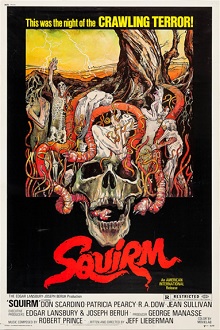
[Freya-dæg] All-Request August Pt.3: Squirm
 |
Introduction
Plot Summary
The Good
The Bad
Judgment
Closing
Introduction
The movie Squirm is one among many in the "nature-strikes-back" sub-genre of horror movies. And perhaps, since the part of nature striking back is none other than the humble worm, the surprise is supposed to horrify as much as the premise itself.
But is this movie really so horrible as to deserve the 30% (from critics) and 28% (from audiences) that it has over at Rotten Tomatoes? Let's find out whether those tomatoes are rotten or just soft because they're worm-eaten.
Back to Top
Plot Summary
Mick, a young man from the city, comes to Fly Creek to meet with a girl he met at an antiques show named Geri. However, the idyllic Southern setting of their romantic rendezvous is ravaged by a storm the night before he sets out and one thing after another goes wrong.
First, he has to wade through a swamp and forest to reach Geri's house when the debris blocks his bus' path, then he's accused of hijacking his egg-cream at the local lunch counter. But things get really weird when Mick and Geri go looking for old man Beardsley, the best antiques dealer in town. Of course, just Mick's presence alone is enough to leave Roger, the hopeful for Geri's heart, seething.
What happened to Mr. Beardsley? Why are worms cropping up where they shouldn't be? And to what lengths will Roger go to to make sure that Mick is taken out of the picture?
Sit back and relax - but, also, be ready to Squirm!
Back to Top
The Good
The acting in this movie is fine, but the accents - the accents are so bad they rebound into the comical.
Everyone except Mick has a Southern drawl of varying intensity. Some of these are light and breathy like those of Geri, her sister and her mother, while others are as heavy as the hillbillies' from Deliverance.
To top off the overdone characters, Mick plays up the role of red-hot lover to a ridiculous extent.
 |
Yet, despite shots like the above, Mick's act is also restrained enough to keep things from going over the top.
The cinematography at times is also fairly well done, considering the movie's genre. Take this excellent dutch angle shot for instance:
 |
For a B-horror flick, Squirm is a good example of the genre. It takes its scares very seriously, and unlike many of the horror films put out today, it relies more on psychological horror than shock horror.
A prime example of this in the film is a scene where Mick and Geri find the Sheriff eating spaghetti with a woman. They tell him about a skeleton they've found, and mention worms a number of times. The woman seems to be there as the audience proxy as she slows herself down and at one point even puts down her utensils - eating spaghetti while talking about worms is never an easy task!
But, the expected scare never happens. None of the spaghetti bits turn out to be the movie's starring monster.
What's more, the movie clearly establishes the potential for the worm-as-spaghetti scare when, earlier in the film, Mick finds a worm in his egg cream (soda) - the next logical step is to have one on a plate of spaghetti, but it never happens. Although it's a relatively small detail, the film is much stronger for leaving this cheap, expected scare out.
Further, even when it doesn't build up the scares, the movie can be down right terrifying. Things get into spoiler territory here, so skip the next paragraph if you're worried about such things.
When Roger gets attacked by the worms we expect them just to kill him. Just to leave him a skeleton as they did the others they've destroyed. Instead, the worms seem to, well, possess him, making him a strange (undead?) worm-man hybrid. This is terrifying visually (thanks to Oscar-winning make-up artist Rick Baker), and also conceptually as we see the worms wriggle up under the skin of Roger's face, leaving welts in their wake.
Back to Top
The Bad
But, why Roger gets possessed while the worms kill everyone else they attack is never explained. This lack of explanation exposes the films' major weakness: its premise is never given any kind of detailed treatment.
Granted, Roger does tell us that when his dad started the worm farm he tried to use electricity to get them out of the ground and that this enraged them (to the point where they bit most of his thumb off), but we don't get any information on how these enraged worms operate.
Case in point, the worms knock down a tree, late in the movie, destroying the dining room in Geri's house while her family and Mick are in it. But this is the first they've knocked down - such a tree's being selected and knocked down suggests some level of consciousness. It seems that they're out to get Mick, and maybe Geri as well.
The other thing that's ill-explained is the worms' being dispersed by "light." This makes little sense because they couldn't have attacked Roger if such was the case, having done so in broad daylight. However, the way that they react to light later in the movie suggests that it's the heat they don't like, not the light. And if this were established as the worm deterrent rather than light when Mick voices his realization, it would help the movie as a whole make more sense.
Now, the same narrow miss at sense is present in the case of Roger.
Because he had his thumb mostly eaten by worms before, it's possible that he has some kind of bond with them. Pair that with his hatred for Mick as competition in the romantic field (though Geri's mother seems to have the hots for him, for some reason), and you have yourself an explanation for his becoming a weird quasi-zombie after the worms' initial attack on him. But this connection is never clearly established. It's strongly implied, but nothing explicit is ever said about it.
Perhaps, though, this is the result of the scientist character being left out of this movie. There's no one in it to say "don't you see...?" or "Of course!" This character could also point out how why, in the world of the movie, this works:
 |
In fact, a scientist character would be incredibly useful at the movie's end where there are so many loose ends that you could bait all the fishing hooks in a salmon derby with them.
Back to Top
Judgment
Squirm is the kind of movie that drive-in theatres would show back when there were more than a few handfuls of drive-in theatres left within the Western world. It's got it's cheesy moments, it's acceptable acting, and its genuinely terrifying bits (so it's also the kind of movie any real life, mack-daddy Mick would approve of). But there are no drive-in theatres anymore.
Times have changed, and the horror genre has changed.
The modern horror movie genre is divided into two sides: One that relies almost entirely on shock horror, and another that relies on human psychology for its scares. Squirm falls in between these two, and so were it to be released now it would probably fall into complete obscurity.
Yet on it's own it does still do what a horror is supposed to do: frighten, scare, and induce a kind of contained paranoia or fear.
However, a truly good horror movie leaves this fear, this paranoia lingering in your mind so that when you flick off the lights that fear can manifest in the darkness of your own home.
Squirm does not manage to do this because it doesn't explain itself well enough. Is Roger possessed? Can Roger control the worms? Does the whole town wind up dead? After the power's fixed and the electricity is no longer running into the ground do the worms go back to being docile?
It's a horror movie that scares, but at the same time forgets that it also needs to tell a complete and coherent story.
So, Freya, fly low if you like, but leave your hook empty for another of the movies in the Field of Fallen Films - this one seems too comfortable where it is, down there in the dark with its worms for company.
Back to Top
Closing
Next week this blog is going to be left to fallow. I'm going to take some time to recalibrate my writing activities so that I can get some of my larger fiction projects moving again and so that I can tidy some things up with my translation blog (as well as with this one).
For full details of the temporary stoppage, check back here tomorrow.
But, though I'm not going to be updating Monday-Thursday, I still plan on finishing All-Request August with a look at the TV miniseries loosely based on the work by Ursula K. LeGuin: Earthsea. So, watch for that review in one week's time, and for tomorrow's fully detailed temporary blog stoppage guide.
Back to Top
Tuesday, July 24, 2012
Annotated Links #10: Massaging Media
1. Chung-Un, Cho. "‘Focus on human nature, not unique cultural aspects’." The Korea Herald 18 July 2012. Web. 24 July 2012.
Robert McKee explains why he finds Korean film so intriguing. He also highlights the importance of speaking to human nature rather than cultural elements in stories intended for an international audience. This article is part reportage, part interview between McKee and the Korea Herald. It is written in a straightforward style with only some minor typos.
2. Dvorsky, George. "How An Alien Invasion Inspired Kevin J. Anderson to Start Writing Science Fiction." io9 16 July 2012. Web. 24 July 2012.
Kevin J. Anderson's accomplishments are listed, and it's noted that his novelization of Rush's Clockwork Angels is due out in September. Included is a long quote about Anderson's seeing the War of the Worlds movie lead him to writing science fiction. The article is written in a light, direct style.
3. MSumm. "Dear Nintendo, Please Give Me a Zelda Game Tougher Than Majora’s Mask." Kotaku 17 July 2012. Web. 24 July 2012.
A rant/letter directed at the major players at Nintendo, asking for a new Zelda game that is as difficult as Majora's Mask. MSumm considers Majora's Mask difficult because of its utter lack of hand-holding and un-skippable tutorials. Difficulty is sought because beating such a game grants the player a great feeling of satisfaction. This article is posted from Kotaku's "Speak Up" forum, so there are some typos and grammatical errors. The article's style is quite casual.
Back To Top
Closing
Tomorrow, watch this space for an editorial entry, and don't miss Annotated Links #11 on Thursday! Then, come Friday, the final part of Nicolas Cage month, a quest to find the good in Seeking Justice, will be posted.
Back To Top
Wednesday, July 18, 2012
[Wōdnes-dæg] A Well Placed Documentary Makes Science Fiction Science Fact
Introduction
The Article Summed Up
Not New, But Great
Publishing's Next Stage and Mainstream Acknowledgement
Closing
Back To Top
Introduction
This past Sunday, the Discovery Channel aired a documentary that has stirred up controversy. The program in question is called "Mermaids: The Body Found," a work of science fiction in the form of a documentary.
Back To Top
The Article Summed Up
The article (from The Christian Post) gives an overview of the controversy and sums it up by stating that the documentary's description and creators said that it is "based on some real life events." Whether or not this is a case of misdirection is not made clear.
Making things even more provocative, the article ends with some statements from the Discovery Channel that present logical arguments for the possibility of mermaids existing.
Back To Top
Not New, But Great
The controversy here isn't so much about whether or not mermaids are real, but about media literacy. And, much more specifically, about the power of the claim that things are "based on some real life events" (or "based on a true story" or "based on real events," whichever variation you might encounter).
This intertitle has become so overused that it's almost meaningless. Anything can be "based on a true story." In fact, any story that is in any way metaphorical (such as science fiction and fantasy stories) is "based on" reality, otherwise its metaphor is useless. The same can be said for comic book stories like Batman - society is faltering because good people do nothing, and then those good people stand up (only in an extreme way that goes beyond what most people would do).
Moreover, it's human nature to relate things to what we know, and most of us know some sort of "real life."
This connection might not seem like a strong argument against specifying that certain things are 'based on reality,' but just as people are apt to read things into various stories, so too are stories apt to feed these readings. Stories that don't have some relation to "real life" often don't make sense and often don't become very popular.
To take a risk and go out on a limb, stories that are successful speak to people's basic desires. Many stories that are coming out now are complicating these desires and the road to their fulfilment.
Christopher Nolan's Batman trilogy, or Geroge R.R. Martin's A Song of Ice and Fire series are good examples of these desires being complicated. Yet, even they still come down to basic desires like wanting to be the hero, personal growth, or safety.
Back To Top
Publishing's Next Stage and Mainstream Acknowledgement
In terms of the documentary form itself, especially regarding the "Mermaids: The Body Found" documentary featured in today's article, it is an especially powerful tool for science fiction and fantasy.
These genres are so continuously popular because people are always looking for more than what they have.
As humans we're always trying to reach beyond our grasp. Putting this desire for more into a form that purports to give straight facts says to people, "hey, you know that thing that you really want to be real? Well, it is, and here are the facts."
That we're so willing to believe is also a great sign of our open-mindedness. Some might say that this willingness to believe is something that people need to guard against when it comes to the stuff of fantasy like mermaids and supernatural cures, but open minds are as necessary for advancement as they are for distraction.
Back To Top
Closing
Don't miss my look at 2011's Trespass for part three of Nicolas Cage month, and be sure to catch tomorrow's Annotated Links!
Back To Top
The Article Summed Up
Not New, But Great
Publishing's Next Stage and Mainstream Acknowledgement
Closing
 |
Back To Top
Introduction
This past Sunday, the Discovery Channel aired a documentary that has stirred up controversy. The program in question is called "Mermaids: The Body Found," a work of science fiction in the form of a documentary.
Back To Top
The Article Summed Up
The article (from The Christian Post) gives an overview of the controversy and sums it up by stating that the documentary's description and creators said that it is "based on some real life events." Whether or not this is a case of misdirection is not made clear.
Making things even more provocative, the article ends with some statements from the Discovery Channel that present logical arguments for the possibility of mermaids existing.
Back To Top
Not New, But Great
The controversy here isn't so much about whether or not mermaids are real, but about media literacy. And, much more specifically, about the power of the claim that things are "based on some real life events" (or "based on a true story" or "based on real events," whichever variation you might encounter).
This intertitle has become so overused that it's almost meaningless. Anything can be "based on a true story." In fact, any story that is in any way metaphorical (such as science fiction and fantasy stories) is "based on" reality, otherwise its metaphor is useless. The same can be said for comic book stories like Batman - society is faltering because good people do nothing, and then those good people stand up (only in an extreme way that goes beyond what most people would do).
Moreover, it's human nature to relate things to what we know, and most of us know some sort of "real life."
This connection might not seem like a strong argument against specifying that certain things are 'based on reality,' but just as people are apt to read things into various stories, so too are stories apt to feed these readings. Stories that don't have some relation to "real life" often don't make sense and often don't become very popular.
To take a risk and go out on a limb, stories that are successful speak to people's basic desires. Many stories that are coming out now are complicating these desires and the road to their fulfilment.
Christopher Nolan's Batman trilogy, or Geroge R.R. Martin's A Song of Ice and Fire series are good examples of these desires being complicated. Yet, even they still come down to basic desires like wanting to be the hero, personal growth, or safety.
Back To Top
Publishing's Next Stage and Mainstream Acknowledgement
In terms of the documentary form itself, especially regarding the "Mermaids: The Body Found" documentary featured in today's article, it is an especially powerful tool for science fiction and fantasy.
These genres are so continuously popular because people are always looking for more than what they have.
As humans we're always trying to reach beyond our grasp. Putting this desire for more into a form that purports to give straight facts says to people, "hey, you know that thing that you really want to be real? Well, it is, and here are the facts."
That we're so willing to believe is also a great sign of our open-mindedness. Some might say that this willingness to believe is something that people need to guard against when it comes to the stuff of fantasy like mermaids and supernatural cures, but open minds are as necessary for advancement as they are for distraction.
Back To Top
Closing
Don't miss my look at 2011's Trespass for part three of Nicolas Cage month, and be sure to catch tomorrow's Annotated Links!
Back To Top
Subscribe to:
Posts (Atom)