Showing posts with label action. Show all posts

Friday, September 28, 2012

[Freya-dæg] The (Good) Samaritan

{The Samaritan's movie poster, found on IMDb.}

Plot Summary
The Good
The Bad
Judgment
Closing

Back to Top
Plot Summary

Foley (Samuel L. Jackson) has just finished his 25 years in the joint and he's eager to start fresh. He meets with his parole officer, gets himself a job - and reconnects with his old partner's son, Ethan (Luke Kirby).

But Foley's chance meeting with Ethan almost causes his undoing, as it introduces the fiery Iris (Ruth Negga) into his life and threatens to pull Foley back into the very world that he wants so dearly to escape.

But meeting Iris quickly becomes a great thing for Foley. The two become more and more intertwined as a couple. In fact they become so close that there are no secrets between them. Except, as Foley finds out from Ethan, one. It's a secret that could tear Foley and Iris apart and twist the knife that knowing the secret himself has thrust into Foley's heart.

Ethan uses this secret as leverage to bring Foley in for one more big score. But will Foley go along with it? Will he be able to keep Iris in the dark or will she be able to handle the terrible truth? Most importantly, even if forced once more into the world that he vowed to leave behind, can Foley emerge once more as The Samaritan?

Back to Top
The Good

For a Canadian film, The Samaritan is a slick picture that weaves a wondrous atmosphere around its viewer. From the dank streets of Toronto to a moody, Peter-Gabriel-esque sound track, this movie is one that offers more than just an escape, it offers a rewarding journey through the darkest of places.

Samuel L. Jackson gives a much more muted performance than in most of his other movies, as his is a character who's more reflective than violent. But this works well with the other elements of the movie and really helps to sustain its atmosphere. Also, Luke Kirby plays a perfect slime ball, while Ruth Negga does well as an addled lost woman.

{Foley, confronted by Ethan's questions of why he killed his father.}


But slick production values and strong casting aside, this movie pulls out one of the few trumps in the noir genre: the Oldboy card.

The twist that Oldboy deploys in its narrative is more elaborately delivered, but the pared down version found in The Samaritan is incredibly effective. What's more, it also takes some extra time to give greater depth to the entanglement between characters. Further, this device is such a rarity in Western cinema that it comes as a welcome surprise.

Back to Top
The Bad

At the same time, The Samaritan is not without its problems.

The pacing of Foley and Iris' relationship is too fast, for starters. Not that a guy who's just gotten out of prison wouldn't fall for a girl like Iris as quickly as he does, but rather there's very little chemistry between them until Foley takes the initiative.

This makes sense, since Foley plays as the world-weary and in-control ex-con all the way through, while Iris is very much caught up in the world of the pimp's fist: opening to dispense coke, and closing to dole out cruel slavery. This dynamic later becomes something more, as Foley strives to help Iris get herself straightened out, but their bumpy start can't be ignored.

The movie's initiating moment, the one that sets up Ethan's and Foley's motivation for the whole of the movie, is also questionable.

In this moment, Foley is faced with the choice of seeing his best friend and partner being killed before being killed himself, or killing that friend, taking the fall, and having to live through prison. The way that this moment is introduced and then developed over the course of the movie does nothing to show us why Foley chose to live rather than die a Roman death.

After all, when he comes out of prison everything has changed, everyone he meets from his old life says that what they did was "1000 years ago," and he has no connections on the outside whatsoever. We don't even see any reason for Foley to have killed Ethan's father aside from his own cowardice (or, in Ethan's words, "to save his sorry ass").

It could be argued that this is how we're supposed to regard Foley throughout the picture, but this doesn't jive with his actual character as we see him. Throughout the movie he's calm, collected, and entirely together - he knows exactly what he's doing, how to do it, and how to keep calm while doing it. His is not the shakey hand of the coward, but the steady one of the expert.

Maybe there was some pivotal, off-camera moment in prison that turned him from craven to maven, but we don't see it and this creates a distracting disconnect between his apparent motivation for saving himself rather than just dying with his friend. And since the moment in which Foley made this decision is what leads to the rest of the movie, the plot itself is undermined.

Back to Top
Judgment

The Samaritan is a movie that very clearly explains its own lukewarm reception.

Samuel L. Jackson is famous for starring in movies that grab your attention, shake you for an hour and a half and then leave you reeling. Likewise, film noir is a genre known for characters and plots that seize your interest and sweep you around from situation to situation until things conclude in a twist of some sort. Combine these two together, and you rightfully expect a twisted thrill ride that delivers atmospheric, hard-boiled action.

However, this just isn't the case.

The thrills are there, as are the twists and the characters, but nothing necessarily grabs and holds you. The whole movie is better described as a film that very clearly proclaims "I'm noir! ...and I'll just be right over there, okay?"

To really appreciate this movie, you need to be willing to take an active role. Not so that you can follow its complexities, but becuase the movie's not going to do much holding for you. It's a movie to get lost in rather than to be lost in. And that is a very refreshing change from movies in the action/noir genre that try to bludgeon their viewers with madcap sprees.

So, Freya, find this one brooding in the Field of Fallen Films, and bring it up, for it's truly a one that deserves to be seen.

Back to Top
Closing

Tomorrow, watch for Annotated Links #19, and on Sunday for a look back/look ahead entry.

Back to Top

Friday, September 14, 2012

[Freya-dæg] An Audience With Your Highness

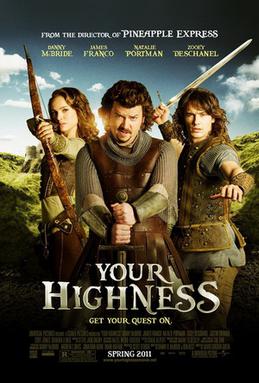
{Your Highness' movie poster, found on Wikipedia.}

Plot Summary
The Good
The Bad
Judgment
Closing

Back to Top
Plot Summary

There is an ancient prophesy in the land that says that if a great warlock can lay with a virgin when the two moons meet, he will create a dragon. The Order of the Golden Knights has stopped the warlock before, but many years later all of the knights of the Order have been wiped out, a great warlock has arisen and the moons begin to converge.

Of course, none of that matters to the brash prince Thadeous (Danny McBride), son of King Tallous (Charles Dance) and brother of the all-favoured Fabious (James Franco). He's about as concerned with prophecies and quests as a bear is with a block of cheese. But when his brother returns from yet another successful quest with the virgin Belladonna (Zooey Deschanel) only to have his wedding crashed and his bride carried off by none other than the great wizard Leezar himself (Justin Theroux), Thadeous is forced by his father to join Fabious on his quest to save his bride and ultimately the kingdom.

Will Fabious be successful in averting a doom that will envelope the land, though he is beset on all sides by villains both traitorous and bad? Will Thadeous grow to be more than a spoiled bawd of a king's son? Or will Lazeer prevail?

Only by watching can you find out if this disparate bunch of questors can break Leezar and make him scream Your Highness!

Back to Top
The Good

Your Highness's cast is simply star-studded. Zooey Deschanel, James Franco, and Charles Dance — all of them have sizeable roles in the film and bring all of their acting chops to bear on the film as a whole. What's more, even the lesser known Danny McBride does a great job as Thadeous.

But what really sends this movie over the top in terms of the acting is the sheer devotion that all of the players show to keeping things medieval. The dialogue, the delivery, everything is nicely tinged with the very stuff of high fantasy. It isn't necessarily accurate to actual historical fact, but neither are many high fantasy stories, and neither are many of the medieval romances on which they're based - something which this movie gets quite close to being.

However, rather than being written by some gallant-minded self-styled bard, Your Highness is closer to what might have come about had Geoffrey Chaucer ever wrote a non-historical verse romance.

The movie's writing is also quite strong, and though the plot develops in a more or less expected way, there are enough fantastical elements to keep your interest throughout all of its 100 minutes.

The movie also nicely straddles the line of satire while also keeping the movie's illusion in tact. Watching it, it's very easy to get the sense that the actors know that they're playing in roles and through ridiculous situations, but they maintain their act all the same. The fourth wall is left firmly in place, so much so that the best analogy is that this movie is the way that players of a D&D game might imagine their own games as they're playing them.

And, just like many a D&D game, the movie has some unexpectedly dark moments, such as when the quest seems to be entirely hopeless and Fabious exclaims that "Belladonna will get raped and die" if they don't get to her in time.

But, most importantly, setting this movie apart from In the Name of the King, is that nothing in it is contrived for the sake of action or a good laugh. Instead all of the jokes arise out of the characters' personalities and the setting itself.

Back to Top
The Bad

However, Rotten Tomatoes' consensus on this movie does have it right - the jokes here are almost all based on the same theme. In this regard it's kind of like something that Trey Parker and Matt Stone might have written, and it does run the risk of getting a little thin by the end. Though that remains as only a risk.

Also, there are some things in the movie that are pretty outlandishly off when it comes to medieval culture, even that of a fantasy realm. Such as this:


Powdered wigs and pale faces weren't quite a male fashion statement until the 18th century, which is just a few centuries too late.

There are also some elements introduced early on in the movie that could use some more explanation: Thadeous' distaste for mechanical things (focused entirely on his brother's mechanical bird companion), and why the "triangle face" that Courtney (Rasmus Hardiker) pulls scares him.

{The horrific "triangle face" in action.}


However, as the film picks up and goes on, these things are forgotten by viewer and writer alike. Adding them into the development of Thadeous would have made this movie all the stronger, though. Perhaps, in fact, instead of just temptations to indulge himself, he could have had to face a mechanical being with a "triangle face" in the labyrinth where he and the party find the Blade of Unicorn.

Back to Top
Judgment

Your Highness is a grand farce of a medieval romance comedy. The humour can be overbearing, but the actors, the script, and the chemistry between them all keeps things going at a lovely trot from start to finish. What's more, this movie passed one of the ultimate tests: it was as fun to watch a second time as it was the first.

So, Freya, don't mind the lewd way in which this one comes on to you as you scoop it from the Field of Fallen Films, nor its lascivious words as you fly with it from there to where all great movies deserve to be.

Back to Top
Closing

A Glass Darkly is going to be undergoing some changes starting next week.

Monday's and Friday's entries will continue as usual, but instead of Annotated Links throughout the week and an editorial in the middle, Annotated Links will be moved to Saturday and expanded to five links from three. The editorial is being dropped and will be replaced with a brief update on my writing endeavours that goes live every Sunday.

Check out the first of these Sunday entries on the 17th of the month!

Back to Top

Friday, September 7, 2012

[Freya-dæg] A Good Reason to Swear In the Name of the King

{In the Name of the King's's movie poster, found on Wikipedia.}

Plot Summary
The Good
The Bad
Judgment
Closing

Back to Top
Plot Summary

Trouble is brewing in the land of Ehb and realm-wide unrest is afoot. Though usually unarmed and disorganized, hordes of Krug are ravishing the land, destroying villages, and, strangest of all, taking prisoners. Duke Fallow (Matthew Lillard), the nephew of king Konreid (Burt Reynolds) may have a hand in these goings on. Or perhaps it is the mysterious magus Gallian (Ray Liotta), who has secretly taken the warrior/enchantress Muriella (Leelee Sobieski) as a lover who is pulling the strings.

All that's clear is that amidst this strife the humble Farmer (Jason Statham) seeks only to live a quiet life with his wife Solana (Claire Forlani) and son Zeph (Colin Ford). This idyllic life doesn't last, however, as it's not long before the Krug attack Farmer's village.

Now, with his family dispersed, and a desire to restore order to the land in his own way, Farmer sets out with Norrick (Ron Perlman) and Bastian (Will Sanderson) to set right what seems to be so very wrong.

Will this trio be just another group stricken down by powers beyond mortal control, or will they be the ones to catch the villain behind it all and cry "Stop, In the Name of the King"?

Back to Top
The Good

In the Name of the King boasts some of the best acting talent in a fantasy movie (not based on any written/drawn work) of recent memory. We've got Jason Statham on action, Ron Perlman and John Rhys Davies (the king's magus, Merick) on all-around-awesome, Matthew Lillard on ham, and Burt Reynolds on kingly bearing. It's a great ensemble and quite a treat to see them all together.

Plus, Statham in the role of Farmer, gets into the thick of some pretty good action sequences, but more than anything he weilds a boomerang in this movie. A boomerang. He definitely must have stopped off at his local wind temple before the events of this movie began.


What's more, this movie was filmed in Hollywood North - Vancouver and Victoria British Columbia, Canada. And more business for Canadian film is always good, right?

Back to Top
The Bad

As you might have guessed from the lack in the previous section, this is not a movie with a lot of inherent redeeming features. So, let's start working through where this one failed, starting with the most nit-picky and working our way toward the more general of the film's flaws.

First and foremost, sumptuary laws, the medieval codes governing the clothing colours and styles and accessories that can be worn by different parts of society, are not observed.

Solana, Farmer's wife, is the worst violator of these laws. Not only does she have her face done up to look like a noble woman throughout the movie, she also wears purple throughout the movie. Peasants were not allowed to wear purple under most medieval sumptuary laws since it was considered a regal colour. Therefore, either she is a noble woman and we're never told about it, or she's a peasant and somebody on this movie's production team didn't do their research.

Similarly, Statham's use of a boomerang can slide, since for a medieval (European) setting it's a nice exotic touch. But, his possession of a sword, even if it looks like an old and worn one, wouldn't be permitted. Medieval law restricted the ownership of swords to the noble classes, partially as a status symbol and partially because they could be expensive to make. Now, a counter-argument could be made here, but it involves spoilers. So, skip the next paragraph if you'd rather not have this film's plot ruined.

<*spoilers*>It turns out that Farmer is the son of the king. This makes him a noble by blood, and therefore allows him a sword. But, the thing with that is, he isn't recognized as the king's son until a fair bit of wrangling goes on in the last third of the movie. Up until that point he is, even in his own mind, just a peasant, and therefore has no business owning a sword.

Speaking of the classic medieval weapon: Though they make for decent spectacle, the movie's sword fights are far too simple.

Instead of the movie showcasing sword-fighting as an art, what the movie shows is more of the hack-and-stab school of swordfighting. This style kind of works for Farmer, since, even if he's always had his sword, he may not have ever learned how to use it, but the generals, soldiers, and wizards in the movie definitely ought to be beyond the most basic of sword strike-sword counter drills that are prominently featured in each fight.

Perhaps the action choreographer (Tony Ching Siu Tung) was going for a simpler, grittier style of sword-fighting to match the grit implied by the movie's generous smatterings of greys and browns, but people who fight with swords for a living aren't going to make wide, large, unnecessary swings - they're going to make precise, small, movements that give them exactly the power, energy, and force that they need in any given situation. And, when life-long swordsmen and women make such movements, they're going to look far more graceful than they do in this movie.

Now, it must be granted that the movie's actors all get a fair shake at showcasing their talents in a fantasy setting, but Ron Perlman is cheated in this movie. <*spoilers*> Norrick dies near the end of the movie, but we're not given any kind of scene centering on this. We see him get hit, we see him go down, and then we see Bastian, who's with him, declare that he's dead. There's no big speech, there're no tear-felt last words, Perlman's Norrick just dies and then that's it.

Also, more a matter of casting or make-up than acting, Ray Liotta's Gallian shouldn't be in command of planar magic, he should be too busy with a show in Vegas to learn such things. Just look at his mug:


Moving from acts, action, and acting, to the movie's screenplay, it's about as solid as the non-existent forest canopies that the movie's Amazonian elves use to swing down from during a major battle sequence.

As a writer, I can understand any storyteller's fear that loading the beginning of their story with exposition will leave audiences confused, disconnected, and disinterested. But that doesn't mean that you should put most of this exposition (especially those things that you could use to lead to some really amazing plot and character developments) into the last 20 minutes of your movie.

Nonetheless, in In the Name of the King, it is within the last 20 minutes that we learn how the world's magic works, that Gallian somehow made himself king over the erstwhile kingless Krug, that there are only two magi left in the world, that magi can transfer their powers to one another, and that Farmer knows what to do with a sword both in melees and in single combat.

Putting all of this up front, or at least spreading it out could have made the movie much more interesting. Instead, what carries us forward through it is the promise of action and nothing else. What's more, we never learn anything about the world, outside of what we learn in those final 20 minutes, that relates to anything that isn't directly involved in the story.

{Not Isengard.}


Adding insult to the injuries already inflicted on its audiences' sense of taste, the movie rips off Lord of the Rings fairly openly. Galleon's keep is practically Isengard, and the Krug seem to be multiplying beneath it, just as orcs do in Sauroman's domain. Star Wars is also plagiarized, but there are already dozens of movies with protagonists whose fathers turn out to be very prominent figures.

Rather unsurprisingly, In the Name of the King also suffers from something I like to call Titan-itis. This movie malady is named for Clash of the Titans and Wrath of The Titans since both of those movies focus almost entirely on their male characters and their relationships, only bringing female characters into the story when necessary for romantic or plot reasons.

In the Name of the King does the same thing. It may even have a worse case of this illness, since Muriella, a capable, strong woman (warrior/sorceress) seems like she's been torn right from the pages of medieval romance, but she is never actually shown doing anything in the realm of men.

And, topping off all of the movie's shortcomings, its relative production values are likely trumped by those of the two Blind Guardian songs that play over its credits.

Back to Top
Judgment

Epic fantasy movies are a difficult bunch. Other films in the genre, like Labyrinth, or The Never Ending Story, have it pretty easy since they weave their worlds carefully, draw their audiences in, and tackle some dark themes while being disguised as "kids' stuff."

In the Name of the King does none of that.

Even worse, In the Name of the King has almost no redeeming qualities if looked at as a whole. Its storytelling is backwards, its dialogue is awkward and out of place, its world is poorly constructed, and its characters, unfortunately, show almost no growth whatsoever.

Even after becoming king, it seems that Farmer just stays as he is. In fact, aside from Farmer's new title, things will probably wind up as they were at the movie's beginning since Gallian, upon delivering one of the movie's weirdest lines to Solana ("I can feel him in you"), reveals that she is carrying another of Farmer's children.

The movie's action keeps it going, but if you happen to turn your brain on at all during the proceedings you'll quickly find that doing just about anything other than watching this movie would be a better use of your time.

So Freya, avoid In the Name of the King at all costs, and let it rot where it lay. The Field of Fallen Films is truly the best place for it, though even there it may keep some of the others from fertilizing the earth beneath them.

Back to Top
Closing

Check back here next week for a look at another ill-thought of fantasy movie, However, if you really want to see a good underdog fantasy movie, check out Your Highness.

Also, the blog update continues, but it doesn't look like my regular entries will become regular again just yet. Follow me on Twitter (@the_penmin) or follow this blog via email by typing yours into the box to the right of the top of this entry to keep on top of the happenings here at A Glass Darkly!

Back to Top

Friday, August 31, 2012

[Freya-dæg] All-Request August Pt. 5: This Means War

{This Means War's movie poster, found on Wikipedia.}


Introduction
Plot Summary
The Good
The Bad
Judgment
Closing

Introduction

When I first saw the previews for This Means War I thought that Hollywood had finally moved onto something new in the rom-com genre. I thought that the usual romantic comedy formula had been done away with and things had begun to progress onto something more substantial. I thought, for a while, that we all had a bromedy (bromantic comedy) on our hands.

Of course, thoughts and reality aren't always in accord, I thought as I sat down to watch this movie to round off All-Request August. Let's see just how much my thoughts and the reality of this movie jive.

Back to Top
Plot Summary

Tuck (Tom Hardy) and FDR (Chris Pine) are two of the CIA's top agents. They're great in the field together, and back at the office they're some of the most popular guys in the agency. But there's something that can tear even the closest of friends apart, something that can be more heinous that a plot to destroy the world, more scheming than any mastermind looking to destroy the diamond market, or more maniacal than a mogul interested in assassinating the leader of the free world. A woman.

Lauren (Reese Witherspoon) is busy at being a product testing executive. Maybe a little too busy, or so her friend Trish (Chelsea Handler) thinks. So she creates a profile for Lauren on an internet dating site - and, seeing the same ad on television, so does Tuck!

But little do either of them know that this will lead to a three-way meeting that might just tear apart the two fastest of friends and put the whole of America at risk. In fact, if they can't resolve their differences it might be more than just these two rivals in love declaring: This Means War!

Back to Top
The Good

Full disclosure, I thought right. This Means War does actually do things a little bit differently from the standard modern romantic comedy. Rather than focusing on a couple who has lost their spark, this movie focuses on two friends and what happens when a woman comes between them. Plus, we do see a little bit of a bromance between Tuck and FDR.

It also sort of portrays some strong, independent women. In fact, all of what it says that's positive can be summed up in Lauren's friend's advice: "Don't choose the better guy, choose the guy that's gonna make you the better girl."

What's more, throughout the movie we actually see some real character growth in FDR. He starts off as a stereotypical American alpha male, but he winds up completely changed (more or less) but for the better. In essence, we actually see him grow up over the course of the film in a lot of ways.

Speaking much more broadly, the movie's premise of spies using their resources to woo the same girl could be interpreted as an evolution of Cyrano de Bergerac's romantic-helper sub-plot. However, instead of both friends working together, or in any otherwise strictly co-operative way, they act on a much more individual basis.

They both rely on teams to gather information on each other and on Lauren, but they use all of this information as individuals, subjecting the raw data to their own analysis, thoughts, and figurings. In that way, then, the premise of this movie lends itself well to a celebration of the power of the individual in the digital age (if say, we replace the teams of data miners with other people who provide people with information, like say, bloggers).

Add to all of this some frenetic action sequences that are intense but easily followed and all-around well done, and you've got yourself an incredible movie.

Back to Top
The Bad

However, in the case of This Means War you'll get all of that and about 30 minutes more. Or rather, too much.

The movie hums along nicely through its first act and most of its second act, with nary a care. There's some morally dark, privacy invasion issues raised by Tuck's and FDR's bugging Lauren's home (while she's in it, no less), but that sort of thing is built into the premise.

What's harder to get past is how the movie deteriorates as the third act comes into view and then crumbles entirely by the time it ends.

Up until the penultimate climactic scene where Lauren, Tuck, and FDR are all together for the first time the movie has, though slightly awkwardly, shown character growth, suggested that it's okay for women to be bold and independent, and made the wise-cracking friend role more of a wise-friend role. But, once the three meet all of this falls apart.

In this scene, Lauren becomes a hyperventilating mess, her friend goes back on everything she's said up to that point by saying "I told you you shouldn't have dated two guys at once," after towing the exact opposite line for the first 2/3 of the movie, and Tuck and FDR are broken up without any real threat to their relationship since the movie's big bad has been spotted and it's still their mission to take him down. What's more, the big bad kidnaps Lauren and Trish, as if they're perfectly helpless damsels in the face of gritty reality - contrary to what the rest of the movie has suggested.

What makes this reversal worse is that the movie telegraphs that it's coming almost from minute one.

The emphasis throughout the first two acts is firmly placed on the romantic stuff at the cost of the spy stuff - but the big bad that's out to get Tuck and FDR for what they did in the opening scene is still there, lurking just out of frame and begging to have his part of the plot resolved. This fulfilment comes in a rush of high-paced action. Up to this point the action's just been drizzled over the two agents' comic rivalry. So it's clear that he's going to be the focus of act three.

Between Tuck and FDR, FDR gets far more character development. We learn about his past, a little of what motivates him at present, and we actually see him change over the course of the movie.

However, Tuck remains largely the same as a character. Only his circumstances change, since after it's revealed that he's a secret agent his estranged wife and kid - whom he had formerly convinced that he was a travel agent - come right back to him, no questions asked whatsoever.

And as far as Lauren's character goes, she is portrayed as a successful career woman, but we also get glimpses of her being hung-up on an ex whom she followed to the city while they were still dating. This situation could be made to bolster her as the strong female figure that she more or less is, but at the same time this is clearly an illusion.

Without ever getting a reason for it, we're shown that she still has a thing for this ex in spite of his being engaged and, by the very rules of the movie, thus unattainable. You could argue that this unattainability makes her want him back all the more, but since it's not clear what made him so special in the first place Lauren's jealousy and desire aren't given enough motivation to take full advantage of the unattainability angle.

The negative transformation of Lauren's friend is a little less predictable. Yet, just before she turns into the "I told you so" character that rom-coms are well known for having, we see her in a setting that's more everyday than those in which we've seen her previously. This is also the scene where she gives Lauren her sage advice.

So what's the situation? Helping her son repair a baseball mitt, while sitting on the couch in her living room and talking about how she loves her husband because he's her own man, despite his faults. This is sweet and all, but it entirely contradicts the firebrand that we've seen her as before. This isn't to say that mothers can't simultaneously be firebrands and motherly (real people are complex, of course), but there's no build up to this scene.

Further, it suggests something curious about marriage that the rest of the movie works towards as well.

The motherly scene with Trish, Tuck's lack of development, FDR's full-on development, and Lauren's loosening up all suggest that marriage is some sort of solidifying ritual. That it somehow locks people into what's truly best for them and that this means, to varying degrees, that growth is no longer necessary for a person.

This is why I've taken this away from the movie: all of its unmarried characters change gradually, we see them grow, evolve, and become something different from what they were at the movie's beginning. Conversely, all of the characters who are married do not change (Trish's sudden change is out of character, but not unpredictable since the movie is constantly reminding us that she's married and has a kid).

It may not have been the movie's intent, but since we're given two main characters (Tuck and FDR) it's hard to not compare the two. And any comparison shows that while unmarried the one changes, and while married the other does not change.

Back to Top
Judgment

The story of two men competing for one woman is definitely nothing new.

Chaucer's Knight tells the story of Arcite, Palamon, and Emily in the Canterbury Tales - written in the latter half of the 14th century. And Chaucer didn't create the Knight's Tale from pure inspiration, it was a shortened version of a story by Giovanni Boccaccio, which itself probably has even deeper historical roots.

However, This Means War does show some character growth within its love-triangle.

Yet, at the same time, it's kind of surprising that this movie got made. Especially now, in a world of phone tapping and drone strikes, and all manner of privacy invasions being made possible by the internet and the degree to which we're all connected to it. It would've made much more sense had they explicitly addressed this in the movie rather than just calling it "immoral" right before an action sequence.

The movie also promotes some of the old curious romcom axioms: marriage saves, and women who are all about their career only mellow out once they meet a man.

There is potential in This Means War, but all of that potential, like an unsatisfying story draft, gets crumpled up by the end of the second act and intricately tossed into a decorative garbage can in the third.

So, Freya, this one may yet moan and move about on the littered ground of the Field of Fallen Films, but don't let yourself be fooled into raising it up. Ultimately, it's just muscle memory at work.

Back to Top
Closing

Next week, the blog update continues, but depending on how much of it gets done over the weekend, regular updates might just return to this blog. Regardless of my progress through that to do list, however, I'll be giving In The Name of the King a look next Friday, and am hoping to find something hospitable within it.

Back to Top

Friday, August 24, 2012

[Freya-dæg] All-Request August Pt. 4: (Legend of) Earthsea

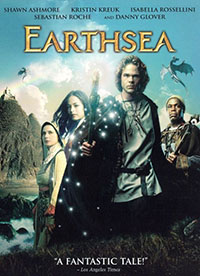
{The Legend of Earthsea's DVD cover, found on Wikipedia.}

Introduction
Plot Summary
The Good
The Bad
Judgment
Closing

Introduction

Normally, I don't do things that aren't movies, but when a request for the Legend of Earthsea (later shortened to Earthsea) came through, I simply could not refuse. Ursula K. Le Guin is a master of the crafts of fantasy and science fiction, and anything based on her work is something that I was sure I could find some good in.

So, let's see what I came out with.


Back to Top
Plot Summary

Ged (Shawn Ashmore) is a typical young man living in a small village. He's skilled with magic and learning from a local wise woman while his father (Dave 'Squatch' Ward) tries to corral him into blacksmithing. Amidst it all though, Ged would rather be spending time with his best friend, Diana (Erin Karpluk). However, beyond the island of Gont, trouble brews. The king of the Kargides, Tygath (Sebastian Roché), is plotting to bring all of the 1,001 islands of Earthsea under his command for the sake of peace.

The king's campaign eventually brings him to Ged's village, where the young wizard uses his wiles to outwit the king's soldiers, but at a terrible cost - the loss of his place as a mere blacksmith and the fulfilment of his greatest desire: to be somebody known and important.

With the promise of his powers pulling him onwards, Ged is thrust into a world of magic and wonder that he cannot begin to comprehend. At the same time, the Kargide king's plan to seize an ultimate, dark power from an order of priestesses is in full swing. Can Ged learn to control his power in time? Will the Kargide king's evil schemes come to fruition? The answers are sure shake all of Earthsea!

Back to Top
The Good

The mini-series begins with some typical fantasy things: the village boy with great hidden power, a mysterious old wise woman, and a call for adventure (some key ingredients in Joseph Campbell's theory of the "Hero's Journey"). Yet these elements are presented in a way that develops them.

We see Ged and Diana (with some of the best chemistry in the series) live out a relationship that's similar to Link and Saria's in The Legend of Zelda: Ocarina of Time.

In fact, the scene where Ged and Diana part ways is just as effective as that in which Link and Saria do the same. We also see Ged and his father's relationship very quickly develop as the two are brought into conflict over the death of Ged's mother and their differing views of what's best for Ged. Plus, the introduction of the great wizard Ogion (Danny Glover) is quite well done.

Earthsea's effects are also quite well done, considering that this was produced in 2004 and on the sort of budget that SyFy (formerly Sci Fi) seems infamous for providing its many mini-series.

In some ways these effects are reminiscent of the animations you'd find in Baldur's Gate on the PC, or of those seen in Hercules: The Legendary Journeys or Xena: Warrior Princess.

The effects aren't breathtakingly realistic (for the most part) but they aren't enough to break the magic and wonder that the mini-series is trying to portray.

On that subject, the world's magic is indeed interesting. Being based on the idea of all things having true names, it doesn't go out of its way to be terribly original (the idea was all the rage among Renaissance thinkers), but it does deliver some intrigue here and there.

The matter of Ged's summoning a shadow - a nameless one - is absolutely fascinating. In fact, this might be the single, best-done part of the movie since his shadow, the Gebbeth (Mark Acheson), is a very effective villain. He's just like Ged, but also always lurking and always threatening until the very end. Unsurprisingly, this is one of the few things brought over from the original novels.

The mini-series' climax definitely delivers, largely because it's the only instance of a real sword fight in the whole thing. This brief duel between Ged and the evil king Tygath is a great fight - possibly because it's the only one we see. Nonetheless, it's definitely a good sign when the series' writers and producers don't go and make their hero an instant swordmaster, and when fight choreography goes fairly smoothly.

Back to Top
The Bad

But the same can't be said for directors and those in charge of casting.

The mini-series' major characters (Ged, Tenar (Kristin Kreuk), Tygath, Thar (Isabella Rossellini), and to some extent Ged's fellow wizard Vetch (Chris Gauthier)) are fairly well-cast, but almost every other actor on screen just doesn't seem to be into it.

One of the essential things that an actor must do in any fantasy movie/mini-series is sell that fantasy; they need to become their character more than ever. This need for an actor to get lost in their role is essential because fantasy stories by their very nature ask their audiences to suspend their disblelief. If the actors aren't entirely into their characters or their lines, that disbelief will be awakened.

It's fair to aim the same sort of double-edged comment at the world's magic system.

The idea of "true names" is a good one to work with, but the reason why it was so popular historically is because it was explained. The original "true language" was thought to be some variation of Hebrew (or, in an eccentric case, Old High Dutch) since that's what the Old Testament was written in, or some sort of celestial or angelic language, since lost to humanity.

Regardless of the varying opinion of whatever the true language is, the point is: People latched onto the idea of an original, Adamic language during the flourishing of humanistic thought in Europe because there were logical speculations about which language is the true language. Not so in Earthsea.

Never are we told who spoke the language of the true names originally, nor how anyone learns true names for things (though there does appear to be a wizarding specialty in true names).

Because we don't get any kind of explanation for this concept it falls flat. Magic can be on the edge of logic (and often is), but it's still within logic. If you don't try to explain it, or even simply have a character say something like "that information is forever lost," then it suggests that you just don't care about keeping your magic system logical.

Moreover, late in the mini-series we learn that faith and magic are somehow opposed to each other. This could make sense if it was explained, but once again no effort is made to explain why there's a rift between two things that are ostensibly forms of extreme concentration.

The other major problem with this mini-series is that it simply tries to do too much. Up until the point where Ged leaves Ogion for the first time, we see enough that we can digest and understand and believe. But once he gets to the magic school the mini-series tries to encapsulate more than it can handle.

Where we could have had a fully realized school with a student body that's as dynamic as that in any of the Harry Potter movies, we get one where we only know the headmaster, Ged's fellow wizard Vetch, the bully Jasper, and a bookish girl who may as well have had a spell of silence on her.

{The redhead on the left communicates almost entirely through looks.}


What's more, the other side of the story, that which is going on with the Kargides and the order of priestesses in charge of protecting the seal on the nameless ones just drags and drags and drags.

Nothing of interest or intrigue is successfully accomplished in this plot-line because it's been done before in its entirey, and, what's more, everywhere it's been done it's been done better. Kossil (Jennifer Calvert) and Tygath's plot to force the high priestess into choosing her as her successor so that she can learn the words to break the seal and she and Tygath can become immortal is played out so predictably that it's almost cringe worthy to watch the transitions from Ged's plot-line to that of the order. Though what Kossil does with one of the women she has to murder along the way is kind of interesting.

Back to Top
Judgment

The TV mini-series Earthsea has its strengths and its weaknesses. It presents some decent actors and some curious characters and wraps them in a fantasy world based on one of the greatest works in the genre, but the essential thing to remember is that it's just that: Based on those books.

What the mini-series fails to capitalize on is the main focus of Le Guin's Earthsea: the conflict between Ged and the Gebbeth that he inadvertently conjures. The otherwise cookie-cutter fantasy story that we get is just filler, essentially. Though why they'd want to do this is beyond understanding.

The cost of making a high-intensity drama where a young wizard faces his inner demons couldn't be that large, and the cast of characters could be unaffected, since that wizard and his demons would have to interact to get across what Le Guin's words did in her writing. Yet this is what we get, this is the Earthsea that was committed to film and publicly aired.

It's an all right mini-series, but it just doesn't bring enough of its potential to bear. Alas, like the wizard that never finds a teacher, this mini-series never found a competent team to bring it together effectively. Watch it for its great beginning, cool climax, and excellent magic, but in between these high points be ready to feel like Ged and Vetch do throughout much of the movie:


So, Freya, grasp this one by the hand if you happen to pass over it, but don't pull, lest its muscled and mighty arm come off of its rotting, leprous corpse.

Back to Top
Closing

Next week, check back here for Part Five of All-Request August: a look for the good in This Means War. Also, check back here every two days for updates on the progress of my blogs' updates.

Back to Top

Friday, July 27, 2012

[Freya-dæg] Nicolas Cage Month Pt. 4: Seeking Justice Review

{Seeking Justice's movie poster, found on Wikipedia.}

Introduction
Plot Summary
The Good
The Bad
Judgment
Closing

Introduction

We close off Nicolas Cage month with a movie very similar to the one with which we opened. Seeking Justice, though not film noir and not a movie featuring a terribly over-the-top Nicolas Cage, is strikingly similar to Deadfall in that it's plot also tries to be a complex of twists and deceptions.

Both of these movies were veritable flops (taking in $12,355,798 out of a $30 million budget and $18,369 out of a $10 million budget respectively), but let's see just what's so bad about Seeking Justice - and what's good about it.

Back to Top
Plot Summary

Wil Gerard (Cage) is just another high school English teacher in the modern city of New Orleans. He's married to the musician Laura Gerard (January Jones), friends with his school's principal (Harold Perrineau), and an all-around good guy.

But then the unthinkable happens - his wife is brutally attacked and raped. A strange man (Guy Pearce) asks a shaken-up Wil if he wants to wreak vengeance on the criminal responsible for his wife's condition, and he says yes. The hit happens and Wil has his vengeance, but the man who offered it can now ask a favor from Wil whenever one is needed.

As the mild-mannered English teacher gets deeper and deeper into this network of vigilantism, will he be crushed by its ever-encroaching presence or will he come out as the only one who's truly Seeking Justice?

Back to Top
The Good

Seeking Justice is definitely an action/thriller that runs very much by the book. But, it has rigorously highlighted some key parts of that book.

Most rigorously of all, perhaps, the movie does a great job of making the viewer despise its villain. The precise moment when he reveals himself for what he is comes fairly late into the movie, but not so late as to make his getting his comeuppance any less satisfying. This underlines the hatred stored up for the character throughout the film.

The movie's major twist is also amazing, though if you're familiar with Lost it might be less of a surprise, since Perrineau is at the twist's center.

Also to the movie's credit, though it plays by the book, it knows well enough how to keep an audience's attention even amidst its clichés. For example, it becomes clear that Wil is going to be blackmailed at one point, but how the blackmail plays out is quite ingenious.

The movie also uses what it establishes, namely the network of vigilantes, in an excellent way.

Back to Top
The Bad

Yet, at the same time, Seeking Justice does little to keep its pacing even.

The first and third acts are fine, but things sag in the movie's middle. This sag is caused mostly by things becoming too convoluted - it becomes unclear just who is a part of the network that Wil stumbles into and who isn't, not to mention why this should continue to matter as much as it does.

While this convoluted storytelling is definitely a good way to show the character's confusion, it isn't useful when it lasts as long as it does and makes little effort to connect with the rest of the movie. The second act would be greatly helped by a line like: "That Simon guy is no good, we want to get him out - permanently." Instead of being given such a signpost though, things just remain unclear.

Although his English teacher cred is definitely restored by a scene late in the movie, all of the other scenes involving this aspect of Wil's character just aren't that great. Instances of him teaching especially seem only to be used to show aspects of the character but without any kind of subtlety.

Ultimately, the movie's ending also lacks subtlety, as loose ends aren't tied off so much as they are cauterized. Major details that should have been addressed for proper closure are entirely ignored. In particular, Wil isn't called in to clarify the circumstances of a death that turns out to be a suicide and not a murder.

Back to Top
Judgment

Seeking Justice is a fine example of a movie that can really reach an audience. It's also an example of a movie that doesn't try to remain aloof from the audience in that characters are easy to relate to. Though, empathy and sympathy are generated more by their situations than characters' individual traits or personalities.

Nonetheless, it's a movie that presents a good use of the elements that it introduces, and that can get you empathizing with the characters and their plight - if you let it.

It's not a great one, but it's messiness can be excused. So, Freya, when next you swoop for one nobly worthy, also grab this worthy one from the field of fallen films.

Back to Top
Closing

That's it for Nicolas Cage month, but don't miss next week's short fantasy tale, editorial, and the search for the good in a generally frowned upon flic. Plus, watch for Annotated Links #12 and #13.

Back to Top

Friday, July 13, 2012

[Freya-dæg] Nicolas Cage Month Pt. 2: Season of the Witch Review

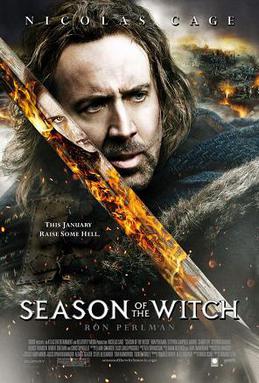
{The Season of the Witch's movie poster, found on Wikipedia.}

Introduction
Plot Summary
The Good
The Bad
Judgment
Closing

Introduction

Part two of Nicolas Cage month is here: A search for the good in the 2011 medieval romp, Season of the Witch.

Generally lambasted and looked down upon among critics (10%) and faring only slightly better among fans (32%), let's see just what's good, what's bad, and how they measure up.

Back to Top
Plot Summary

It's the fourteenth century and the crusades are in full swing in the Middle East, while alleged witches are being persecuted in Europe. Enter our two protagonists, Behman (Cage himself) and Felson (Ron Perlman).

After realizing that a truly good God would not call upon men to slaughter innocents, the two desert and start out across the country only to find that a strange plague has struck the land.

However, while on the lam the two are discovered, imprisoned, and then contracted to take an accused witch that people believe responsible for the plague to a monastery where she can be properly dealt with.

Having no other choice, the two set out with the priest Debelzaq (Stephen Campbell Moore), the swindling guide Hagamar (Stephen Graham), and Kay, a young altar boy seeking knighthood (Robert Sheehan). Their journey to the monastery takes them over some dangerous terrain, but only when they arrive at the monastery will they discover that it's not bear, wolf, or boar season, but it is indeed the Season of the Witch.

Back to Top
The Good

This is not a historical movie by any means - but it is a very medieval movie in the way that it's told, in the way that dialogue is written, and in the way that characters interact.

This isn't to say that it's in iambic pentameter and characters pull elaborate schemes on each other, but instead that were there a medieval bard alive today, this is the sort of story that he would tell. For Season of the Witch is the stuff of medieval romances: magic, adventure, characters who play well off of each other, and intrigue.

Plus, the movie puts the power of language front and center as twice we're shown that saying the proper words (in Latin!) over the bodies of women killed when hung or drowned (tested for being witches, in other words) is the best way to ensure that their bodies are not reanimated.

The fact that these words are in Latin, only weilded by priests, and contained in an ornate book, does a lot to really make the medieval setting accurate. Theatricality is a big part of medieval entertainment, and this movie is definitely theatrical.

This theatricality is further helped by the movie's special effects. They aren't perfectly photo-realistic, but their style helps keep the atmosphere of a medieval story going strong throughout.

The movie also puts forth some really amazing things (especially considering that it's an action movie): The power of psychological warfare on an individual basis, some great suspenseful bits, an excellent cast of characters, and a book that is so obscure it's a triumphant surprise to see it represented on screen.

{The woman Behman slew in a crusade raid, as she appears in his nightmare. This is where over-the-top lives in Season of the Witch.}


Back to Top
The Bad

However, the movie's an hour and a half long and could easily shed 1/3 of that length if a plot hole was removed.

The reason that Behman and co. need to go to the monastery is because that's where there's a book that describes the necessary rituals for dealing with the witch they have captured and believe to be responsible for the plague. So they only need to get there for the book. A thing that they could have brought to them in the city.

Making this minor change would cut out all of the traveling through the dangerous wastes and forest that the Behman's party has to go through, it would mean that there' be no zombie monks, and it would help the movie keep its complications as the movie's final fight would likely happen in an area populated with innocents rather than re-animated, plague-ridden corpses.

But, because the writer, Bragi F. Schut, has them go the monastery the story becomes very thin very fast.

The fact that two key characters, Kay and the witch, are not given any kind of backstory whatsoever certainly doesn't help matters either.

Kay's backstory could explain why he's an altar boy and not already on the way to knighthood. It could answer questions like: Did his father leave his estate to someone else? And, did Kay disgrace himself in the lists?

And we definitely need to know more about the witch because *spoilers* she's possessed, */spoilers* so knowing whether she was devout or not, and just how and why and when she was possessed would fill in so much about her character. Plus more development of her character would set her up to say something more profound than 'this is what really happened with the plague' at the end of the movie.

As per the final battle scene and its zombie monks, the whole thing is disappointing. It's effectively action-packed and all of that, but the entire trip from the city to the monastery could be expanded and lightly edited into a taut full-length psychological thriller, so an action-packed climax is a let down.

Further, although the power of language and of books is definitely rather accurate, there are other details that are not. Specifically, the oath that Behman has Kay recite when he knights him. This oath mentions on the martial duties of a knight, and perhaps this is the sort of oath that knights would give if knighted in the field, but knighthood isn't just about messing up people's sh**.

A quick summary of an actual knightly oath involves things like avoiding trafficking with traitors, protecting women, and observing fasts and abstinences.

After all, knights were guys with swords, but they were also nobility, and therefore had to set something of an example for the rest of society. Moreover, some knights also fulfilled the role of rulers in the medieval three estates system (a social model that broke society down into those who work (the Peasants), those who rule/fight (the Nobles, including knights), and those who pray (the Clergy)). So their code of behaviour goes a bit beyond smiting enemies.

Back to Top
Judgment

The Season of the Witch is a movie that balances itself as well as its lead characters do when they cross a particularly rickety bridge.

The story is thin, the climactic battle is disappointing, and there isn't enough backstory given for some of the main characters. But, those characters still play well off of each other, the setting is stylized but rather accurate, and magic and the demonic are very well portrayed.

In the end though, what tips the scales is the modern medieval romance style of the movie as a whole. That's something of a rarity among medieval action movies, a group of films that are more often too concerned with packing themselves with flashing steel and overflowing flagons of sudsy ale to get into any medieval depth.

So, Freya, as you skim the field of fallen films, reach down your powerful arm and pull this one up with you to movie Valhalla.

For that is as true a judgment today as it was when the judged was written, directed, and produced. Amen.

{A peek into the movie's take on the Key of Solomon.}


Back to Top
Closing

Next week check back here for another creative writing piece, an editorial on a piece of the newest news, and part three of Nicolas Cage month - a search for the good in 2011's Trespass.

Back to Top

Saturday, June 30, 2012

[Freya-dæg] The Wrath of the Titans More Effective Than Their Clashing

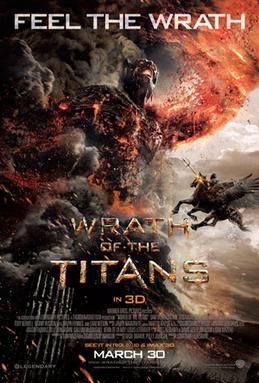
{The Wrath of the Titans's movie poster, found on Wikipedia.}

Plot Summary
The Good
The Bad
Judgment
Closing

Back to Top
Plot Summary

The age of gods is fading and the age of men is dawning. But on the cusp of this change, a threat lingers. Hades (Ralph Fiennes) and Ares (Édgar Ramírez) have cut a deal with the leader of the Titans (and Zeus (Liam Neeson), Poseidon (Danny Huston), and Hades' father), Kronos, and are working to revive him so that he may plunge the world of man into chaos.

Fearing the worst, Zeus appeals to his son, Persues the Kraken slayer (Sam Worthington). Since his heroic deeds of a decade past, Perseus has lost his beloved wife Io (not featured in this film), and been raising his son Helius in a simple fishing village. Hoping to keep his oath to his departed wife that he will never let his son Helius (John Bell) wield a sword, Perseus reluctantly joins Zeus in the fight against Hades and Ares - but will it be enough to soothe the Wrath of the Titans?

Back to Top
The Good

The best thing about this movie is that it is definitely an improvement over the first - Clash of the Titans (read my review here).

The story is told in a better fashion, character conflicts are better handled, and the graphics are improved to the point where there are only a few flawed frames and textures.

The story is told in a way that's similar to Clash of the Titans. Where that movie had an unbalanced pair of parallel plots, Wrath of the Titans presents a much more balanced pair. Not only do we see what's happening with Perseus and his quest for the Spear of Triam, but we also see enough of what's happening with Ares and Hades and Zeus to care about it.

And within that divine trio, there is some definite drama in the conflict between Zeus and Hades. This drama comes mostly from Hades' having a decent motive to fight Zeus - he holds a grudge for being banished to the underworld when the gods were still young and sorting the universe out. This explanation doesn't gel with the original myth, wherein Zeus, Poseidon, and Hades simply draw lots for the realms of air, sea, and underworld, but it's at least something.

The conflict between Perseus as an unbeliever and reluctant demi-god and his father Zeus is also fairly well-done, considering the sort of movie this is and its obviously teenaged male key demographic. *spoilers*Especially poignant is the scene in which Zeus dies, as it packs an unexpected amount of dramatic punch for a movie that is otherwise entirely action-driven.*/spoilers*

Back to Top
The Bad

However, Wrath of the Titans is not a complete and entire improvement over Clash of the Titans.

While there's definitely a more balanced approach to storytelling in the more recent film, it still suffers from something rather noisome. It plays out far too much like a video game.

On the one hand this isn't necessarily a bad thing, there's nothing wrong with storytelling methods associated with one form of entertainment being used by another. But, at the same time, it isn't carried out in a fashion that's well-suited to the screen. The end result is heavy implication that this movie was produced with high hopes of (or maybe even because of) a movie tie-in game.

The plot follows the general "pyramid" or "arc" convention of exposition, rising action, climax, falling action, denouement. But, instead of having one climax, the movie tries to pull off two. This can be made to work through clever writing and plot twists, but this movie has neither.

The first climax is the reveal of Kronos at approximately the one hour mark, after an entire hour of buildup. Then, after this reveal of a slow-talking, slow-moving, lava-monster like thing (think the Nome King from Return to Oz, but on fire and less clever). And the second is a three-minute let-down of a fight involving Perseus, Pegasus, Kronos, and the unimpressive Spear of Triam (essentially a glowing stick).

{Kronos above, the Nome King below. Which is more terrifying? Image of Kronos from F*ck You: Idiosyncratic Wit and image of the Nome King from The Fourth Wall: A Television and Film Blog.}


Thus, just like so many action/adventure games and RPGs, the movie's 'exposition -> quest -> last minute complication -> more quest -> quest completed' plot arc is more suited to video gaming. Simply put, the false climax device is better suited to a medium where a good twist isn't needed to pull it off. Video games can make a much better use of this sort of device since good gameplay can pull in players to the point where storytelling becomes truly secondary. Experimentation is good, but this one is definitely a failure.

Characters don't suffer quite so much, at least in their portrayal, but there's a glaring absence in this movie. There are only three named women, and one of them has only a smile for a line.

Those other named women are Andromeda (Rosamund Pike) and Io, who doesn't even appear in the movie. The one who does, Andromeda, is essentially present to balance Perseus' party. She is underdeveloped (it's not clear who she's fighting, how she knows where Kronos is going to come from after he's freed, nor is the romantic tension between her and Perseus properly established).

In fact, it's fair to say that she's just in the movie because all action films need a femme fatale, and all the more if she can wear a completely impractical leather sleeveless top and skirt (skirt!) - which she does throughout the entire hour and a half running time of the movie.

However, the sense that there was a "No Girls Allowed" sign hung over this movie during its production and editing is solidified when Hephaestus mentions Aphrodite, but makes no mention whatsoever about catching her and Ares in an adulterous embrace. This would have made Hephaestus' motives for helping Perseus and his party so much stronger, since it wouldn't just be a matter of saving the world, but some revenge could also be involved.

Back to Top
Judgment

Wrath of the Titans is a fine action film that is squarely aimed at teenaged boys who likely spend most of their time playing the standard sort of FPSs and western RPGs that are full of male/male conflict and warrior women clad in armor that would only protect them from torso-aimed dodgeballs.

But, if you can set that aside, it's a decent enough movie that actually does get inches deeper than most others in the genre, and that is a definite improvement on its predecessor.

But is it improved enough?

Not quite. Some real effort has been put into improving this movie, but without a well-portrayed female lead, or a fully engaging plot, this film falls flat.

Freya, fly low and take a look, but smile or frown, leave this one down in the field of fallen films.

Back to Top
Closing

Check back here next week for another piece of creative writing, an editorial on the newest news, and part one of Nic Cage month - a month of looking for the good in some of the lowest rated efforts of the action star. And of course, Tuesday and Thursday will host more annotated links.

Back to Top

Saturday, June 23, 2012

[Freya-dæg] All About The Last Airbender

{The Last Airbender's movie poster, found on Wikipedia.}


Plot Summary
The Good
The Bad
Judgment
Closing

M. Night Shyamalan, a director best known for movies like The Sixth Sense and The Village should stick to what he knows, or at the least to doing what he does best: creating an engrossing plot that strings the audience along until they reach some crucial twist.

Not only is adaptation outside of his wheelhouse, so too are movies where his signature twist is missing. Put the two together, and, somehow, you get the live action adaptation of the animated series Avatar: The Last Airbender: The Last Airbender

Back to Top
Plot Summary

Based on the idea that each of the “books” referred to in the title cards of the animated series could be turned into a movie, The Last Airbender follows the plot of “Book One: Water.”

For those unfamiliar with the Nickelodeon show about a world where people can bend water, earth, fire, and air to their will, this section of the story introduces Katara (Nicola Peltz) and Sokka (Jackson Rathbone) of the Southern water tribe shortly before they discover Aang (Noah Ringer) frozen in a glacier with his sky bison. He winds up freed from the ice, and after a brief encounter with the reviled Fire Nation, the three of them set out to help Aang realize his potential as the Avatar, the one who holds the four elemental forces of the world in check.

Ultimately, Aang, Katara, and Sokka end up at the city of the Northern Water Tribe, so that Aang can master water bending, and also so that they can help to defend it from an upcoming Fire Nation assault. As General Jao (Aasif Mandvi) of the Fire Nation plots to kill the spirits of the moon and ocean, thus robbing the water tribe of its bending power, defeat looms over the last truly free city in the world and only our three heroes can help to avert it.

Back to Top
The Good

As you might expect from a movie about a world where people can bend the elements to their will with movements that Bruce Lee or Jackie Chan would be proud of, the choreography in this movie is decent. And the effects are fairly well done. Whatever else may be said about it, it has no shortage of spectacle. Especially when the fire and the water fly in the final battle.

Also, and this was more a surprise than anything else, but Dev Patel does a good job of playing the brooding, exiled Fire Nation prince Zuko. His character is softened, but it's still really obvious that he's absolutely brimming with conflicting hatreds and loyalties and desires.

Aasif Mandvi's appearance was also a very pleasant surprise. He didn't play anything up for laughs, and a movie based on an animated series (other than Avatar: The Last Airbender) might not be expected to offer up the chance to show your dramatic chops, but he definitely hits it out of the park as General Jao.

{The Daily Show's Senior Hollywood Correspondent goes a little too deep undercover for his exposé on bad adaptations. Image from a screen capture}


Seychelle Gabriel also works well as Princess Yue of the Northern Water Tribe – she even puts some feeling into her lines.

Back to Top
The Bad

Cool World is not a very good movie. However, having seen The Last Airbender, it seems as though the quotation used to introduce The Bad in it was used too soon.

The biggest problem with this movie is the absolutely bizarre pronunciations of names and things that are pronounced in entirely different ways in the animated show.

Where the series pronounces Aang as “(r)ANG,” and Sokka as “Sock-ah,” the director of the movie (Mr. M. Night himself) has them changed to “Ah-ng” and “So-ka.” At one point, a character even refers to the "Yang" in "Yin and Yang" as “Yah-ng.” So, first off, why not just follow the pronunciation that fans have become familiar with over the course of three television seasons?

The next biggest problem (a very close contender for the title) is that all of the character arcs that are presented throughout the show's many episodes are almost entirely shaved away to make sure that this movie is feature length. This is an understandable change, but, if The Legend of Zelda: Majora's Mask teaches one thing about building character, it's that it can be done in a limited space and a limited time.

Rather than trying to pack the movie with all of the side plots and diversions that the show presents so wonderfully, why not just have Aang, Katara, and Sokka interact with people in the Northern Water Tribe city as stand-ins for the characters they meet in the show? It'd even be possible to just move some of those characters into the city so that they could still be interacted with.

To be fair, the movie doesn't try to pack everything in, but it skips over so many key moments for character development that the characters are left to develop through dialog that's not only written so it conveys almost no subtlety but that's often delivered as if it's being read for the first time.

Dev Patel works well as Zuko, and Seychelle Gabriel does an alright job of playing Yue, but the actor that was cast as Sokka just doesn't seem to get it. In the show, Sokka is a goofball of an older brother who's always hatching plans and making schemes that have some hole or other in them. He isn't solely a comic relief character, but he often is the one that audiences are meant to laugh at – at least early in the series.

As the three travel together and their characters develop, Sokka does become more serious, but that seriousness is always undercut with a bad pun or a silly gag. Instead of this nuance, Jackson Rathbone plays Sokka as some kind of straight man who hardly ever smiles. And when he does – especially when Yue is telling him about how she died when she was born and is alive because the Moon Spirit gave her its life – it's really poorly timed.

{Maybe Rathbone's Sokka is off because his timing, the heart of comedy, is off. Image from a screen capture.}


Aang and Katara are a little bit better, but again, because we see them in so few situations compared to the show, they aren't as nuanced as they are in the original. Aang's Monkey-King-like energy and playfulness are replaced by a more sullen, “I-don't-wanna-be-the-Avatar-because-then-I-can't-have-a-family” nature, and Katara is, well, just Katara. By the end of the first book in the series, it was already clear that there was some chemistry between these two characters, but in the movie there's practically nothing to suggest this.

Mercifully, Zuko's absolutely mad sister Azula, is only shown briefly in only two scenes. But, these two scenes set her up as more of a giggly little girl than as the scheming, psychologically twisted monster that she is in the series.

And, to end on a minor detail, a running joke in the series is that everywhere Aang, Katara, and Sokka go, they wind up upsetting a man's cabbage cart. Even the new series Avatar: The Legend of Korra, includes a scene where a cabbage man is dispossessed of his cabbages.

It might be fan service, but it would at least show the fans that you care about something that they admire, Mr. M. Night. And, including the scene would also have assured people familiar with the series that you had actually watched it and not just written your script based on some sort of terribly truncated SparkNotes summary.

Back to Top
Judgment

The Last Airbender is not the movie it could have been.

Now, it's unrealistic to expect any filmmaker to be able to condense 20 episodes of a television show (about 6 hours and 40 minutes) down into something that's less than two hours while retaining things like characters, a coherent story, and a fully realized world. But there are ways that such an adaptation could have been made to work.

The discovery of Aang could have happened during the opening credits. Then a voice over could give the background of the setting and what had happened up to x-point as the characters did something (maybe fly somewhere on Appa, or walk between villages with a group of people trailing them since Aang is, you know, the Avatar and all). From there, most of the movie could be based in the Northern Water Tribe city with flashbacks to fill any gaps, fully realized relationships with the city's inhabitants to develop characters, and simply more dialog that revealed the story in an organic way, rather than lines that even the actors seem to balk at from time to time.

Unfortunately, M. Night Shyamalan's adaptation was not so bold as to make this many changes. Instead, he seems to have taken a more scissor-happy approach, trimming away everything excess until only the bare outline of the first season of Avatar: The Last Airbender's plot remains.

Some of the actors were definitely well picked, and the spectacle that the movie offers is quite impressive. But the four elements of Patel, Gabriel, Mandvi, and spectacle alone aren't enough to save the world of water, earth, fire, and air.

Freya, feel free to shed a tear as you fly over this one, but do no more save let it remain.

Back to Top
Closing

Check back here next week for more creative writing, an editorial on the newest news, and a hunt for the good in, and hopeful redemption of, another generally despised movie.

Back to Top

Friday, June 15, 2012

[Freya-dæg] A Whole Cool World Is Just too Aloof to Care About Explanations

{Cool World's movie poster; the first sign of things to come. Image from Wikipedia.}


Plot Summary
The Good
The Bad
Judgment
Closing


Before Brad Pitt made it big, he starred in a number of TV movies and features that didn't make it to theaters. He was even on a few episodes of the hit series Dallas (check out Wikipedia for his full filmography).

One of the movies from this early part of Pitt's career is the Ralph Bakshi picture known as Cool World, a move that, just like Who Framed Roger Rabbit? in 1988, splices real footage with animation.

Back to Top
Plot Summary

Immediately we're introduced to the movie's hero, Frank Harris (Brad Pitt), as he returns home to his mother after WWII. But, Frank's post-war life is cut short when he crashes his motorcycle after swerving to avoid a drunk couple in what might be a strange nod to Manos:The Hands of Fate. However, just as the ambulance pulls up, Dr. Vincent Whiskers brings Frank into the animated “Cool World.”

Skip ahead 47 years to 1992 and we meet Jack Deebs (Gabriel Byrne), the creator of Cool World, as he finishes off a prison sentence. But Jack's life isn't about to get any easier, since his most famous drawing, Holli Would (Kim Basinger), keeps bringing him into Cool World in the hopes of having him make her real. As Cool World's top cop, Frank can't let this happen, and a mad pursuit follows.

Back to Top
The Good

It's always a welcome experience to see big stars in their early roles, and this is no exception. Pitt isn't fantastic here, but it's instructive to see someone like him in a movie like this. It inspires a certain amount of hope.

On the point of the power of individuals in movies, David Bowie also wrote a song for the movie entitled “Real Cool World.” It's a decent example of Bowie's work in the 90s, but it's precise part in this movie will be addressed later on.

As a Ralph Bakshi film, there's definitely a fair deal of trippy animation and visuals, which are good. But only up to a point.

Also, some neat ideas do come up over the course of the movie. Particularly in many of the early exchanges between Jack and Holli – the creator and the created. Actually the entire relationship between Cool World and the real world is rather interesting.

But. Neither of these ideas are particularly developed.

Back to Top
The Bad

To quote the one-time open mic stand up comedian Doctor Pepper (Patton Oswalt repeats his best bit on Feelin' Kinda Patton): “I don't know where to start or where to begin.”

There are a lot of problems with this movie.

None of the mechanics of the universe are explained. We never get any more information about which came first, the Jack Deebs or the Cool World. We never know if Cool World was created by Jack Deebs from nothing, or if Cool World existed in some kind of realm of ideals and Jack simply pulled it into the real world with his comics.

There's never a reason given for why there are 47 years between the time when Frank gets pulled into Cool World and when Holli starts stirring up trouble.

We never get any real background or idea of what Frank's character is actually like.

We're never told why Holli wants to be made real aside from it allowing her to get power, and “be real.”

Too much time is spent on pointless animated vignettes that scream at the audience “Hey! We're in a cartoon world, isn't this wild!?”

But, on top of all this, the David Bowie song (part of the soundtrack that was better received by critics than the movie itself) is reserved until the end credits. It's not played in parts through the movie, it's not hinted at by any kind of guest appearance. It just plays over the end credits like a minstrel found by house hunters in a secluded closet.

In short, the first hour and fifteen minutes of the movie could be cut down to 20 and the only effect would be that this movie would be about 42 minutes long instead of 98.

{An apt expression to pull after watching Cool World. A screenshot from the movie.}


Back to Top
Judgment

Cool World is a movie that presents a handful of neat ideas, but those ideas are hidden under sheets and cells of animation that do almost nothing to forward the plot.

This movie would have greatly benefited by starting with the chase scene at the hour and twenty minute mark, and then telling the story in flashbacks, or with some other sequential shuffling.

It also wouldn't have hurt if a reason was given for why it took 47 years for something to happen in Cool World with Holli, or why it took her until the end of Jack Deeb's prison sentence to start trying to get him to make her real.

Or even some kind of explanation of why Holli wanted to be real, and what the purpose and/or origin of a spike on top of a random Vegas hotel was would have helped. But, to quote the good Doctor Whiskers himself, “the spike...is beyond our understanding.” And so too is much of the motivation within and for this movie.

Freya, fly high, and when you pass over this one, make sure that you don't look down, unless there be a thick covering of cloud.

To help wash away the terrible taste of this movie from your mind, check out this music video for Bowser and Blue's “Just A Cartoon.” It does so much more with the idea of human/cartoon crossovers than the entirety of Cool World.

Back to Top
Closing

Next week, check back here for another variation on Monday's entries, an article on the newest news, and a hunt for the good in M. Night. Shyamalan's The Last Airbender

Back to Top