Showing posts with label Ontario. Show all posts

Wednesday, June 6, 2012

[Wōdnes-dæg] Abortion: Politics of, and Reasons to be Pro-Choice

{An Ontario Conservative MP takes part in the March For Life anti-abortion rally on Parliament Hill, 10 May 2012. Image found on theglobeandmail.com from Sean Kilpatrick/THE CANADIAN PRESS.}


Quick Warning
Introduction
Summary
Reason One
Reason Two
Reason Three
Afterword
Closing


Quick Warning

A quick warning - parts of this entry may be more graphic than you're comfortable with. If the discussion of abortion, especially when sarcasm and analogy are involved, makes you squirm, then you may just want to skip this one.

Back To Top
Introduction

It’s heartening to know that abortion is a sheerly political thing among Conservatives at the party level. At least, that’s what this article from today’s Globe and Mail suggests.

Back To Top
Summary

The article explains that a lone Tory has put forth a motion to redefine when human life begins, and that the Prime Minister’s Office has tried to keep this motion from getting support. The official line is that a vote for what is essentially an anti-abortion motion is a vote against Mr. Harper’s wishes, but senior party members have also said that it is a vote against Mr. Harper himself.

So what could be triggering party member Stephen Woodworth’s desire to re-open the abortion debate in Canada? Some sort of high morality founded on invented dogma? Nope. Not explicitly so.

Apparently, this MP knows that his re-election in 2014 depends on anti-abortion supporters. And he wants to make it clear to them that he really is the man they voted for.

This story ran on page A4 of the print edition, so isn’t big news (rightly so, since Toronto is still reeling from Saturday night’s Eaton Center shooting). But it is good to hear that Canada’s legalized abortion will not be coming under federal scrutiny any time soon.

So why am I, a Catholic of many years, thankful that the debate will lie dormant for now? For three reasons.

Back To Top
Reason One

I agree with the current Canadian law that states that a fetus becomes a human person after it has exited its mother’s birth canal.

I agree with this law because it makes concrete sense. Yes, the different stages of development have been mapped out and know that such a vital thing as the heartbeat starts at 6 weeks, can begin to hear at 18 weeks, and can potentially respond to your voice at 25 weeks. But if you put a seed in the ground and peek in on its progress as it sprouts into a tree, once the seed breaks open, but the sprout still has to get through to the earth's surface, can what's come out be declared a sapling or a tree?

Until a fetus has left its mother it is a part of her, just like any organ is a living part of any other human being. It’s not a pleasant analogy because babies are so cute and full of potential, but could a tumor be declared a human being if it grew its own working heart or lungs or mind?

(The tree and tumor analogies may be crude, but defining "human life" is a sticky thing to do with some degree of objectivity.)

Back To Top
Reason Two

Fetuses are very much a part of their mothers up until the point when they’re born or brought into the world. Because of this, if you remove the mother, then the fetus would not be able to survive. A baby couldn’t be expected to survive if left alone either, but the key difference is that a baby is no longer hooked into the human female’s automatic feeding system after it’s born. The cord is cut, and it becomes it’s own separate entity.

Whether you consider a fetus a part of a woman’s body or not, it is living inside of a woman’s body and that woman should be able to decide what she wants to do with it. And that’s not playing god, it's simply altering the body, something people do all the time in ways both obvious and not.

Further, abortion is not a recent invention. Though where surgery or one sort or another is the norm today, in earlier times it was much more common for a woman to abort a fetus through one of several folk methods like fasting, hard labor, taking diuretics, or getting an enema (check Wikipedia for a full list).

Back To Top
Reason Three

Making abortion illegal would do more harm than good.

If abortion is made illegal that won’t stop people from getting them - even though making drugs, extortion, and rape illegal certainly has stopped people from getting and doing them.

But what’s truly dangerous about making abortion illegal is that it would force those who seek them out to go underground, and methods hidden in the darker parts of society are not going to be as clean and safe as those practiced in well-lit clinics.

Though, considering the economy’s current state, maybe abortion should be made illegal - it might give the wire coat hanger industry a boost.

Back To Top
Afterword

This editorial also appeared in today’s Globe and Mail, and it nicely sums up what Catholics really should consider when it comes to real world issues like abortion and the LGBTQ presence in schools.

Gay, straight, Catholic
Re Catholic Schools Fear Fallout From Bill 13 (June 5): In 2008, Georgetown became the first Catholic university to open an LGBTQ resource centre. As a Georgetown student, a Canadian and a Catholic, this meant the world to me and my friends, several of whom are gay and practising Catholics. Why did the Washington university open the centre? Because the violence that emerges from ignorance and intolerance violates Catholic teachings. Because love, respect and growth are cornerstones of Jesuit teaching. Because we are men and women for others.
After donating $1-million for LGBTQ programming at Georgetown, former NFL commissioner Paul Tagliabue explained: “The Center is inspired by Catholic and Jesuit principles of respect for the dignity of all and education of the whole person …” It is upsetting that Ontario’s Catholic school boards are unwilling to act on the core values of Catholicism: tolerance, non-judgment and love.
Kelsey Spitz, Toronto
Back To Top
Closing

Check back here Friday for a hunt for the good in the newly released thriller Gone.

Back To Top

Monday, May 7, 2012

[Moon-dæg] A Final Look at Wind Farms

Introduction
On Either Side
The Hazy Long View
Winding Down
Closing

{Ontario Premier Dalton McGuinty giving a brusque, verging on covert, mid-response thumbs up to wind farms. Image from the Globe and Mail.com}


Back To Top
Introduction

People's positions on wind farms are hard to change. But what really underlies the passion on either side of the debate?

Back To Top
On Either Side

Resistance to and/or acceptance of change is certainly a major factor in the matter of wind farms, but just as deep is a concern for the future.

Those who are for wind power are those who believe that it truly is for the best, and that it really is just what needs to be done in order to help prevent global warming, to make power generation more sustainable, and to just plain make the future a more hospitable place for the generations that will have to live there.

On the other hand, those people who are against wind farms in rural Ontario are those who believe that wind farms are just the choice de jour of a government that wants to bully those with less power than citizens living in cities, or who believe that wind farms and wind power are some kind of elaborate sham - no more efficient than coal power, and certainly no more green.

Back To Top
The Hazy Long View

Compelling evidence has been put forth on either side. Some research suggests that wind farms cause local warming, and other research suggests that wind farms are becoming cheaper and cheaper.

Although not nearly so charged as when debates involve things like the definition of life or when it starts, the place of wind farms in Ontario is definitely divisive.

However, taking the long view, wind farms seem beneficial. Are they expensive to consumers? Of course. Have they been forced on some municipalities by a government that some have decried as overly paternal? Sure.

Maybe it’s overly idealistic, but it seems that any transition into a new form of power generation is going to be painful - partly because of cost, partly because of inconvenience, and partly because of a perceived threat to the pastoral ideal, the old idea that any countryside is pristine and unblemished in every way possible - from its soil to its people to its skyline.

Perhaps a better question to ask than whether people should be for or against it is simply whether or not there will be any kind of benefit to it in the long run.

Bringing in wind farms with little negotiation might be a classically paternal move on the part of the McGuinty Liberals, or some stereotypical Liberal over-spending at the cost of bill-paying citizens, but in 50 to 100 years will it do as much harm as people are saying? or will wind farms have done some good - maybe making Ontario’s countryside more pristine than it was before?

Back To Top
Winding Down

Perhaps this issue has sparked so much debate because the only way an answer can be firmly grasped is more by feeling than by thinking. The future that Ontario wind farms might positively or negatively effect is so far off that trying to forecast just what will happen involves too many variables.

There are immediate woes and victories, but do either matter as much as either side make them out to?

Back To Top
Closing

On Wednesday check back here for an article on the newest news, and on Friday be sure to stop on by for a hunt for the good in London Boulevard.

Back To Top

Monday, April 23, 2012

[Moon-dæg] Logical Defenses Of Ontario Wind Power

Introduction
Wind Farms Forced on Rural Ontario
Wind Turbines Are Eyesores
Wind Turbines Don't Turn When Power's Needed Most
Closing

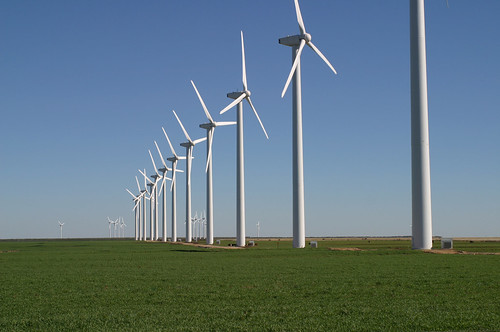
{Turbines aligned, like solid arguments for and against them. Image from an Earthy Day 2012 blog}


Back To Top
Introduction

There are a number of arguments that have been raised against wind turbines in Ontario. A mere three are that: The wind turbines were forced on residents of rural areas by the current Liberal government; the turbines are eyesores; the turbines don't generate power when it's needed most.

Back To Top
Wind Farms Forced on Rural Ontario

Although there appears to be little record of it on the internet, many residents of rural Ontario feel like the provincial Liberals have forced wind turbines into the landscape, giving the affected residents and municipalities little say in the matter.

At the least, Energy Minister Chris Bentley has said (in February 2012) that rural municipalities will have some say in the locations of wind farms, but there's little to suggest that rural municipalities will be able to outright refuse wind farms.

On the one hand, it makes sense that this lack of democratic choice has caused so much protest on the part of rural Ontario, but on the other it could be seen as a provincial government simply doing what a provincial government does: govern.

In a democratic society the governing process needs to involve the say of the governed, but going around that brings up one major question.

Were wind turbines, in any form, mentioned in any of the Liberals' platforms for the 2003 and 2007 elections?

No, not specifically, at least.

But a quick Google search turns up the 2003, the 2007, and the 2011 platforms.

A search for the word "energy" in these platforms reveals an emphasis on "clean" and "renewable" energy in the 2003 platform; the statement that the Liberals will

"Make our energy greener and cleaner, with the province’s first long-term energy plan in a generation. Our plan will replace coal by doubling renewables and doubling conservation" (page 6)
in the 2007 platform; and energy that's described as "clean," "green," and "renewable" is mentioned throughout the 2011 platform (which also includes dramatic shots of people in front of wind turbines).

The references to renewable power are vague, yes, but they do hint towards things like wind power - it may sound cruel, but Ontario got what it voted for.

Because the Liberals have had a majority in the past three elections, running on a platform with a mention of such energy (though not explicitly "wind power" or "wind farms"), it's logical to conclude that even if rural Ontario wasn't unanimously for the Liberals in the 2003, 2007, or 2011 election, the province at large was, and the Liberals could take that acceptance (even as narrow as it was in the 2011 contest) as a green light to do what they thought best for the province.

Back To Top
Wind Turbines Are Eyesores

To argue that wind turbines are eyesores and blots on the previously pristine Ontario countryside is to do what some likely did when skyscrapers first began to be built. City skylines have indeed been changed by the presence of the skyscraper, but these former eyesores have since become part of the cultural idea of what a city is - arguably worldwide.

Now, it's true that wind turbines can't exactly be compared to skyscrapers in all respects - it's much easier to make a building aesthetically pleasing because all it has to do is stand firm, when moving parts get added to the mix and these parts' motion needs to be efficient things get more complicated. However, places like Germany, where wind power is used to a great degree, don't seem to have much of a problem with the turbines and their appearance.

They're clumped together, sure, but that doesn't really make things that bad.

Anyway, having wind turbines dot the landscape is not a bad thing, it adds variety to an otherwise repetitive skyline. Forests and fields and cliffs and ravines are excellent, but adding in some wind turbines isn't necessarily that bad.

And though they may make some stretches of countryside less appealing to some people, they have attracted tourists to others, and will help to make those spaces left untouched even more prized than they are already.

Back To Top
Wind Turbines Don't Turn When Power's Needed Most

Another argument lobbed against wind power (in Ontario, at least) is that when the power that these turbines generate is most needed it's nowhere to be found. The best example of this are hot summer days where the oh-so-necessary wind isn't blowing, and the turbines sit idle.

However, if excess power generated by wind turbines is stored in the grid during peak hours/days, then this argument is rather toothless. On the other hand, if excess power from wind turbines is not stored in the grid (or elsewhere), then more planning in that regard is definitely necessary.

Back To Top
Closing

Check back here Wednesday for an article on the newest news, and check back on Friday for a hunt for the good in The Darkest Hour.

Back To Top

Monday, April 16, 2012

[Moon-dæg] Winding up for Wind Power

Introduction
Megawhats?
Causes for Concern
More Information
Closing

{Typical turbines. Image from publicdomanpictures.net, taken by Peter Kratochvil}


Back To Top
Introduction

As the first part in the next four part series here at A Glass Darkly, and since the new moon means a lack of light, this entry is a pooling of information about wind farms - specifically in Ontario. However, it is by no means complete and will point to things that are a little more complete when necessary.

So what's the skinny on these three-armed towers cropping up over the countryside in recent years? In short, they're part of the Liberal party's plan to help Ontario to go green. The cost has turned many off of the idea, and the noise that they are reported to cause has turned off a few more.

However, according to the IESO website's tracker, this is how much energy Ontario's turbines are currently outputting:


Back To Top
Megawhats?

A megawatt is 1 million watts, and according to WikiAnswers, one megawatt could power 1000 average American homes for 1 hour. Or, it could power an average home for 1000 hours. Since Americans and Canadians have roughly the same power consumption habits (multiple computers, TVs, charging devices like phones and iPods, and electronic kitchen and cleaning implements) using American statistics doesn't seem particularly off.

An estimate of 750 homes on the megawatt by the Toronto Star, gives a similar picture.

Back To Top
Causes for Concern

What gets people's dander up about wind farms, though, is that they've come in at tremendous cost. Whereas other generators get about 7.4 cents on the kilowatt hour, wind generators get 12 cents.

As Ontario swings into more wind power generation, though, A.J. Goulding of the consulting firm London Economics believes that there's potential for a vicious cycle in which the burgeoning wind industry would create jobs that would only compensate for those lost in other energy sectors.

Among those on the ground, so to speak, there are also concerns that wind turbines are responsible for headaches, dizziness, sleep disturbance, and/or hearing loss. Though these concerns are addressed in a report issued by the Chief Medical Officer of Health of Ontario, the conclusion appears to be that wind turbines are not responsible for adverse health effects from a strictly scientific standpoint.

Back To Top
More Information

Nonetheless, the groups for and against wind power in Ontario dot the province's landscape as much as the mills that are the cause of their reactions. These include Wind Concerns Bruce, Ontario Wind Resistance, Harvesting Wind Support, and Ontario Highlands Friends of Wind Power.

For more stats check out thewindpower.net, canwea.ca, and/or centreforenergy.com.

Back To Top
Closing

Check back here Wednesday for an entry on some of the newest news and on Friday for the search for the good in Clash of the Titans.

Back To Top

Thursday, December 1, 2011

SFContario-Inspired Convention Musings

Conventions. If you have ever lived in a mid-sized city with a fair sized hotel you have probably seen signs for one sort of convention or another over the summer months. Psychic Expo. Philatelists United. Comic Books and Assorted Figurines. Niche markets, specific demographics, a bunch of people gathered together with similar interests that aim to concentrate on a single topic for the span of a few days. But is it worthwhile to go to a convention if you consider yourself a member of such a niche (or someone interested in becoming one)? Even a convention that might not boast the star power of something like the famed San Diego Comicon or a World Fantasy Convention? I have not been to a large convention for a while, but having recently gone to a smaller convention, I have been put into mind of convention going, and what these events can be all about. The smaller convention in question is SFContario 2, hosted in Toronto, Ontario, Canada.

Like most writing conventions, SFContario had plenty of books in its sales area (or dealer's room, in "con speak"). This is something of an aside, but because there are so many of them at writing conventions big and small, small press books need to be talked about. These books are generally fine, though sometimes their editing seems a bit slipshod, but what always bothers me about them is that their cover art is terrible. The somewhat generic, bad cgi effect used to create many of them just screams amateur to me. A lot of the covers also seem crowded, and it is generally the best covers that make the greatest use of empty space. In short, those books that don't show the books' characters standing in a dramatic pose appeal to me the most. After all, if I wanted a shot of main characters gazing out toward the viewer or some kind of middle distance, I would just find a cinema and walk around, admiring the posters. Just as I'm insistent on completing my Song of Ice and Fire collection without buying copies that are marked with "Watch the series on HBO" I prefer to keep the media of film and print separate. They use different methods to tell stories, and they have different strengths and weaknesses, which I may get into in a later entry.

Stepping outside the dealer's room of your standard writing convention, these meetings are basically made up of panels. On this point, I have to say that a smaller convention is likely to give better panels. Larger conventions can draw some very interesting and well-known guests, but something that often happens, especially in my experience, is that the star power of such prominent figures can often cast a glamour over a person who is new to conventions. This can lead to the need for a lot of gutsiness to ask a question during a panel, or to approach a panelist afterwards - both of which being very rewarding experiences. A smaller convention, on the other hand, has a feeling that is more similar to a small group workshop, where everyone is at least visibly familiar to everyone else, and the big stars are big stars within their niche, rather than at large. This difference is important, I think, because it makes the big names at a smaller convention approachable by the dedicated fan and curious newcomer alike. After all, the dedicated fan is already familiar with the niche star and their work, and to the newcomer the star is just another interesting panelist, with little to distinguish them from the average convention-goer except for an extra badge or ribbon on their chest

However, smaller conventions do mean smaller convention spaces. Again, this makes it easier to meet the same people over and over again, and thus build a sense of community, but it also means that things can be claustrophobic at times. Of course, larger conventions often have an opposite problem - plenty of space and also plenty of people which can at times make almost anyone feel a little agoraphobic. However, a common trait of any convention regardless of its size is the consuite, a room in which a convention will offer free food, beverages, and seating to all registered convention-goers. At a big convention where the sheer number of people can be overwhelming these consuites are great spaces in which to relax with a smaller crowd, and at smaller conventions these consuites are usually spacious enough to help restore a person's feeling of personal space.

Considering these aspects of conventions - the dealer's room, panels, and the consuite - I think that SFContario 2 was well worth the price of admission. The dealer's room was big enough for most of the author guests to set up shop in, the panels were particularly well done, and the consuite featured everything from chips to vegetables to cheese to Chinese takeout. Two extra notes about the panels, however. First, one panel in particular was incredibly interesting to me. This panel, called SFContario Idol, involved the anonymous submission of the first page of a novel or short story which would be read aloud judged by a panel of guest editors. The editors did mention that they were going to be more exacting than usual, but the fact that details like writing out sound effects or using individual words (such as "shards") were sometimes enough to discount a submission was really quite shocking to me. Granted, when one of the editors replied to another who expounded on the original disclaimer by saying that he would often receive 1000 submissions a month for approximately 10 spots in a magazine the stringency of the criteria made sense. Nonetheless, that panel alone made me glad that I attended.

The other point about panels that I want to raise is the matter of repetition. At the larger conventions that I went to often 30 of roughly 100 panels would be repeated from year to year. I can't confirm it just yet, having only ever gone to a smaller convention, I fear that this panel repetition would happen on a wider scale at these smaller dos. I can't confirm this, though, having only been to one small convention thus far, but I hope that I'm right only in the sense that university departments offer the same basic group of courses every year and professors give them a personal spin. Essentially, though if a similar proportion of panels are repeated at the very least a smaller convention has the greater benefit of fostering closer conversations between attendees and panelists. And for that, if you are interested in finding out more about your niche or interest rather than running out to pitch an idea/story to an agent (such things happen more often at bigger conventions), a smaller convention is probably a better place to start than a larger one.

And as per SFContario - I will definitely be heading back next year. A dealer's room that doesn't overshadow the rest of the convention, a hospitable consuite, and excellent, informative panels make this a great weekend of meeting other writers and editors and discussing the written word.